


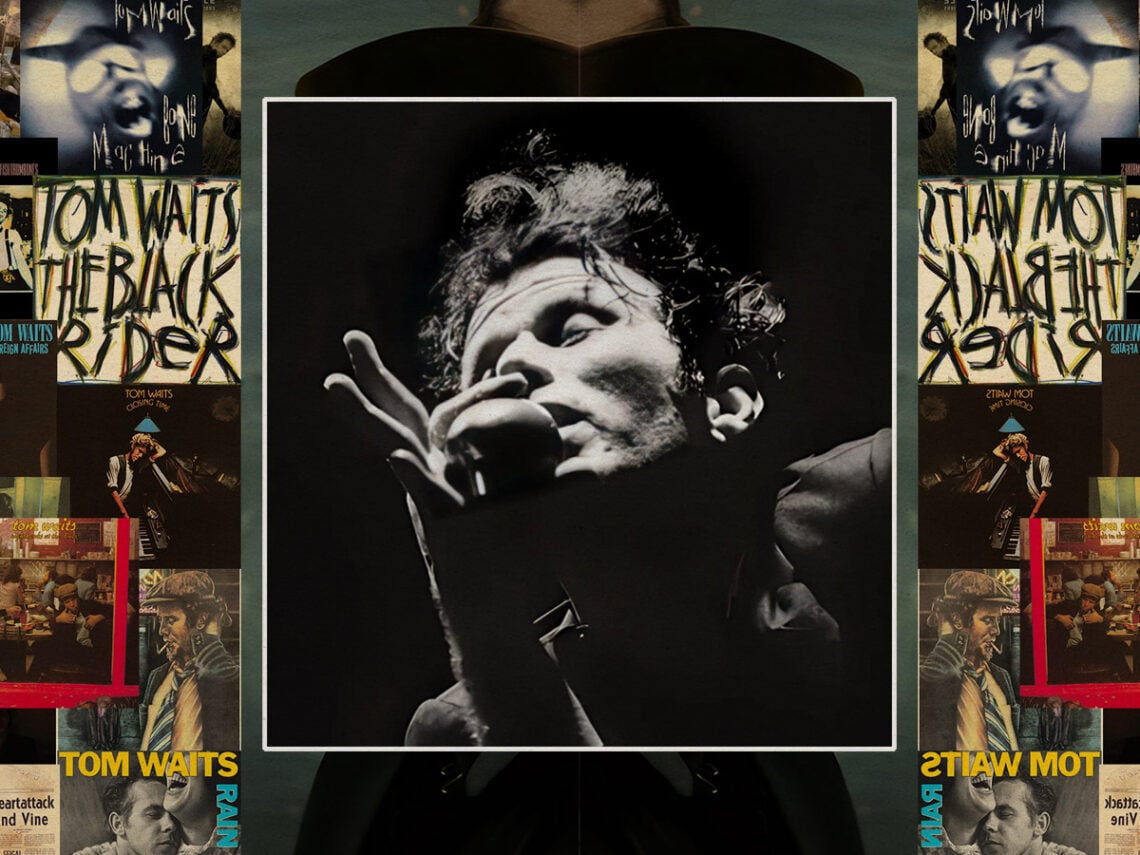
‘Closing time’: Ranking the final song from every Tom Waits album

We all know that first impressions are important. The opening song from any album needs to grab the listener, invite them into the rest of the record, and make them want to hear more. A great album really needs an engaging introduction, that is, an impactful opening song; even an interesting opening lyric can be so important and a grand declaration of the artist’s intent. Something like ‘Gimme Shelter’, ‘Come Together’, ‘Thunder Road’, ‘Gloria (Part I: In Excelsis Deo / Part II: Gloria)’, ‘Running Up That Hill’, ‘On the Bound’ or ‘Elevator Operator’, or else, something as sickening and shocking from Tom Waits as ‘Underground’ or ‘The Earth Died Screaming’.
But last words are equally as important. Those final flourishes and closing notes of the last song on an album are the ones you’re left with that truly leave a lasting impression on you once you return to your life after the music has stopped. Almost anyone can come up with a great song for their next album and load it at the front to grab our attention, but keeping that level up over the course of ten or so songs and then ending on a high note is another thing entirely.
Tom Waits is one who has never had trouble with either starting or finishing an album, and it hasn’t ever felt that he’s had much truck with all the bits in between, either. He hasn’t yet put out a bad record, an incredible feat considering his first collection arrived in 1973, and you know what? There aren’t really any bad songs to speak of, either. No filler to fuss over or clunkers that clog up an otherwise horrible and beautiful album of his.
Sure, some are more popular than others, some grander or more ambitious, some take longer to reveal themselves to you, and some scare you in more exciting ways. But while there are plenty that might leave you thinking, “Christ! What is going on here?”, it’s never because they’re lacking in quality. Every one of his songs has the power to leave a lasting impression. But when making each of his albums, he picks certain songs to bear the responsibility of bringing down the curtains on the collection while holding up the magic in the mind of all those who came before it.
Waits has written music for multiple operas throughout his career, but his own albums themselves are chock-full of operatic travelogues and tributes to the underworld, the netherworld, the next world and the lost world. They’re full of high drama and carnivalesque characters, and there’s no shortage of imaginative narratives, either. A theatrical performer and prolific actor, Waits knows the importance of that narrative structure. Of high drama and of building to a crescendo, of constantly raising the stakes until they can’t be hoisted any higher.
He doesn’t just do it in each and every song but across every album, piling up the images and building his mad and magical, mysterious and miraculous world for us to step into whenever we choose. Some of his major albums end on instrumentals, which can feel like the receding of the tide once the moon has set and the storm of what went before has passed. Or else, they can feel like the end credits to a dramatic movie full of blood, lust, grit, and gore, allowing you a moment to breathe and take in what Waits has just put you through. Some don’t feel like an ending at all but an invitation to the rest of the night and all of the adventures that can entail. So, let’s take a trip through those endings, invitations and adventures.
Every final song on a Tom Waits record ranked:
‘Spare Parts II and Closing’ (Nighthawks at the Diner, 1975)

Like so much of the Nighthawks album, the closing track is a warm exercise in atmosphere. The whole album is probably the best that Tom Waits the jazz-man ever sounded, and that is in no small part due to the band behind him – an ensemble who had played behind the likes of Ella Fitzgerald and Sinatra, including Pete Christlieb on tenor saxophone, Bill Goodwin on drums, Jim Hughart on bass and Mike Melvoin on piano – and they all get their due here, as Waits closes out this quasi-live album, recorded in the studio in front of an energetic audience, with a parade of introductions, gags and riffs.
“I gotta make like a hockey player and get the puck outta here” he drawls over a bed of upbeat, loose and lively jazz before appropriately taking his leave.
‘That Feel’ (Bone Machine, 1992)

This song sounds as appropriately rough and off-the-cuff as any collaboration between Tom Waits and Keith Richards should. When the pair first got together, Waits joked that working with Richards meant that something was going to get finished: “It might be the bottle or it might be the song.”
In this case, their second collaboration and the first since 1985’s masterpiece Rain Dogs, it sounds like they’re still working things out. The song is coarse, rough around the edges and weary behind the eyes. The song isn’t quite polished, but when it’s over, the album is done, so maybe Waits was right in his assessment that something always gets finished when the pair get together.
‘Rainbirds’ (Swordfishtrombones, 1983)

Swordfishtrombones might just be the most important album in Tom Waits’ entire oeuvre. With this record, he changed the trajectory of his career and took his music into a musical realm which few, if anyone, had ever been to before. Although he had been experimenting with a new persona and electrified style since at least 1978’s Blue Valentine, Waits was at risk of being pigeon-holed and becoming a caricature of an all-night, down-on-his-luck jazzbo. In 1983, he slammed on the brakes of the gloriously beat-up Jalopy of his career and took a sharp and unexpected left turn.
Opening with the creaking, terrifying, skeleton-army-on-the-march ‘Underground’, the album introduced all the new things which would come to characterise and define what is so creative and so great about Tom Waits over the coming decades: the nightmarish instrumentation, the new cast of characters in his songs, the energy and the voice. Man, how that voice had changed. He’d always been gruff, but now he was horrifying in all the best ways. None of those things are present in ‘Rainbirds’, but it is still a beautiful, wistful and touching piece of music.
‘Carnival’ (The Black Rider, 1993)

Does any word sum up the sound, style, feel, tone or most appropriate setting in which to listen to Tom Waits’ music more than the word ‘carnival’ does? All of his songs are carnival songs, but the carnival has caught on fire on this one. It’s a carnal and carnival descent into a hellish underground, complete with fantasmagoric orchestration, steam trains and whistles and nightmares gone way wrong.
Coming at the end of one of Waits’ most impenetrable, foreboding, unforgiving, menacing and punishing albums in The Black Rider, it perfectly caps off the madcap extravaganza and unleashing of damnation which had unfolded across the preceding 53 minutes and change.
‘I Can’t Wait to Get Off Work…’ (Small Change, 1976)

One of the quintessential songs from Waits’ early career barfly, jazzbo period. So often he was singing for the luckless and the down-and-outs back then. So often he was singing for the raindogs and rainbirds, but here he was singing for everyone. Who doesn’t love to get off work, especially when their baby is waiting right there for them?
“It’s nice work if you can get it, now who the hell said it?” he growls early in the song. And he really is growling here. He backs himself on the piano with a slow and lilting repeating phrase as he stumbles through his nightshift – and he sounds like a man who has only ever worked the nightshift – with only the dream of his girl to get him through the drudgery.
‘Foreign Affair’ (Foreign Affairs, 1977)

This song is almost a pastiche of the sound that Waits was so effortlessly tossing off at the time. It felt like for a while back there, every time he opened his mouth, he was turning out and churning out beat-up beatnik masterpieces.
With rolling piano and lush strings to accompany him, as they so often did back then, Waits sounds like what you’d have ended up with if Randy Newman had grown up on the low side of the road. Having already mastered this exact sound in the opening song of his previous record, ‘Tom Traubert’s Blues’, Waits doesn’t feel like he is adding much with ‘Foreign Affair’, although it is a beautiful song in its own right.
‘Closing Time’ (Closing Time, 1973)

“OK, let’s do one for posterity”, Waits utters at the start of this closing time lament, the final song on his debut album. So many times over the years, Waits will close a landmark album with an instrumental piece, a habit he picked up right here at the very start of his career.
Though he has such a unique, interesting, moving and captivating voice, none of his instrumental compositions are diminished for its absence. Waits is a fantastic lyricist, but even all of his instrumental pieces themselves are so lyrical. The call and response, the entwining and encircling of piano and muted trumpet here are divine, as they tango and twirl around each other and slow dance into the hazy barroom night.
‘Blue Valentines’ (Blue Valentine, 1978)

If Waits is going to name his latest album after one of the songs on the album, more often than not, it’s going to be named after the closing number. It makes the song feel like the climactic closing and credit sequence after the movie of the album has come to an end. It’s the final culmination of all the themes in all the songs, pulled into one final sign-off.
Blue Valentine was an essential album for Waits in that it was the first time that his voice was detached from the piano and propped up by an electric guitar as the lead instrument, instead. On this final offering from the album, it’s just Waits, his poetry and two electric guitars. One is lilting and distant, one is scorching as it climbs the scales and slashes at the song. The night has come to an end. The box of cigarettes is empty, though the air is thick with smoke, and the bottles have all run dry. There’s a neon light flickering and a gentle patter of rain at the window. Above it all, Waits’ voice is pained and exasperated but defiant. It’s a farewell to his old character, a farewell to his old self. He’s going away, someplace new, in some different direction, but at least he promises to write to us when he gets there.
‘The Ghosts of Saturday Night…’ (The Heart of <br>Saturday Night, 1974)

More of a spoken word piece of poetry set to jazz than a true song, this closing number really is a ghostly hangover and remnant of all the life and magic that has come and gone earlier in the album.
The album’s opener, ‘New Coat of Paint’, is the life at the heart of the excitement in the buildup to every Saturday night, but the last song sounds more like the indifference which comes shortly after the regret of Saturday night slowly turning into Sunday morning. The birds have begun to sing over the last remaining songs of the night, the sky has begun to lighten. You don’t know where you’re going to head next, but your shoes have already started shuffling up the sidewalk. It’s the longest time between here and the next Saturday night.
‘New Year’s Eve’ (Bad As Me, 2011)

Tom Waits has sounded like he was at least 500 years old since about 1978, so it can be hard to pin down just when some of his songs come from. They sound like they have drifted in through your window among the dust in the air, but simultaneously like they’ve always been with you, gathering a dust of their own, and that they always will be. Here, on the closing song from Waits’ still most recent album, he sounds like he’s rolled back the years. He sings this wistful ballad with the youthful lightness and optimism of a kid of a mere 250, over a bed of serene acoustic guitars and lilting accordions.
Way back in 1978, Waits used to combine his own ‘Christmas Card From a Hooker in Minneapolis’ in concert with the Christmas carol ‘Silent Night’. Similarly, here he does something similar, segueing into a chorus of ‘Auld Lang Syne’. It’s fitting, then, that Waits has been absent from the studio for so long since this recording, and that this last song from his last album, a song about times long since past, would contain a snippet of such a song and such a sentiment.
‘Fawn’ (Alice, 2002)

One of the most devastating pieces of music you’ll find anywhere on a Tom Waits release. His characteristic piano just gently plucks out the chords alongside hints of marimba, all underneath a broken-hearted violin, which scratches a lead line at the top-most point of its upper register. It soars and sears into your soul and hurts your heart to listen to, and is about as moving as a piece of music could ever hope to be.
Alice is a mystifying, confounding and confusing album in places. It can be one of his most difficult records to get into, break down and understand at times, but you don’t need to understand too much when listening to ‘Fawn’ to know that it’s you who is going to break down before the slight 1:43 runtime is through.
‘Innocent When You Dream (78)’ (Frank’s Wild Years, 1987)

“This is a song my dad taught me when I was a kid. That’s a lie,” Waits once said when introducing this song in concert. “This is a song I learned from some kids in the alley behind the theatre. That’s a lie, too. I learned this from Gregory Peck. That too is a lie. They’re all lies. The whole song is a lie. No it’s not.”
The second of two versions of this song on Frank’s Wild Years closes the album and is the better of the two. This rendition sounds like it’s coming through some ancient relic Victor Victrola or phonograph. It sounds more like something you’d expect to hear at a carnival in 1887 than on a rock record in 1987, and contains some of Waits’ finest writing of the decade in lines like “I made a golden promise that we’d never part, I gave my love a locket and then I broke her heart” and the chorus “it’s such a sad old feeling, the fields are soft and green. It’s memories that I’m stealing, but you’re innocent when you dream”.
A Good Man is Hard to Find’ (Blood Money, 2002)

A good man may be hard to find, but for Tom Waits, good songs are easy to come by. This song contains a great story, moving images and powerful emotions. Though originally written for the experimental German/American play-slash-Opera Woyzeck, the song has a lot in common with the plays of Chekov, or else the great writings of Tolstoy, and it also invokes, of course, Flannery O’Connor and Bessie Smith, too.
You’ll find all human life and the history of the world in Tom Waits’ songs like this one. It’s desolate and it’s howling and bare and it’s grim, but it is also brimming with life and longing and power, desire and ingenious wordplay. “I always play Russian roulette in my head” goes the opening line, and then puns on the roulette part of the lyric. “Seventeen black or twenty-nine red”. It’s an image that Waits returns to in the devastating refrain, “A good man is hard to find. Only strangers sleep in my bed. My favourite words are goodbye and my favourite colour is red”.
‘Day After Tomorrow’ (Real Gone, 2004)

For all the inventive racket, all of the devilish invention and terrifying stories and soundscapes that Tom Waits so famously conjures up, some of his most magical performances come in the many slower, evocative and heartfelt ballads that litter the wasteland of his output.
Combining the influence of rapid, stream of consciousness Kerouac-style writing on his own with a more Steinbeckean worldview and landscape, Waits’ songs like ‘Day After Tomorrow’ are almost novelistic in their storytelling, but as good as the writing and playing in any of these songs is (and, both are excellent. Take lines like “Tell me how does God choose whose prayers he will refuse” or any of Marc Ribot’s textural guitar runs as examples), but the thing that really sends them over is the bleeding emotion and life in the death-rattle of Waits’ voice.
‘Ruby’s Arms’ (Heart Attack and Vine, 1980)

Another gut-wrenching song that is based around a wandering piano part and lush strings (and, this time, augmented with stately brass, too), ‘Ruby’s Arms’ is distinct enough from anything Waits had done until then to avoid comparison with previous songs. Even if you could compare it to something else he’d done, though, it would stand up by itself and on its own.
Waits’ voice is dripping with despair, heartbreak and remorse in each and every syllable, and he makes you feel each and every last drop of every emotion. For all of Waits’ reputation as a carnival barker, a clanking nightmare mechanic or a junkyard devil, he might just be at his best when he is breaking your heart into a million little pieces on one of his many gorgeous laments and ballads, as he does here. He is a true poet, but his songs are also plays and novels and moments from real life. “Said, ‘Jesus Christ, this goddamn rain!’’ he sings towards the end of the song, setting the scene for the final crushing blow. “Will someone put me on a train? I’ll never kiss your lips again, or break your heart”.
‘Anywhere I Lay My Head’ (Rain Dogs, 1985)

One of Waits’ most blistering, earth-shattering and hair-raising vocal performances of all time. Here he howls every single note into the rainy night of the song. This is an unrestrained, uninhibited invocation to freedom and a battle cry of self-confidence and self-contentment.
And, once the bellowed vocal has delivered its manifesto, it’s party time. The song devolves into a raucous romp of brass and drums, and brings a triumphant close to one of Waits’ greatest ever collections of songs.
‘Come On Up to the House’ (Mule Variations, 1999)

Much like Rain Dogs, Mule Variations has to be in the conversation for the title of Waits’ best albums, and, just like Rain Dogs, it ends on an incredible and incredibly moving note.
‘Come On Up to the House’ is much less of an invocation of the individual than ‘Anywhere I Lay My Head’, though, and instead is an invitation to companionship and to our shared humanity. Where Waits had sung that “anywhere I’m gonna lay my head I’m gonna call my home” almost 15 years earlier, he now sang that “the world is not my home, I’m just passing through”.
This is about as spiritual as Waits’ music has ever gotten. There is a gospel feel and a true divinity that speaks through this song, and adds additional weight to incredible lyrics like “come down off the cross, we could use the wood”. It’s not just Waits that tears it up, here, either. The drum sound across the whole album is exemplary in both the playing and production, but it feels especially alive and impactful here. The harmonica that cuts the song in two rips through every last fibre of your feelings and blows through your every nerve. So much of Waits’ music deals with the devil, but this one is nothing but Heaven on Earth.
