


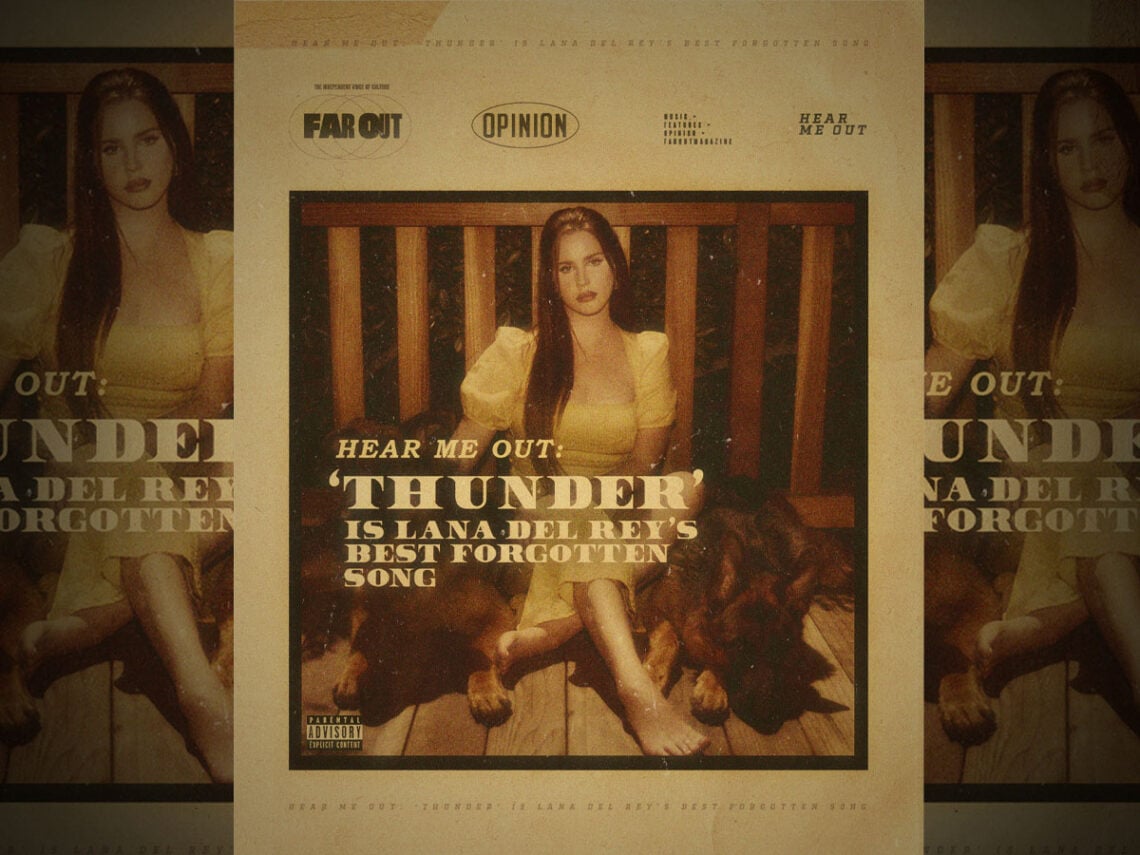
Hear Me Out: ‘Thunder’ is Lana Del Rey’s best forgotten song

Lana Del Rey occupies a curious space in the pop music landscape with one of the most fervent cult-followings of devotees who rush to attention the second the singer-songwriter’s name is mentioned.
At once candid and controversial, her music never shies away from chronicling her life’s darker moments, in all of their brutality and sadness. She shifted the trajectory of pop music’s sound with her debut album Born to Die, introducing a gentility and moodiness that paved the road for alternative artists to follow.
Additionally, she offered material that dug into the depths of the pain, rage and the confusion of womanhood that is so ubiquitous yet rarely spoken of, let alone sung about, changing the way people listened to and interacted with pop music (myself included). Even with an undeniable stake in the history of contemporary music, Lana Del Rey, perhaps intentionally, feels like a mystery.
Born Elizabeth Woolridge Grant, Del Rey’s early name change signalled a desire not just to become someone else, but to transcend herself entirely. Her music acted as a communicator between her subconscious and the spiritual realm, attempting to parse through her emotions while writing in the vein of Sylvia Plath or Amy Winehouse. Honest and poetic, Del Rey keeps her musical cards close to her chest and, if and when we are lucky, she lets us into her world.
Her solitary approach to craft is heard best on 2021’s Blue Banisters, which, as is with the majority of her album releases, she rolled out quietly, never one to over-explain her art’s content. The album itself is rather quiet, too; known for her breathy vocals, melodic pianos and keys and soft, hushed tones, Blue Banisters follows suit, reminiscent of a coffeehouse medley. It remains her most misunderstood album, garnering nowhere near the amount of appreciation it deserves, not even from the artist herself. Across her extensive discography (including her infamous collection of unreleased material), the songs on this record are most glaringly absent from her live setlists, and heartbreakingly so.
Unfortunately, Blue Banisters’ fate cannot be discussed without a mention of its predecessor, Chemtrails Over The Country Club, released earlier that year, which is frankly her weakest work, seeing her venture into country-tinged Americana but lacking the depth of her previous collections. Especially considering the sonic and commercial successes of 2019’s Normal Fucking Rockwell!, Chemtrails didn’t stand a chance, and while the latter was lost in the former’s attempts at reinvention, it remains the better of the two by a landslide.
Blue Banisters hears some of Del Rey’s best lyricism to date. opening it with ‘Text Book’: “I guess you could call it text book / I was looking for the father I wanted back,” she reflects, backed by a film noir-esque medley of piano and bass. She mourns her innocence and naivety, singing, “I didn’t even like myself, or love the life I had… You touched the detriment most of the friends I knew already had”.
Her acute self-awareness continues on songs like ‘Black Bathing Suit’, where she proposes, “Untraditional lover, can you handle that? / I guess I’m complicated, my life’s sorta too / I wish you could see through my soul through this black bathing suit”. She explores a dance ballad on ‘If You Lie Down With Me’, finds peace after heartbreak on ‘Violets for Roses’, and succumbs to her anger in emphatic screams on ‘Dealer’ (where her vocals merge perfectly with Miles Kane’s): “I don’t wanna live / I don’t wanna give you nothin’,” she shrieks and, like a siren, beckons us all to scream along.
The true underdog of the record, however, is ‘Thunder’, one of the few songs Del Rey has never performed live, though its structure would fit perfectly into her dreamlike constructed worlds on stage. From the start, we are warned that this love story is robbed of any optimism. “You roll like thunder when you come crashing in,” Del Rey bemoans, weary of not just her lover, but his hold over her, “I know what you’re like when the party ends”.
Her repetition of “just do it, don’t wait” fortells an anticipated danger, her allusions to alcoholism only fueling the song’s underlying tragedy. The instrumentation does not expand far beyond the strum of an acoustic guitar, simple piano keys and a steady, mellowed drum beat, and each emphasises the melancholy entrenched in the lyrics; foregoing elaborate melodies, all Del Rey needs are her operatic vocals and a loyal band to keep her rhythm and communicate her pain.
By ‘Thunder’s’ end, Del Rey’s voice grows stronger, but her emotions weaken, “‘Cause if you’re on fire, you’re on fire / Just keep burning, ‘til rain / Baby, keep me ablaze”. She conveys the push and pull of a love that is doomed from its inception but is still addictive in its chaos, as she slowly tries to distance herself from it all. She rushes the line, “If hello just means goodbye, then, baby, better walk away”, as though it pains her to sing it, while a choir echoes “Just do it, don’t wait” throughout, that by the closing fades out of memory.
‘Thunder’ is an unsung hero of Del Rey’s most eloquent writing, wielding her characteristic sorrow and refinement into a story that, like many of her best, embraces the former in the face of doomed optimism. All of Blue Banisters is deserving of reassessment, though, and ‘Thunder’ bleeds with novel passion at its core.
