


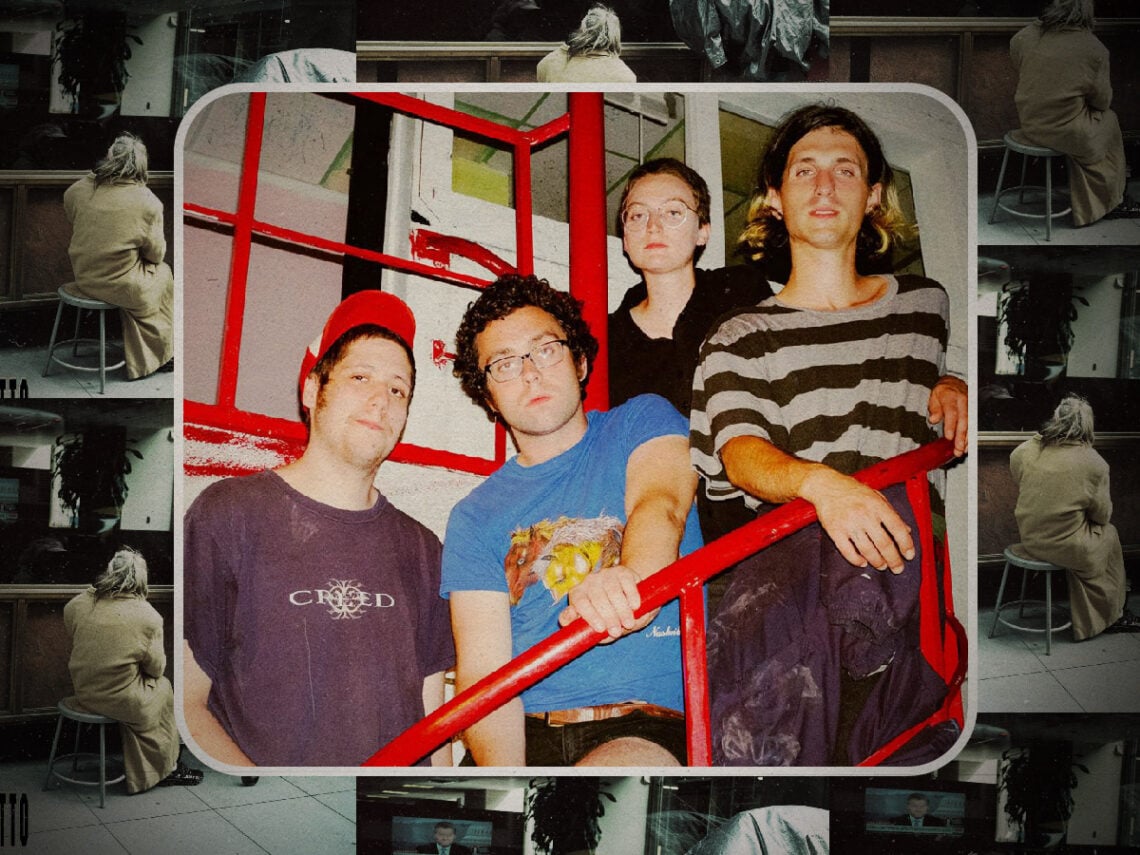
Why did They Are Gutting a Body of Water turned their backs on studio technology?

At its core, “shoegaze” is a balance of sounds both graceful and shocking, resting somewhere between a dream and a nightmare.
Dean Wareham, the founder and vocalist of Galaxie 500, an indie rock band known for their “dream pop” sound, described the genre most eloquently for Pitchfork in writing, “Shoegaze bands are more of an assault, a wall of sound,” in comparison to dream pop and its fruitful empty space where melodies have the room to grow.
Where the Irish-English band My Bloody Valentine paved the way for shoegaze to break through the haze with their 1991 sophomore album Loveless, and the English band Slowdive, in tandem, with the release of their 1993 sophomore album Souvlaki, modern bands have continued in their tradition, notably heard in the sludge-fueled renditions of the Philadelphia band They Are Gutting a Body of Water.
On their fourth album, 2025’s Lotto, TAGABOW’s leader, singer Doug Dulgarian, felt the urge to remove all outside influences from the creation of the record, which for him meant prioritising the sound of his guitar. “I just wanted to strip all the shit back,” Dulgarian explained. “All the plugins, the pedals, the vocal effects – everything about it. I just wanted to make a fucking record where the riffs really get stuck in your head.”
This approach was a departure from TAGABOW’s previous album, their 2022 debut, Lucky Styles, which heard a heavy influence from digital production. For Lotto, the band abandoned all digital technology and honed the sound of their live performance, with a particular emphasis on perfect imperfection.
“In a world of perpetually increasing artifice, this record is my attempt to surface through the sea of false muck,” Dulgarian reasoned, noting that the audible mistakes on the record emphasise its humanity.
“The more I utilised [technology], the softer I got. More fragile.”
Technology, in Dulgarian’s eyes, became something of a comfort zone, where even an instance of, say, resorting to staring at his cellphone in social settings, became a reckoning with comfort – or lack thereof. “In moments of clarity, I am often very aware that we’re currently watching the homogenisation of art right before our very eyes,” he said. “I am afraid that technology and convenience will cure the world of life.”
In stark contrast to this, Lotto becomes an album of discomfort, in the best of ways. The collection is confrontational and abrasive, but it is real and honours the act of sitting within such discomforts in order to produce art that can withstand such force. TAGABOW favoured the more raw moments that not only displayed their musicianship, but firmly clung to the very human element that drives their music, in the first place.
This sensation is immediate from the opening track, ‘The Chase’, introduced by a mangle of guitars that solidify Lotto’s heavy tone. Sludge metal merges with their shoegaze roots on songs like ‘rl stine’, each note of the riffs performed with a sentimental weight. At just 27 minutes long, Lotto encompasses a full spectrum of emotions, an achievement in crafting songs that, as Dulgarian desired, linger after each listen.
As Dulgarian describes, the mission statement of Lotto is “living in truth is a practice, and it’s never too late to get real again”.
