


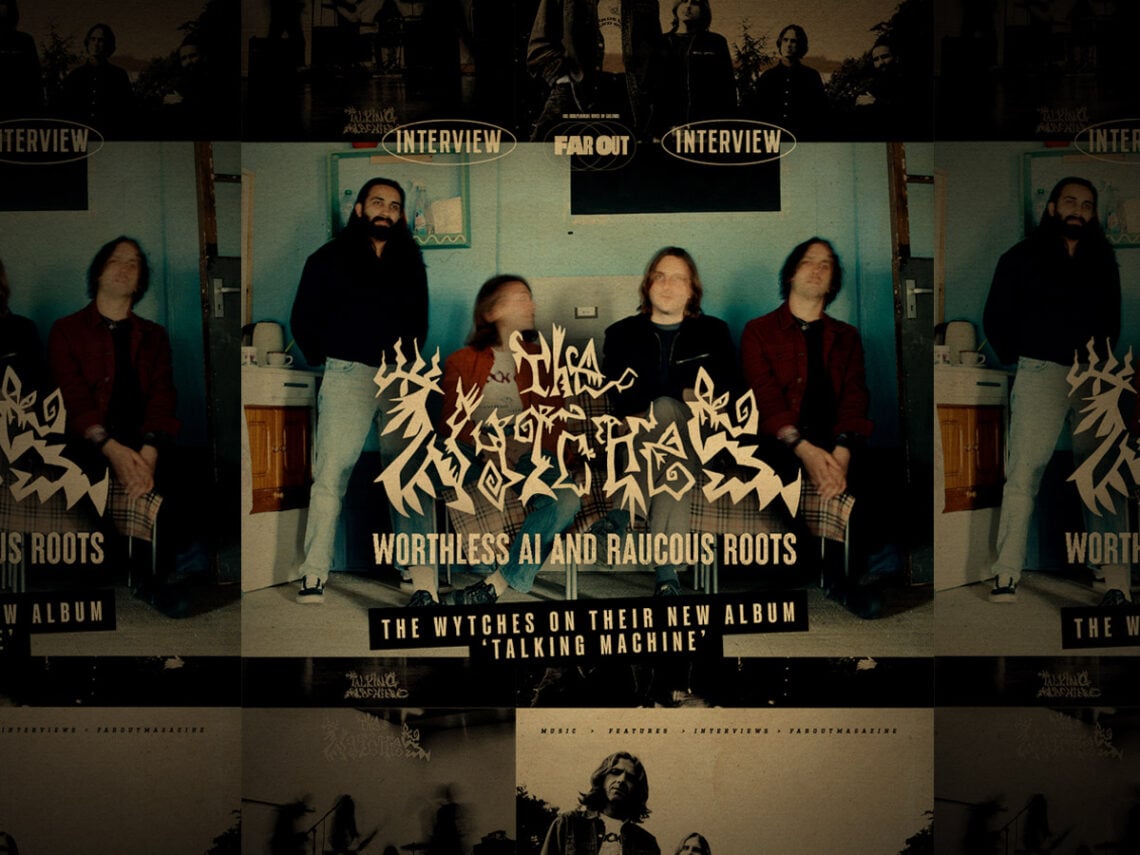
Worthless AI and raucous roots: The Wytches on their new album, ‘Talking Machine’

Opening this conversation with The Wytches’ frontman Kristian Bell by talking about album number five almost seems ridiculous. Such is the passing of time, it only feels like yesterday that I was a fresh-faced teen embarking on a new life to study in Brighton and discovering this surf punk outfit with a buzz about them.
After a series of well-received EPs, their debut album, Annabel Dream Reader, was released in 2014 to widespread acclaim, and on a personal level, I felt as though the hype around a band from the local vicinity had proven itself to be justified. However, despite the initial traction that the band received, they found themselves struggling to capitalise on this and keep their strong early momentum going beyond this positive start, and Bell claims that he was suddenly treading carefully in trying to navigate moderate success.
“I used to have all sorts of strange paranoia about what might happen to us if we did this and we did that,” Bell claims, reflecting on the early years of the group. “I used to think that because of the exposure, that this was having an influence on people, and I used to think really hard about it. If the music is so sad and depressing, is this gonna lead to something terrible with a fan?” After realising that no artist is fully responsible for how fans interact with them or behave, things have been a lot more freeing for him and the rest of his band, both in a musical and personal sense.
The rapid nature of their early releases, with second album All Your Happy Life coming out barely two years after the debut, meant that the intensity of adhering to the industry’s demands led to burnout. As a consequence, Three Mile Ditch didn’t arrive until 2020, but that didn’t mean that all of the worries had disappeared for Bell. “Because it was during Covid, I kind of sat in my room and freaked out and had all the same feelings about putting yourself out in public, especially in that time where it was weird to even see a person,” he argues, noting how the release of that album’s first single, ‘Cowboys’ triggered the same concerns that he’d felt in the earliest years.
It did, however, improve from this point onwards. “After that, I knew that this was really what I wanted to do again,” he muses. “It just felt more free suddenly because there weren’t as many people bothered, and I kind of liked it. When you’re a new band, you get put in everyone’s face, and there’s going to be a lot of people that hate it, so there was a lot of that back in the day.”

The release of their fifth record, Talking Machine, arrives with significantly less pressure being applied than on any previous album of theirs. “We’d be making music regardless of The Wytches,” Bell argues, “but the fact that this band remains has a lot to do with it not being something you should turn your nose up at, having people around the world who enjoy this particular musical collaboration. Even though the music industry isn’t as fruitful anymore, it’s still a massive thing for us to be in this position.”
However, with this newfound sense of freedom meaning that they could apply themselves in different ways, they ended up finding themselves reverting back to older methods of recording, opting to record Talking Machine live, just as they had done for Annabel Dream Reader. Large amounts of this can be credited to the recruitment of new drummer Bhav Thaker, who seemingly took to the role in an instant.
“He had so much enthusiasm for the band,” Bell recalls of getting Thaker on board. “I think the first time we rehearsed with him, he’d just come straight from work and had learnt everything. We basically just gelled immediately as a live band with him, there was just a chemistry there, and we just knew that we could pull it off. He hadn’t even been in the band for a year when we recorded the album.”
Drawing further comparisons between the latest record and the debut, he explains that the first album was recorded live for simplicity’s sake, due to the band’s lack of experience of being in a professional studio environment compared to their experience of playing live. “On this one, it was more about missing that element of it,” he explains. “With the last two albums before this, we’d never actually really heard what they sounded like live. We were able to fine tune things rather than sitting there with headphones on working out your own part.”
The rapid nature of how things were working with this new setup also inspired Bell to write more frequently, rediscovering a love for the creative process. “I used to relate it to skating,” Bell humorously recalls. “Before I went skating, I would watch loads of skate videos, and I remember when I moved to Brighton, before I’d go and rehearse, I’d watch loads of live bands playing, so I started doing that again.”
“It felt very reminiscent of beginning again,” he continued. “If this album was total crap, I would still have a lot of fond memories of it because it just came together in a nice way.” That doesn’t mean that everything was suddenly straightforward, and there were always going to be elements that he wanted to tinker with from a production standpoint. “Because we were conscious of studio time, some of the songs we took back to my little studio and added a few things, but it wasn’t to complete anything,” he confirms. “It was just to have a bit more fun with some of them.”
It’s not just the methods that the band employed during the recording process that saw a return to their origins, but also the sound of Talking Machine, which harks back to the sound of ‘60s garage rock that permeated through the debut. It was largely due to Bell’s recent employment in a record shop that reignited a passion for this sound, and having also worked as a producer, he began to recognise certain aspects of this style that were much more advanced than he initially thought.
“Sometimes, you have one genre, and then you hear this prototype from way before that other genre happened,” he notes of this newfound intricacy. “I started hearing a really raucous, punk thing in ‘60s music, and I’ve listened to that kind of music since I liked music to begin with, but it was something about listening to them on 45s where they just sounded giant.”
He relates this back to his earliest musical experiences of being in bands in his hometown of Peterborough alongside Wytches guitarist Mark Breed. “Because we’re from a hardcore scene back in Peterborough, I always thought we had to involve that in some way, because that’s our roots,” he ponders, “but we’ve come out with a few metally things that I’ve ended up not being proud of. I found a lot of garage music recently where it was just as ballsy, but still thinking about the melody at the forefront. There’s something about the pop sensibility, but it was just completely raucous.”
Citing records like The Creation’s ‘How Does It Feel To Feel’ as an inspiration, which came out in 1967, there are similarities between the immediate aggression heard in the guitars on the opening few tracks of the record, including title track and lead single, ‘Black Ice’. Despite this, Bell acknowledges that while this nod to older techniques is exactly what he was after, it doesn’t necessarily stand up to the work of the band’s contemporaries, and this is something he’s also noticed in his production for other acts such as Japanese Television.
“With recording, there’s an industry standard way of doing it,” he argues, “and I kind of started falling into this by the book way, for a while, even though it was very experimental. If it sounds good, it sounds good, and it doesn’t need to correspond to music technology. You mic up a drum kit the way they teach you at college, and it can just sound so boring. When bands come into the studio, they expect a certain isolated, clinical sound, and then they think that when you take it away, it’s gonna come to life. I’m way more about trying to get that sound while they’re there.
Other acts may expect a sense of slickness on their finished records, but standing out from the crowd is a badge that Bell wears with pride, especially when placed next to modern bands on playlists. “As soon as we come in, it just sounds really thin and weird,” he laughs. “I like the fact that it stands out a little bit because it’s not a bad recording, it’s just a different type of recording.” While artists from the 2000s garage rock revival such as The White Stripes and The Hives are two formative projects that helped Bell discover an affinity for rawness, it took him a while to come to the realisation that the progenitors of this scene were employing this just as much.
Returning to his origins in Cambridgeshire, we found ourselves discussing moving from what we both determine to be “culturally devoid” areas, and trying to establish our own musical identities when there were limited places to explore different genres in our locality before moving to a city with far more to offer. “Peterborough was all metal and hardcore music,” he recalls, echoing my own experiences of growing up in a Wiltshire commuter town. “I was very young when I first started touring in a hardcore band called Kick Down. I was the drummer, and we took it really seriously. We were gigging as much as we could, we were putting out EPs all the time. There were very few venues to do it in, so we used to go to Nottingham and play at Bunkers Hill where they had hardcore all-dayers. I was like, 13, 14-years-old, witnessing what popular gigs looked like.”
This did, however, mean that he got to experience the feeling of community that the hardcore scene offered, and while the frustration of not being able to take things further in the direction that he wanted to at this time, the formation of The Wytches and their subsequent relocation afforded him more freedom to branch out away from metal and indie sleaze.

“I don’t know if it was like this by the time you moved, but there was a real ‘60s thing going on in Brighton when I first moved there,” he says, something I can personally attest to. “I thought there were fancy dress parties going on in the street, and it was really different for me, because in Peterborough, you’d just get beaten up for looking like that. That definitely informed a bit of our sound, the fact that there was this big emphasis on the ‘60s going on in Brighton.”
As much as this retro worship still plays a major role in The Wytches’ sound, the lyrical themes of Talking Machine reflect largely on the state of modern technology, and all of the fears it has managed to instil in people who work in artistic fields. AI is a particular concern for Bell, and so we tried to dig deeper into how he feels it will continue to impact those around him. “It’s making things accessible in a good way and a bad way,” he reluctantly admits. “You can get a track mixed and mastered by AI now, and that’s great for someone who doesn’t have the budget to go to a sound or mastering engineer to do that, but in the long run, it’s damaging. I’ve got friends in plenty of industries who know their job is going to be the first to go. There’s a lot of paranoia around it for me.”
Speaking more about how the album’s title arose, he claims that a lot of inspiration came from reading Greg Milner’s book, Perfecting Sound Forever, especially the opening section on Thomas Edison, from whose essay the album’s title was borrowed. “Not everyone then could afford to go to a concert hall and watch music,” he explains, “but it was a lot more affordable to get a gramophone. At that time, everyone was freaking out about that, but then that ended up being a completely harmless thing and it was great for the music industry.”
Unlike the gramophone, however, artificial intelligence probably won’t be able to eventually spin the narrative for itself to present itself in a positive light. “I don’t know if I’m being ignorant, but I can’t see any good in it,” Bell remonstrates. “Realistically, the first thing that it will be used for in a normal scenario is adverts and library music. Once upon a time, I used to think that when I’m not cool enough to be in a band anymore, maybe I’ll do some funk music for TV or whatever, but I think that will be the first thing to go.”
Library music as we know it may soon change in favour of using AI, but mainstream music is already also being infiltrated by the rapid emergence of AI-generated bands like The Velvet Sundown and Bleeding Verse. “What freaked me out is some people were like ‘oh yeah, it’s not bad’, but it is bad” Bell argues. “It’s terrible. These are people who listen to real music as well, but what moves me about art and music just isn’t there at all.”
Much to his frustration, his friends have curiously fed his music to ChatGPT and showed him the results. “They prompted it to write a Wytches song, and the lyrics weren’t that bad,” he admits. He won’t ever find himself using these sneaky workarounds to help him write in future, but he hopes that humans will eventually prevail over their virtual adversaries. “I saw something where an AI crashed recently, and it was continuously apologising and saying ‘I’m worthless’ and this and that,” Bell laughs gleefully. “I don’t know if that’s fake news or whatever but yeah, I should probably stay off the computer a bit more.”
As long as AI doesn’t negate the need for the band to exist, then The Wytches are likely to remain a band for a considerable amount longer, and making comparisons to other bands who emerged at the same time as they did isn’t something that they live in fear of. “I can’t remember all the bands we came across, but the sort of bands we would support or who would support us are either larger than life now, like Wolf Alice or Soft Play, or they just don’t exist anymore,” Bell states.
The Wytches are a completely different prospect. “Our band feels quite strange to me, because we more or less play the same venues we were playing 10 years ago,” he continues. “There was a period where you’re looking at those bands who got successful and wondering why you’re still here, but it doesn’t bother me anymore. I’d probably get all these paranoias back again that I was having in the early days. There are people who were destined for it, and those that just seem right in that place, and I kind of feel like we just seem right in the place we’re at. The fact that we’re creatively intact is enough for me to keep going.”
