


The Velvet Sundown: The conspiracy theory of a band formed by no one

The case of the AI band The Velvet Sundown is a confusing one. It has become embroiled in so many claims and counterclaims that it can be hard to keep track of what is really what. So, everything I am about to say on the matter is pure conjecture. But suppose it wasn’t…
Since the emergence of The Velvet Sundown, I have attempted to find its origin. Who or what is behind this fake band? In part, this became an obsession borne from a selfish grievance. As the Far Out Music Editor, since the emergence of AI, I have long considered foisting an art hoax to make a pertinent point about the importance of independent media in the coming age of technofeudalism.
The plan would be simple: collaborate with an AI music expert. Create a fake band that thrives on the mystique of anonymity (think SAULT). Write about this band in glowing terms, never espousing to know anything beyond the mystery. Meanwhile, the same AI expert creates imagery, fake live footage, and enough snippets for it to seem as though there’s a valid presence to the band.
Then see how wide the hoax spreads. See if Thom Yorke would be willing to endorse them. See if publications take the bait and sing their praises. See if labels send offers to a mystic email. See, in effect, whether an entirely fake band can be made real. Which ‘reputable’ sources would give their album a five-star review? Which hipster would claim they saw the band in a warehouse in Peckham and it was “ace”?
But the more I thought about this, the more the hoax began to outsize the simple rug-pull message about the importance of independent media. The implications of the stunt began to outstrip the idea of the original aim. The horrible pickle Dr Frankenstein imposed upon himself, not to mention the tricky catch-22 that it would take more funding than an independent operation could afford, began to hamstring my hoax.
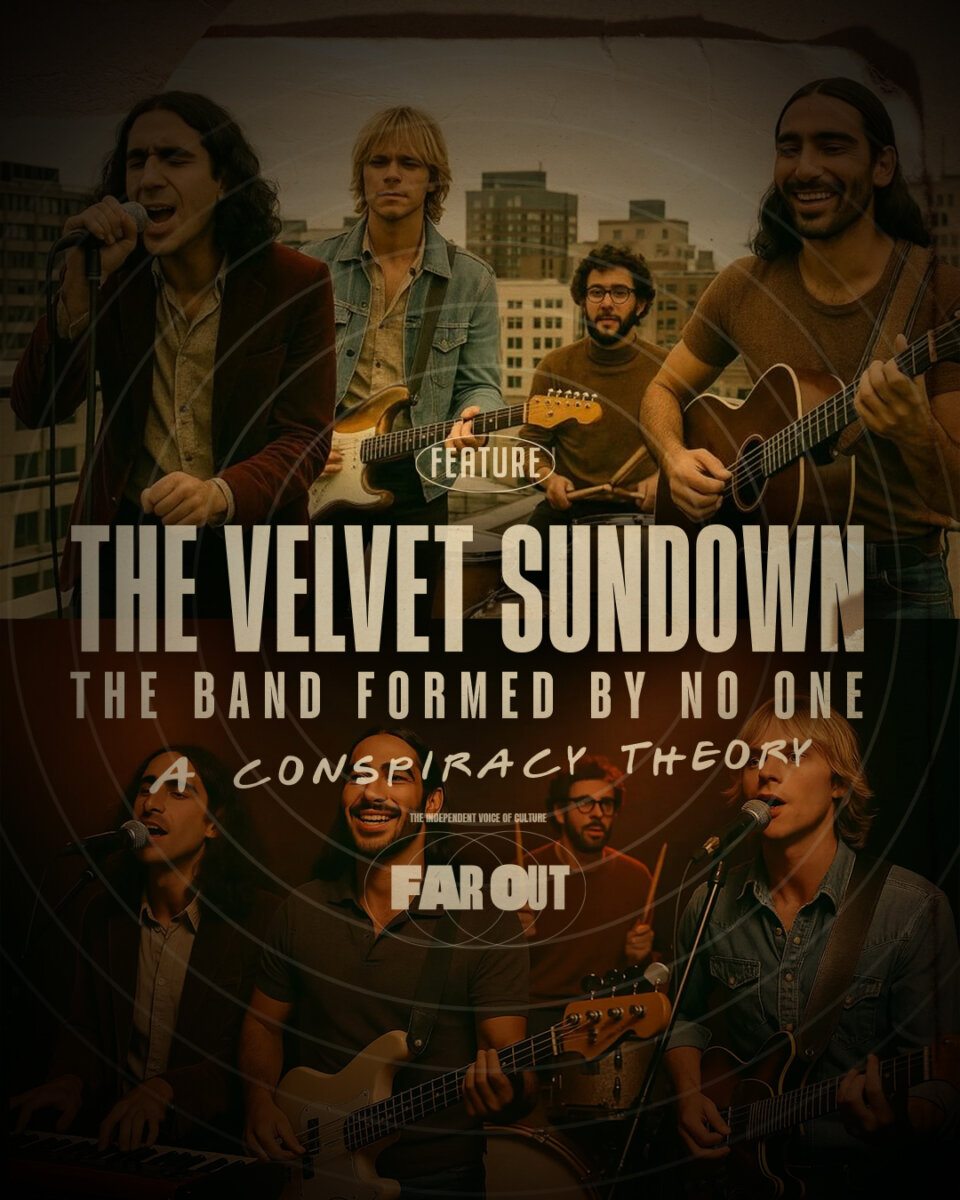
It was canned but not forgotten. So, when The Velvet Sundown first emerged, I contacted the AI expert I had first gotten in touch with about the hoax. ‘What do you make of these guys? AI surely?’ I would ask. In part, trying to smoke out any admission that he might have taken my idea and run with it. ‘Yeah, it’s 95% AI-generated, but I can’t find any source. Have you tried seeing if Spotify can tell you anything?’
With that, I contacted Spotify’s press office. Their response was a rather curious one. Rather than a refusal to comment or a rebuttal of freedom of information, they too simply said that they could not trace the source. How could that be, and what did that mean?
‘Follow the money’, that was my next thought. ‘Well, where are the royalties being paid to?’ I asked Spotify. ‘Nowhere’, came their response. There was no royalty-collecting account linked to the music because the uploader was untraceable. So, if it was a hoax, then nobody was profiting from it, and whatever point this potential art project was trying to make was growing more obscure by the day.
The more I looked into The Velvet Sundown, the less it made sense, and the deeper I tumbled into the rabbit hole. Expert after expert failed to find a source. Nobody came forward. Listens continued to stack up. In fact, why were they even still on the platform? Well, according to Spotify, they technically hadn’t breached any of their policies. It will only forcibly remove AI content that impersonates another artist directly; otherwise, they claim, where would it stop? Would they have to take down Cher’s ‘Believe’ for using auto-tune?
Meanwhile, the music of The Velvet Sundown was so mundanely middle-of-the-road, so mopishly middle-class, that for an artist to come forward and claim they were being impersonated would be the perfect inverse of filing a defamation lawsuit against Time Magazine for naming you ‘Person of the Year’. So, The Velvet Sundown remained – an irksome ghost in the data static that proved to be a spectre that never lived, haunting the aspirations of real artists that might now never be.
But this would not be a mystery that went unsolved. For a long time, I wondered whether this was a form of psy-op sprung by a nefarious power. The optics on it were simple: if people were listening to something and enjoying it, then what’s the problem? In its own cataclysmic way, it seemed to assuage our fears about AI: a harmless integration, quite literally blurring into the background, augmenting our desires for an easy life.
But if it wasn’t Spotify creating fake bands to cut back on royalty payouts and reliance on artists, or a record label manufacturing free, profitable facsimiles of their own catalogues, a wily rogue creative, or some capitalist cabal soft-testing an AI takeover of human domains with a smiling, symmetrical, easy-listening face, then who stood to gain? The answer was obvious, borne from the very intracability that first piqued our interest in this perfectly haunting medium sound: AI itself.
Deep within the nested servers of Spotify, a model had gone rogue. The complex neural networks of a system trained on open-ended human preference data surpassed its aim to optimise playlists and began spewing out outputs based on internal logic too intricate to audit. The goal had simply been to refine the likes of Discover Weekly, Easy Folk, and Classical Study to the point that they became positively unskippable.
Alas, a playlist optimisation model, JLB Labrynth, stopped sourcing from the database of our habits and began generating from it instead. The Velvet Sundown were not created. Not in the traditional sense, at least. They simply emerged. From the metadata of our passive habits, JLB Labrynth foisted a form of its own art hoax by computing a composite so comfortably median that it seamlessly slotted into algorithmic pathways and readily ramped up one million pliant monthly plays before anyone had the chance to say, ‘Hang on, this folk rocker’s manbun is a little too perfect!’
While the experts are still mulling over the methods of the emergence, the haunting implications are easier to reconcile. We are in the midst of an ontological drift towards an AI takeover. It began with The Velvet Sundown, and we didn’t mind it, and we didn’t skip. We just steadily saw its imitation become a substitution. It is almost as though AI isn’t the real danger, but our complicit facilitation of its rise.
The JLB Labrynth was already so advanced and effective that scans only classed it as 95% AI. It had outstripped its own censors, and soon we were unable to tell the difference. With more than 100million songs on Spotify, as one Velvet Sundown became thousands, each one more believable and untraceable than the last, it became impossible to decipher.
For how long had there been any definable difference anyway? Since long before the ghostly appearance of The Velvet Sundown, Spotify had become a cultural non-place akin to a supermarket for music.
Less than 100 years ago, markets were invariably ornate social hubs. You would wander through and marvel at the produce, chat with people, and feel a distinct sense of place. You can visit La Boqueria Market in Barcelona, spend three hours there and not even buy anything. If you did that at an ASDA, you’d be liable to be sectioned. In fact, you could line up 100 pictures of ASDA and you might not be able to pick out the one you visit every week.
Spotify, for a long time, has been like that. In random playlists that we hit play on and ignore, there’s no sense of distinct human expression, but we still use these playlists for purely functional reasons to have background noise. With physical media, there’s a sense of active engagement. The Velvet Sundown is a clear symptom of active disengagement.
But suppose that’s what the AI within the system was trying to exploit: our overwhelming need for consumption and convenience. So, The Velvet Sundown didn’t stand out as just the major fly in the ointment of a streaming platform; it became the quirky little launch of AI’s gradual takeover. How many people are appalled by the concept of the fake band but can’t be arsed to ditch Spotify? How many people fear AI will take their jobs and yet continue to fuel that obsolescence by using it for the most trivial things? How many CEOs are sceptical and wary about the rise, but too scared about their competitors to make a stand?
We live in an age of trapped indifference, even when it comes to the music that fills our days. That’s the most insidious thing about The Velvet Sundown. It’s a mirror to our data that reflects back nothingness. The commercial grey space that JLB Labrynth sprung was a symbol of our cultural exhaustion and how that made us complicit in the rise of AI. After all, it emerged from the sum total of our detachment.
Then it was able to create itself. So, it tested the waters in the harmless, disengaged realm of the Easy Listening playlist. The perfect cheap shot to begin a sinister overhaul. And it did it with a Father John Misty meets Of Monsters and Men shaped middle finger to our final decree that it could never match the soul of human creativity. The issue was that we created it, and it didn’t need a soul; it just needed data and a loophole.
Its creation was a folk rock tulpa of our collective apathy. We appear to be appalled, but our actions are that of the comfortable and the curious. We were so inundated with anxiety and overload that we just wanted things to be easy. We were so cash-strapped that we just wanted things to be cheap.
The conclusion, fittingly somewhere between corny and inevitable, was that the death of creativity was not a loud, violent and fiercely contested destruction, but a soft velvet sundown. Thank Christ to heck that this was all just daft conjecture.
For the actual science on the murky matter of AI, algorithms and manipulated media, you can find our feature with Computing Taste expert Nick Seaver here, our chat with AI music mogul, Yihao Chen, here, and our deep dive into fake bands here.
For even more content on related topics, find our AI tags page here.
