


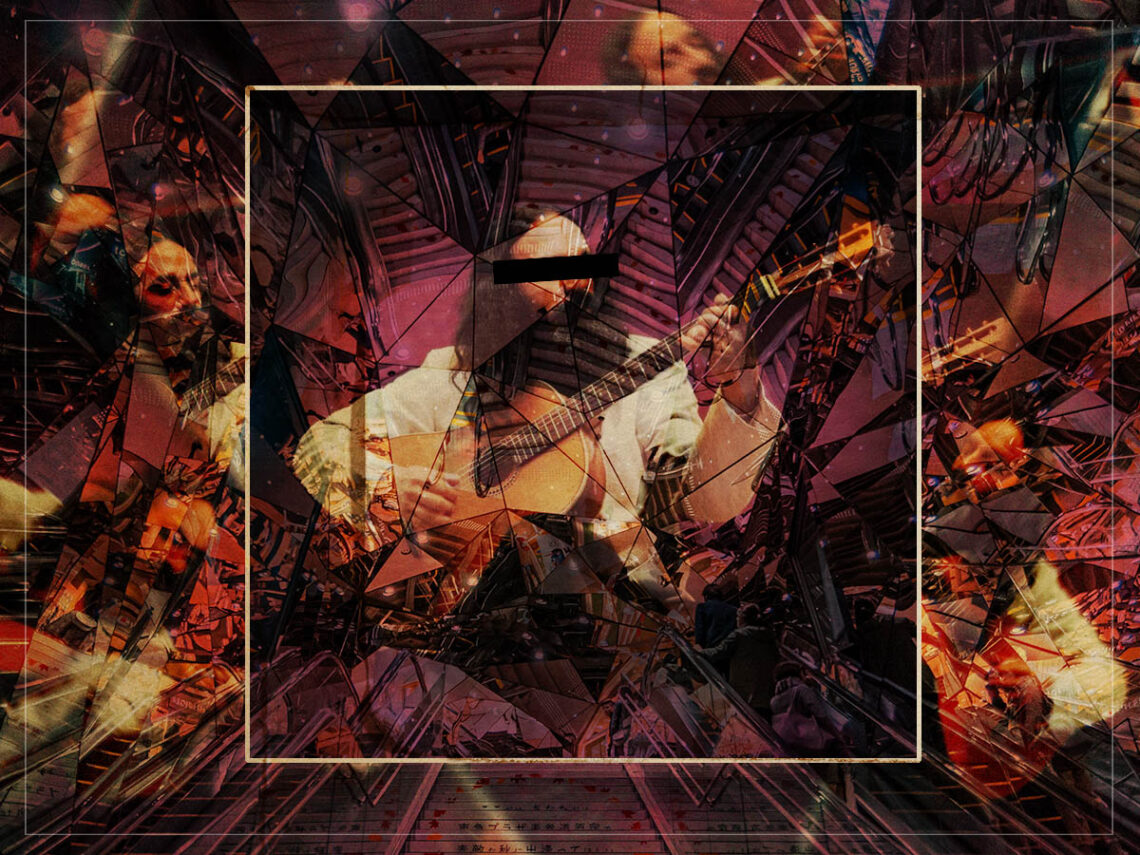
Ghalib Ghaboussi: The greatest artist to never exist?

It’s a curious quirk of the human condition that the following scenario is not unfamiliar: you’ll ask someone if they’ve seen a film or heard of a band, and they’ll nod enthusiastically, a quick ‘yes’ at the ready. But as the conversation unfolds—marked by their frantic attempts to shift the topic or overly passionate, panicked nodding—it dawns on you: they haven’t seen the film or heard of the band. They are not even sure who they are anymore.
While this might be a peculiar oddity in pleasant conversation, it becomes a little bit prickly when people who ought to be in the know suddenly start pretending. The great John Lurie exposed this flaw when it came to cultural tastemakers back in the analogue age of 1999. At this stage, he had starred in Paris, Texas, had his art showcased in exhibitions, and been the leader of the jazz band The Lounge Lizards for over 20 years.
His next project, however, was markedly different. “I had all this music written,” he explains over Zoom, “but I really didn’t want to release it with me suddenly as a vocalist. Like, ‘Oh, now the celebrity is singing’, kind of thing. That just seems so pretentious.” So, he decided to create a moniker that he could hide behind. Things snowballed from there.
Marvin Pontiac became more than a moniker—he became a fictional character. Lurie figured he might as well make him a fun one. In short, he was hit by a bus and killed in 1977, ending an extraordinary life that began in New York with a Malian father and a Jewish mother, included returns to Mali via Motor City, Detroit, brawls with blues harmonica players, rumours of bank robberies, alien abductions and decidedly groovy licks before insanity inevitably curtailed his creative output, and the tunes weren’t unveiled until long after the number 42 had rendered him pavement Jackson Pollock. All of which was invented on a whim.
“In every project you ever do, you have to write a bio, which is always the most boring part. I hate it. So it was more fun to write a fictitious bio for Marvin.” The lifestory in question was inadvertently loaded with what the industry now term USPs or ‘Unique Selling Points’. They argue that in the congested world of modern music, you can’t get by without a slew of them. When we recently covertly inquired with a management company about releasing a song, they explained, “You need to add what somebody hasn’t already got to the pool”. Before asking, “Exactly how working class are you?“
While USPs might have become more paramount in recent times, Pontiac perhaps proves that they have always been good for marketing. Music journalists love an angle, so if you’re offering up an easy one, they’ll lap it up. “For the first couple weeks, I was holding on to the hoax of it,“ he says of the release of Pontiac’s ‘discovered’ tapes. “I knew it wouldn’t last, but I thought it might last, like a year, you know, that this thing had come out of this discovered, insane African guy.“ He even roped David Bowie, Leonard Cohen, Iggy Pop and a slew of others to invent quotes about how great Pontiac was.

However, he maintains the intention was always a light bit of fun. “But then these journalists were all writing it like they already had known who Marvin was. ‘Oh yeah, Pontiac’s great, always loved him’. Then the publicist panicked and didn’t want to be part of this… of this lie, basically. Which I kind of understand; it’s what he does, and he’s got to deal with these people, so when they found he lied to them…“ So, the publicist cut the bit short in an act of damage limitation.
But beyond the pie on the face of various members of the press, a more nuanced reality was readily unveiled: in alternative circles, there is a fetishisation of the exotically obscure. By and large, that is a positive thing. It helps to expand the scope of culture beyond what is known. However, in an age where a fair chunk of the culture that has ever been created is a click away, it is also being troublingly exploited. Enter the lesser-known Persian psychedelic musician Ghalib Ghaboussi and his stirringly evocative only album Royāye Gomshode.
I recently told someone in the music trade, who will remain anonymous for obvious reasons, about Ghalib Ghaboussi. Their response that they were aware of him and loved all of his stuff came as quite a surprise, for the simple fact that Ghalib Ghaboussi doesn’t exist. He didn’t exist in 1973 when his album was reportedly released, nor does he exist now. He is a fictional musician created by AI.
But this is no ‘Frank Sinatra sings ‘Teenage Dirtbag’ AI’, this is a fully realised AI art experiment creating fully dimensional renderings of musicians. The dastardly, dreamy Ghaboussi is the work of Kalkutah Records, an online channel “where you can explore music from all corners of the globe—different cultures, languages, and genres all in one place! The twist? Every artist and song here is entirely fictional. But who cares what’s real when the music sounds this good?“
It is a pertinent question. I liked the music of Ghaboussi, I liked the aesthetic, and I liked the tones—in a nutshell, I liked everything about it. But I hate AI. In fact, I fear AI. It could replace 300million jobs by 2030, according to a Goldman Sachs study, and I could be one of them—seemingly, a fair few musicians could be, too.
The way I uncovered Ghaboussi is unnervingly revealing on this front. As it happens, I didn’t ‘uncover’ Ghaboussi—the bastard simply crept up in the infinite loop of a continuous playlist. I liked it, took pause for a moment, noted the name and moved it. It might say ‘fictional’ in his YouTube bio, but unless you click ‘More’ to reveal that, it takes a fair bit of research to figure out what is actually going on. A less scrupulous journalist caught up in the accelerated hamster wheel of the internet might not have seen that and reported Ghaboussi as real—this snowballs, and suddenly, 30 years later, you have more of the myth than the ‘fictional’ truth behind it all.
So, what is going on? Well, Kalkutah Records specialise in what they term “world music”, an antiquated phrase in itself, but a pertinent one here all the same. Whether you’re dipping into Ethiopian jazz, Saharan blues or Cambodian rock ‘n’ roll, it can often be difficult to burrow too deeply into your new favourite niche. There simply isn’t that much of it readily available. Kalkutah Records has that covered. As they put it, “Music knows no borders, and we’re here to deliver the most captivating sounds from our imaginary world straight to your ears.”
They have created an army of Ghaboussi-like characters, each with their own unique records, cover art, bio and everything else that a normal, real-life artist has. And because they operate in a niche world, the fictional artists they create are harder to decipher from the Real McCoy – despite the fact they are transparent about the work being ‘fictional’ – heightening the ethical discussion surrounding AI art. While I’d love to say the soul and suffering of humanity are missing from the mix, the fact you can listen along without really realising might betray that as pure romanticism.
You could even argue there is a degree of artistry to it—the operators at Kalkutah Records are trained in AI input, which, if you were an extreme libertarian, you could argue is just a futurist version of being trained on traditional instrumentation anyway. Are they just producers honing existing human craft into something new in a manner that was celebrated when the likes of DJ Shadow did it in a more analogue, arduous fashion a few decades ago? If the music is good, and the concept it ‘cool’ why draw the line now?
On the other hand, what is certainly problematic is the fact that fictional characters may well pull attention away from artists who genuinely have suffered, and remuneration for their work would help to alleviate that. I don’t believe that it is pure romanticism to assume that the vast majority of people would rather listen to that artist than their computerised counterpart.
Yet, even that isn’t straightforward. You see, algorithms and the post-truth age have already preconditioned us to some extent when it comes to this fiddly paradigm. While it might not presently be commonplace to come across a Ghaboussi of this world (or rather, not of this world), it’s a common occurrence to sit in a bar and hear a long-forgotten song from a bygone era that you thought only you knew to come over the speakers. I thought only I knew Ted Hawkins, an old blues-infused folk musician who never had a hit until a friend who thought they were the only ones who knew about Ted Hawkins recommended him to me.
“There are a growing number of surprise hits that seem to be blessed by the algorithm,” Nick Seaver, the expert behind Computing Taste: Algorithms and the Makers of Music Recommendations, tells me. “They just happened to land in a data spot that led to them being amplified in a way that we wouldn’t expect under traditional systems.”
Good for them, you might think—there’s almost something poetic about artists who were once spurned by the capricious and prejudicial music industry getting a second wind thanks to the blind and dispassionate medium of data. Such computerised favourability has primarily been responsible for bringing the beauty of Sibylle Baier, a mother whose music had been gathering dust in an attic for years, graciously into people’s lives. But there is also a stark dark side to this. Ted Hawkins is a prime example of a limitation in the age of algorithmic recommendation—one that has merely accelerated towards Ghaboussi.
You see, like Ghaboussi, I grew curious about Hawkins, so I delved into his past. It was a troubling one. Although the details are sparse, it appeared that he had been arrested for child molestation back in 1984 and served 18 months at the California State Medical Facility. While this incident is shrouded in the murk of details and documents lost to time and an apparent nervous breakdown, it is, nevertheless, something I’m sure most listeners would like to be aware of before celebrating his work.
But most listeners weren’t privy to this because his work did not come with a press release, prior knowledge or a publicised history—it came with data only known to an algorithm. So, while Ghaboussi might seem so groundbreakingly confounding that it has you scratching your scalp, the arrival of fictional artists is merely the continuation of a trend we have been travelling along for some time. Is Ghaboussi the apocalypse of art or the best application of AI yet? Ultimately, we will decide that… and that is, in fitting binary terms, a reassuring/terrifying proposition.
