


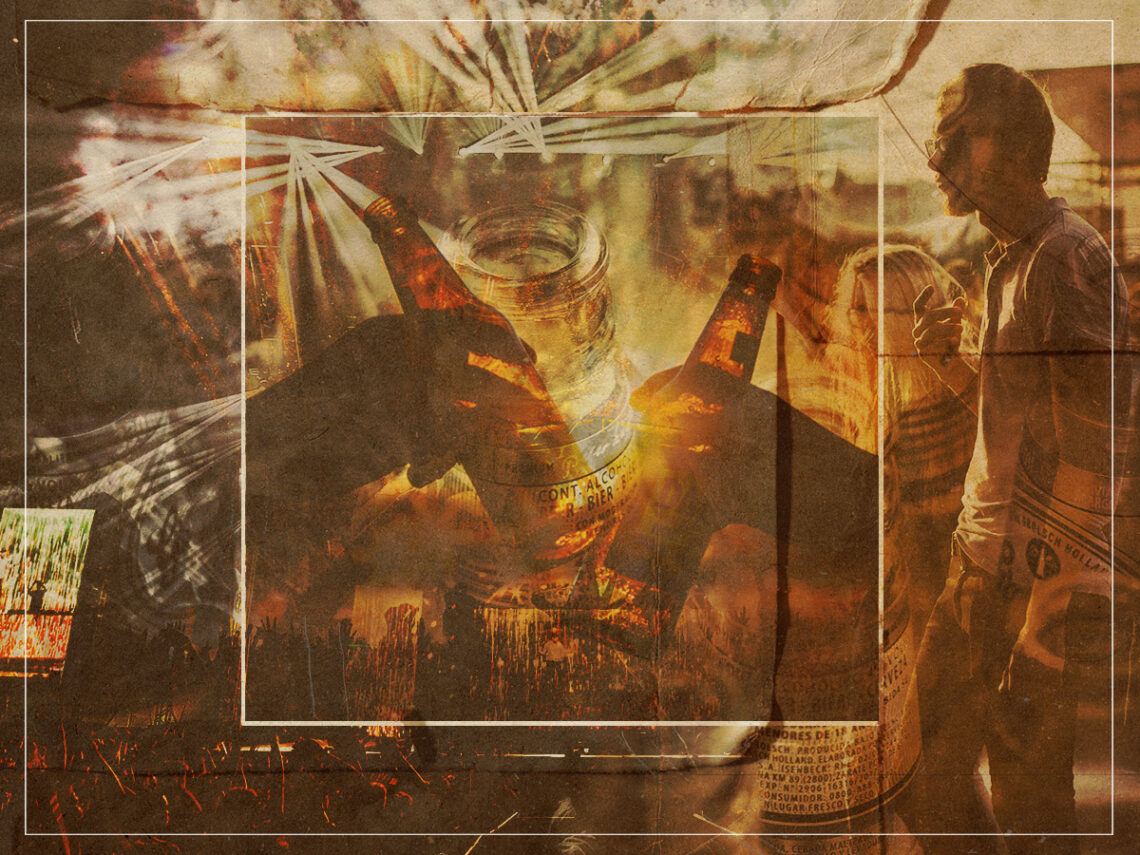
The underbelly of live experiences: Is it time we confronted alcohol culture at music festivals?

“Make sure you drink at your own pace,” it says on the UK Drinkaware website under a document regarding their festival survival guide. “Festivals are the highlight of the music lover’s calendar,” it reads, the necessary “drinking responsibly” ethos not far behind in the whirlwind of unsolicited truths about what you should and shouldn’t do during festival season.
The need for a ‘Festival Survival Guide’ during festival season seems entirely appropriate considering the significant amounts of alcohol organisers stock up during periods of such high demand. The guide joins a long list of educational materials that organisations and activists have implemented in recent years to increase education and awareness surrounding the dangers of alcohol.
The connection between alcohol culture and live music goes back centuries, and understanding the root cause of this is historically and psychologically complex. Still, with changing attitudes and shifting demographic preferences, a number of groups have pivoted towards creating a more positive and supportive environment that involves harm reduction and heightened safety protocols.
While we know why alcohol consumption remains not just a significant aspect of festival culture but an undeniable ongoing selling point, the changing attitudes around it are difficult to ignore. More people are becoming drawn to the idea of cutting down, becoming “sober curious”, or abstaining entirely for various reasons. However, until recently, the idea of festivals or events supporting this choice felt absurd.
The reason for the shift is entirely fathomable: a lot of what alcohol sells is artificial, from the idea of it being effective social lubrication to a gateway to enhanced enjoyment, but it also causes tens of thousands of deaths per year, increases domestic abuse to 55%, and significantly impacts mental health, causing or increasing the symptoms of depression and anxiety.
But spelling out the facts isn’t always impactful, and often, people already understand why alcohol is bad for health. Yet, festival-goers continue to embellish complicated relationships with the substance through ignorance and prioritising fun. There’s nothing wrong with the choice, but there has been a definite societal and cultural shift where environments are becoming more inclusive, even though alcohol culture and live music form a marriage that continues to thrive.

This year, Glastonbury stocked more than 1,200,000 pints worth of beer to ensure the outpour of alcohol “never runs out”. The festival organisers also ensured there were soft drinks and alcohol-free options, but the gravity of a potential alcohol shortage was much more frightening and financially detrimental. Why? It’s simple: alcohol demand at events is still soaring.
To go alcohol-free in today’s world is still—to borrow a sentiment from author and general expert on the subject, Holly Whitaker—considered somewhat radical. It’s radical to shun the percentages for zero. It’s radically “uncool” to decide to keep a steady head because it’s radically odd and unreliable to actively choose alertness over haziness, health over the hangover. Alcohol has become so normalised that going without is often met with the dreaded judgmental question: “Why?”
However, there seems to have been a shift in recent years, with more people ditching alcohol for safer, more tasty alternatives. Speaking to The Sober Girl Society author Millie Gooch about whether festival culture is changing in subtle ways, it’s clear that some organisers, activist groups, and individuals are working hard to raise awareness of the harms of alcohol consumption while providing a necessary and important reminder about what the life of a music lover could look like alcohol-free.
“Before, I couldn’t get ready without music blasting,” Gooch explains. “So, that became associated with drinking and nights out. I just don’t enjoy it anymore, which has also made me more discerning about the music I do listen to now.” Most people can probably relate to Gooch’s story: despite being able to go days, weeks even, without touching an alcoholic drink, when she did, she would binge until reaching an infamous state called “blackout drunk”.
Realising the insidiousness of “hangxiety”, she knew her life would improve infinitely if she ditched the booze and re-discovered herself. Now, witnessing how much alcohol is engrained in various social cultures, like festivals, Gooch supports the necessity for greater awareness and more sober inclusivity to help more people dabble in something that could potentially turn their lives around for the better.
“I think it is changing,” Gooch states. “My first few festivals [being sober], I was lucky if I got anything outside of a Diet Coke.” According to Gooch, when options are low, more people are inclined to give in to willpower and drink because of the “fuck it” mentality that feels heightened when hanging out with friends. However, more options at festivals means people can actively make better choices, even if they’re not even close to thinking about abstaining completely.
Beyond drinks, however, those not drinking or pacing themselves at festivals or concerts might need something a little more supportive than just more drink options. According to Gooch, having dedicated areas or greater general awareness is key. “More festivals have chill-out areas,” she explains. “Festivals can be quite overwhelming, and sometimes you just need a little breather.”

Regarding changing attitudes, she adds: “I’ve seen a change, but then I think you are getting more people going out less because they don’t want to be around so much drinking. So, there are a lot of alternatives now. You’re seeing people go into different music spaces like Morning Gloryville and Daybreaker and House of Happiness and all that sort of stuff.”
In her book Quit Like A Woman, Holly Whitaker explains the prophecy that we don’t have fun because we are drunk; we have fun because of what we are doing and who we are with. Referring to some of Allen Carr’s most hard-hitting teachings and his self-help guide book The Easy Way to Control Alcohol, she says: “If we need to drink something, we probably shouldn’t be doing it anyway.”
But getting out there and confronting certain situations is difficult for some and impossible for others, especially if it’s a place where there will be live music and huge crowds. There’s a reason why people with anxiety or neurodivergence sometimes use the drink as a crutch, and it’s not because of the taste. “When you think for years that you’re supposed to drink, then realise you don’t have to drink or play the same game everyone else seems to be stuck in, it is the sweetest, most liberating feeling,” Whitaker explains.
“When we use booze as a crutch, we tell ourselves almost anything can be made interesting,” she continues, criticising the age-old fallacy that alcohol enhances experiences and makes even the most boring events seem effervescent. In Whitaker’s view, if we need substance to “aestheticise” ourselves, we must re-evaluate how we approach certain situations. If we drink to have fun, why can’t we have fun sober? What is it that prevents us from tapping into our childhood ability to have fun without the aid of something artificial and, let’s face it, poisonous?
Emotional implications aside, more festivals are taking strides to foster more inclusive spaces at festivals that not only make people feel safer, neurodivergent people feel less overwhelmed, and sober people feel they belong, but it’s challenging the ways people feel about spaces that were once reserved for celebrating the long-celebrated “fucked up” mindset. A blanket ban on alcohol wouldn’t work by any measure, especially at long-established festivals like Download and Glastonbury, but raising awareness and focussing on harm reduction while creating more inclusive spaces is key.
Speaking to Sacha Lord, co-creator of the Parklife Festival and The Warehouse Project, alcohol-free options at festivals have undergone the exact delineation as vegetarianism, whereby options were scarce, but awareness has increased demand. “It’s a fantastic move,” Lord says, commenting on the shift. “I really, really welcome it. There are people that can’t drink for religious reasons, so it’s making the whole thing more inclusive.”

Regarding the change in attitude and improving attendee safety, he adds: “I think there’s a responsibility on event organisers like myself to actually try to educate people whilst they’re at your festival. We don’t condone drugs, but we know how to educate people if you’re going to do it on how to do it safely.” Lord recalls attending a bar recently where he noticed something “that would have never, ever happened five years ago.” After being approached by someone who lost their son and noticing a cocaine anonymous group nearby, he realised the power of honesty in today’s culture.
“When you’ve got 80,000 young people in an environment like Parklife, we shouldn’t shy away from talking about these topics,” he says. Back in 2009, Lord gave a speech about the dangers of alcohol and how young people are typically drinking less. At the time, he realised that, when he was growing up, you would often go out and find yourself the star of a Facebook post the following day, crouched over, letting your body pump the toxins out of your body, and it was normal. Something to have a good laugh at.
Now, tastes and preferences have changed, albeit subtly, and organisers need to adapt. “I’d say to any event organiser now: You have to cater for non-alcohol drinkers. You’ve got to, otherwise you’re missing a trick and actually it’s not really fair. If you’re not giving a good no-alcohol offering, and I’m not talking about cans of Coke, then you’re not really being fair to the customer.”
While implementing heightened control to access to alcohol would be difficult and a complete misunderstanding of the root cause of the issue, some organisers have actually decided to shun such cultures entirely and create something that urges attendees to confront their connection with something even bigger than visceral intoxication—nature. Solstice on the Mount was curated with the purpose of being an alcohol-free experience where goers could enjoy music and culture in a unique way, safe in the immersive blanket of the elements.
Andrew Perkins, CEO of Wasing Estate, regards nature as “the cornerstone of everything”. If we can refocus the festival experience to include nature, we’ve really hit home regarding what live music is all about. “It’s about enabling people to enjoy themselves and have a good time,” he explains. “It isn’t about having a great big sign up and flags that say ‘BAR’ that people are running to. It’s a subtle thing. We’re not having those conversations [about alcohol] if that makes sense. It’s more about putting some nice things on.” Therefore, while the Mount wasn’t created to criticise drinking culture directly, it does say a lot about changes in society and the sorts of environments more people are becoming drawn to.
Attending a completely alcohol-free seems alien to some, but the reality is difficult to describe, and not just because alcohol and festivals have become so reliant on one another. Really, it’s hard to put your finger on because the enjoyment evades simple description. “The atmosphere at that festival is really hard unless you’re actually there,” Perkins says. “But it’s about freedom, it’s about expression, it’s about being who you are. It’s about connection. I’m not here to sit and say alcohol is good or bad, but it can make people go off in different ways and not enable people to be present. I think that’s one of the key factors in all of this.”
Although what makes people enjoy festivals will likely differ from person to person, the authenticity of a festival like the Mount seems difficult to argue with. There’s an endless list of why drinking to lose presence is bad, unhealthy, and impossible to endorse, but it’s one of the main reasons why people do it. But what if we reframed our thinking to value being present and decided to value crystal-clear memories over a hazy lack of inhibitions?
Drinking alcohol is a personal choice, but more festivals opting for inclusive options at events means that everybody can be happy, and the benefits from a corporate and financial standpoint of more people attending because they can speak for themselves. However, despite all of the recent discourse, raising awareness and allowing concertgoers better all-around support doesn’t just fall on the shoulders of the organisers. According to Gooch, the whole subject is tricky to get your head around because there are so many influencing factors at the crux of alcohol culture and music.

For this reason, instead of eradicating drinking culture entirely, we need a complete upheaval of what it means to experience live music. “I think music and alcohol and drugs are always going to be tied, which is really interesting,” Gooch says. “I think they probably have clamped down on this in recent years, especially post-Amy Winehouse, like clamping down on artists being horrendously pissed or encouraging drinking when they’re on the stage.”
She continues: “I know that it’s not really something that you can control, but you used to get a lot of bands encouraging people to get fucked up. I think having that kind of responsibility is always good as well.”
Over the last few years, it has been reported that an estimated 70-80% of festival goers drink, but how many of those are probably giving in because of a lack of choice? There are many factors that need to be taken into consideration when evaluating why alcohol and festival culture became too heavily intertwined, not to mention the fact it goes back to the rock ‘n’ roll lifestyle promoted and enabled by some of our favourite stars.
But, considering all of the dangers and the pitfalls, including the physical and mental after-effects, what if we stopped and really thought about what would be better for us, not just in terms of warding off the impending hangover but when it comes to raw experiences, where joy and fun are actually felt and not replicated? According to Whitaker, toying with alcohol-free experiences is a gateway to a wondrous world where you feel closer to who you are as a person, empowered to step down from the things that make you feel empty inside.
“When you take alcohol out of the picture, you get really clear about what things you actually enjoy, what people fill you up,” she writes. “You get more time because you aren’t wasting it doing things you doing things you don’t want to do, and you get clear on what actually tickles your pickle or which people you can laugh with. In other words, you get choices back, and those choices are endless and wonderful.”
How much alcohol consumption impacts people’s lives varies, but at the heart of it lies a sobering question: would you enjoy live music more with a clear head? Would your companions see the real you, and would you appreciate the person you’ve allowed yourself to be?
Evolving demand has shown that many people have already asked themselves these questions, and to aid the transitioning mindsets of those at music events, some organisations are partnering with more mental health charities and drug and alcohol services to match up to the discourse. As a result, more are focusing on education and harm reduction, implementing small yet necessary steps to equip people with all of the facts while demonstrating genuine support. Mental health charity Mind, for instance, now operates as a vendor at British Summer Time, All Points East, Secret Garden Party, and more, with volunteers showing support for attendees who might need a breather.
Many festivals also now feature on-site drug and alcohol services, providing information and support to attendees, should they want or need it, showing that access to these services at traditionally alcohol-centric events is becoming greater and more efficient in order to meet newfound interest and changing needs. “Festival environments can be overwhelming, and having somebody who can listen is sometimes all people need to get back into the festival-ready mindset,” explained Likewise, the drug and alcohol support service based in Sheffield that is partnering with more events, including the local Tramlines.
“As with many party situations, people may drink more and use drugs,” they continued. “That’s why it’s important to have friendly people on-site who can help to keep people safe. Creating these spaces allows festival-goers to learn more about what they’re taking, know if there are any heightened risks with, for instance, mixing certain drugs, and ultimately have a safe and amazing time at the festival.”
On such a broad topic, it’s essential to understand that relationships with alcohol are not straightforward or linear. However, while there will always be dedicated spaces which allow alcohol-induced settings to thrive at festivals and live concerts, with more people realising the health dangers and mental pitfalls, demand is changing subtly, and organisers are listening.
With a growing focus on inclusivity, it’s important to consider those who choose to attend events sober, regardless of their reasons. For example, someone with autism might need quieter, safer spaces where people around them are drinking non-alcoholic beverages. A religious attendee should feel comfortable and understood by organisers, knowing their needs are recognised and respected. Someone with anxiety might prefer to avoid hangovers to maintain a stable mindset. The reasons are varied and valid, and failing to recognise these shifting needs leaves both organisers and attendees at an impasse.
For businesses, thinking more broadly about enhancing inclusivity at festivals can not only support the health and well-being of attendees but also yield various other benefits, like boosting sales and promoting a positive image, contributing to the overall success of the event and the businesses involved. For attendees, whether choosing to go alcohol-free or reevaluating their current relationship with drinking, having access to these kinds of supportive spaces can help them achieve the very reason they are there in the first place: enjoyment.
If you are concerned that you or someone you care about has a drinking problem, there is help available. Drinkline is a free, confidential helpline for anyone who is concerned about their drinking, or someone else’s.
