


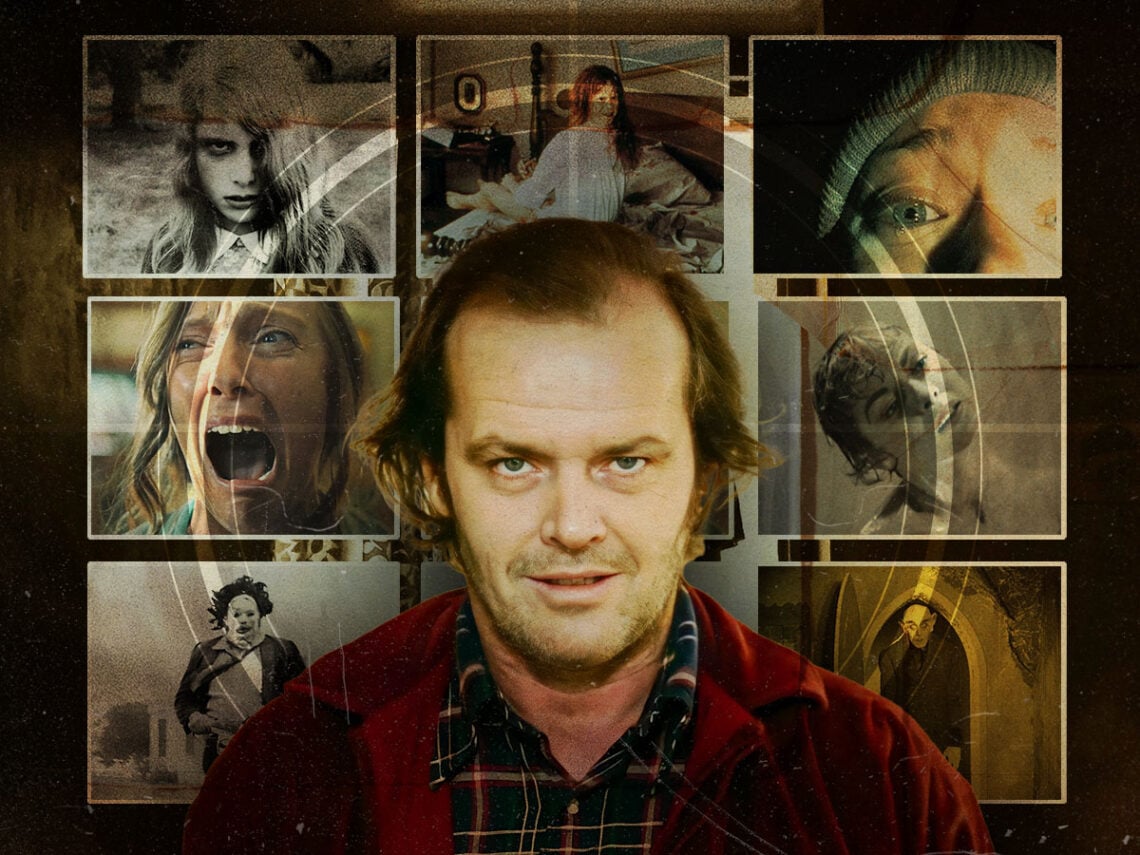
The 50 greatest horror movies of all time

Horror has existed throughout human history, used to conjure folk tales for children, keep our mortality in check, and nip curiosity in the bud. While it may now rest as part of our entertainment lexicon, the notion of using fear to keep us engaged is a tale as old as time itself.
Exploring the inner workings of our fragile, fleshy minds to the inexplicable fears of the wider universe, horror is a genre ingrained within the subconscious of the human psyche. So how did this natural reaction to some of the world’s darkest problems manifest itself as one of Hollywood’s most iconic genres?
There’s a strange thrill to being terrified, with this being self-evident when you’re on a rollercoaster, lost in the world of VR, or indeed sitting in a cinema gripping the armrests with tense fear. Though it can make us profusely sweat and keep us awake at night, horror movies have the strange capacity to bring viewers closer together, with vicious creatures, insidious spectres or axe-wielding murderers being the common enemy for movie lovers, young and old.
More of a feeling or a reaction than of a genre in and of itself, horror burrows into the fabric of everyday life, rearing its ugly head in countless sub-genres of cinema, which are each explored in our list of the 50 best horror movies of all time. Depicted in Elem Klimov’s disturbing view of WWII, Sam Raimi’s visceral, disconcerting comedies and Hideo Nakata’s Japanese moral tales, horror certainly spans many definitions.
Morphing through time, often to reflect the fears and anxieties of contemporary society, horror holds up a black mirror to the bleak realities of life itself. Whether the genre was commenting on the mounting worries of war in the 1920s, rising gender, sex and race tensions in 1960s America or the concerns of technology in the new millennium, horror has always been used to try and overcome and explain the angst of life.
Charting 50 movies from across the world of cinema, from contemporary cinema to its very dawn in the 1920s, discussing early filmmaking pioneers like F. W. Murnau to modern greats like Jordan Peele, explore our list of the fifty greatest horror movies of all time below.
The 50 greatest horror movies:
50. Black Sunday (Mario Bava, 1960)
The horror genre owes a lot to Italian cinema, specifically the work of directors like Dario Argento and Mario Bava. The latter was a pioneer of the giallo, helping to welcome more violence, sexuality, and stylishness to horror. His 1960 film Black Sunday emerged during the same year as Psycho and Peeping Tom, signalling a new era for the genre, soaked in blood and brutality. In Black Sunday, we follow Barbara Steele’s Asa Vajda, who returns from the dead after her brother kills her, seeking vengeance.
The film is both intensely violent and beautiful, with haunting black-and-white imagery framing each scene. Black Sunday had a significant impact on Italian cinema and horror as a whole, with many filmmakers paying homage to it over the years. Its use of eroticism was a significant turning point, and since its release, horror has never really been the same.
49. The Witch (Robert Eggers, 2015)
Having only directed two feature films, following a trio of short film projects, it’s truly impressive to acknowledge how much of a following that filmmaker Robert Eggers has gained following 2015s The Witch and The Lighthouse starring Willem Dafoe and Robert Pattinson.
Bringing traditional folk horror to the mainstream, Robert Eggers’ The Witch is a dread-filled countryside fairy-tale, perpetuating a feeling of vivid paranoia in 1630s New England. Where folk tales of witches were once shot in muddy, cheap grain, Eggers adopts a sharp resolution with fantastic cinematography using natural light’s limitations. It’s a beautiful, dread-soaked journey.
48. Repulsion (Roman Polanski, 1965)
Catherine Deneuve gives an incredible performance as a paranoid young woman with a fear of men in Repulsion, released in 1965. Set in London, Deneuve is a quiet young woman named Carol who lives with her sister. While her sister frequently sees a married man, Carol is repulsed by the male species, becoming incredibly suspicious and scared of them to the point of isolation. She descends into a state of madness, seeing shadows and becoming consumed by hallucinations.
Stylish and gorgeously filmed, Repulsion emerged at a time when horror was still yet to blossom into the genre we recognise today. There is no extreme gore compared to the kinds of scenes we’re used to now, but the atmosphere elicited is haunting, making the audience feel paranoid, too. Exploring the effects of trauma and the female experience, the movie has proved highly influential, most prominently inspiring Edgar Wright’s Last Night in Soho.
47. The Devils (Ken Russell, 1971)
Emphatically interested in themes of sexual repression and its subsequent effects on the human psyche, The Devils is a dramatised historical account of the life of Urbain Grandier (played by Oliver Reed), a 17th-century Roman Catholic priest accused of witchcraft.
Grim, slimy and provocative, Ken Russell’s film is a horror film elevated by Derek Jarman’s gloriously elaborate set design. In a twisted narrative that merges blasphemous terror and a compelling romance, The Devils spirals into helplessness in the final act as darkness prevails and society crumbles. Russell’s film has since become a cult classic, honouring its 50th anniversary to the sound of uproarious celebrations.
46. Hereditary (Ari Aster, 2018)
A game-changer when it comes to the contemporary horror genre, 2018’s Hereditary brought brains to a somewhat generic horror tale. But, whilst the story itself is not too extraordinary, the execution from American filmmaker Ari Aster is revolutionary.
Horrifically hopeless, dread is built upon within an intense hotbed of guilt, envy and regret with help from fantastic performances across the board, including Toni Collette, Alex Wolff and Milly Shapiro. As a single entity, that car scene is an example of horror at its very best. Aster’s follow-up, Midsommar, would cement his prominence in the contemporary horror genre, lacing his bleak narratives with strong subtextual emotion.
45. Let the Right One In (Tomas Alfredson, 2008)
Released the same year as the ‘tween’ phenomenon Twilight, Let the Right One In showed an altogether darker, more humanistic approach to the classic monster.
Part horror, part coming-of-age romance, Tomas Alfredson’s remarkable film revolves around Oskar, a bullied schoolboy, who, with the help of his new, mysterious friend, Eli, finds revenge and much more. This horror film is rooted in a love story, played out with organic aptitude by lead actors Kåre Hedebrant and Lina Leandersson. Though presenting this touching tale of young love, the film effortlessly weaves in moments of pure terror as well as marvellous artistic set pieces that will leave you conflicted about Oskar’s newfound friend.
44. Raw (Julia Ducournau, 2016)
Female coming-of-age has never been so violent than in Raw, directed by Julia Ducournau. The film explores a young woman’s transformation from being a shy vegetarian into a sexually confident cannibal after she is forced to eat raw meat as a hazing ritual. Raw is truly grotesque, with graphic scenes of the lead character eating human flesh serving as a reminder of our corporeality. As Justine discovers a love for flesh, she also enters the world of sex, and the boundaries between the two begin to blur.
Through a feminist lens, Ducournau dissects the pressures of the patriarchy and the expectations placed on women. Here, cannibalism represents intensity and an all-consuming need, with Justine transcending further into depravity as the film progresses. Raw doesn’t hide from showing the more abject elements of the female experience, daring to show us images that aren’t commonly shown in cinema. For these reasons, Raw is a truly important piece of body horror and one of the most accomplished entries within the genre.
43. Come and See (Elem Klimov, 1985)
Russian filmmaker Elem Klimov did not set out to make a horror classic when he created the war drama Come and See in 1985, but the film has since become a totem of the sheer depravity, sorrow and fear of WWII.
Klimov’s incendiary masterpiece encapsulates the horrors of humanity’s capacity for unabashed destruction through the tale of a teenage protagonist whose psyche crumbles before our very eyes. As the filmmaker stated: “It was some kind of reflection of what I felt of my own emotions at the time of the war. Or, you might say, of my wartime childhood. …These were my memories of the war. Memories that will never leave me. And I am sure that, one way or another, they were reflected in the film Come and See”. There’s a reason Klimov’s classic tops many lists of the greatest WWII movies of all time.
42. Dawn of the Dead (George Romero, 1978)
Possibly the most celebrated zombie movie ever made, Dawn of the Dead is a joyous horror-thriller that also strikes an important sociological chord, comparing the lifeless bodies of the dead to the consumerist structure of contemporary life
Urging the audience to ask questions about the ideological constructs of capitalism, religious morality, and anti-natalism, all whilst crafting a compelling, highly enjoyable watch, George Romero helped turn the zombie genre on its head. Between the scalping of zombies and the frenetic injection of a brilliant soundtrack, Romero pauses to reflect on the actual evils that threaten to destabilise our society.
41. Les Diaboliques (Henri-Georges Clouzot, 1955)
From Henri-Georges Clouzot, the director of The Raven and The Wages of Fear, comes Les Diaboliques, a horror-thriller that would have a significant impact on the shape of 20th-century cinema.
Telling the tale of a wife and mistress of a loathed school principal who decides to kill him, Les Diaboliques is riddled with suspense as it cranks towards its final conclusion. Included on Stephen King’s list of his favourite ever movies, the author told Criterion that Henri-Georges Clouzot’s film was a “suspense-horror masterpiece”, even adding the director, “out-Hitchcocked Hitchcock”.
40. Salò, or the 120 Days of Sodom (Pier Paolo Pasolini, 1975)
Often recognised in the shadows of cinema fan forums as one of the most disturbing movies of all time, Pier Paolo Pasolini’s Salò, or the 120 Days of Sodom, remains fascinating viewing—if you’re able to look past the depravity.
Set in Italy during WWII, the film follows four fascist libertines who round up nine adolescent boys and girls and subject them to 120 days of physical and mental torture. Part provocative exploitation film and part a genuinely interesting postwar analysis of Italy’s political and sociological scars, Salò, or the 120 Days of Sodom, is by no means an easy or enjoyable watch. Still, there is truly no other film quite like it.
39. Evil Dead II (Sam Raimi, 1987)
Departing from the tone of the iconic original, Sam Raimi’s Evil Dead II, turns the horror genre into a sandbox playground, injecting a good dose of manic comedy to create one of cinema’s most innovative films.
Surviving the horrific onslaught of the previous film, Ash (Bruce Campbell) becomes the leader of another group of strangers hoping to survive against the evil dead, barricading themselves inside a cabin to fight off the flesh-eaters whilst they each become increasingly insane. In Raimi’s inventive, slapstick approach to gory horror-comedy, he had subverted the bad taste of the genre like few others had ever done before. His bombastic journey into the depravities of hell’s most ghoulish and malleable creatures is campy horror fun, and equal parts grimy horror and deranged hilarity.
38. The Blair Witch Project (Daniel Myrick and Eduardo Sánchez, 1990)
The infamous found-footage horror film of the 1990s, The Blair Witch Project, was, in many ways, a literal ‘project’ that challenged the cinematic medium as well as audience expectations.
Unapologetically unsophisticated and unpolished, Eduardo Sánchez and Daniel Myrick’s film is simple, following three young film students through the woods as they try to capture footage of the urban legend, ‘The Blair Witch’. What results is a frantic dash through the Maryland wilderness with rare moments of respite as the characters become lost in a labyrinth of occult mystery? It’s a paranoid chase scene with an invisible predator and horror at its most basic, resurfacing in your mind every time you go for a nighttime stroll.
37. Kwaidan (Masaki Kobayashi, 1964)
Inspired by Lafcadio Hearn’s folk tales, Kwaidan is a mesmerising horror anthology by Japanese master Masaki Kobayashi. Kwaidan manages to capture the entire spectrum of horror by separating it into four different narratives with common subtextual elements.
A sprawling exploration of Japanese horror, each of Kwaidan’s four tales shares a supernatural theme that comes together to create a general atmosphere of true terror. As Kobayashi reflected: “I hate to sound self-aggrandising but watching my films today, they don’t feel dated. What this means is that I really spent time on the editing, but also spent a lot of time working on the whole sound of the film, including the music. So when I finished a film, it was really complete”.
36. Martyrs (Pascal Laugier, 2008)
The New French Extremity has given us some incredible yet hard-to-stomach movies, like Martyrs. Brutal and unforgiving, the film, helmed by Pascal Laugier, is perhaps one of the goriest on this list, but these graphic images are hardly there for just the shock factor. Martyrs follows a young woman who was imprisoned and abused as a child as she seeks revenge on her former captors. She arrives at their fancy home brandishing a gun, subsequently unleashing a reign of terror that takes an unexpected turn.
Laugier tests the viewer with graphic scenes that bring us face to face with our mortality, with the filmmaker exploring how far some people will go to interrogate the idea of life beyond death. Martyrs also asks questions about the needless yet widespread torture and abuse of women’s bodies, with the main character, Lucie, fighting back with ruthless energy.
35. Pulse (Kiyoshi Kurosawa, 2001)
Fears of a new digital age fuel 2001’s Pulse (Kairo), Kiyoshi Kurosawa’s horror mystery about the ever-present isolation and loneliness of the internet. It’s a movie that feels more prevalent with every passing AI-soaked day.
After the mysterious suicide of a computer analyst, two groups of people set out to uncover the truth, discovering that spirits may be invading the human world through the door of the computer screen. Using an ingeniously spine-tingling choral soundtrack, Pulse depicts a new kind of spirit. Unstable, otherworldly and utterly terrifying, their dreamlike movements brandish their mark on horror cinema.
34. Silence of the Lambs (Jonathan Demme, 1991)
The second iteration of serial killer Hannibal Lecter in cinema, Jonathan Demme’s Silence of the Lambs, is a crime thriller with serious bite with help from a delightfully shocking performance from Anthony Hopkins.
Based on the novel of the same name and series of books following the serial killer from author Thomas Harris, Demme’s film tails along with a young FBI cadet seeking help from an incarcerated cannibal in an effort to track down another vicious serial killer. With a central plot that is palpable in tension, Hopkins’ performance drives the drama, fueling the film as it propels at a terrifying pace. Lecter’s piercing, unwavering stare consumes the young FBI agent, played by an excellent Jodie Foster, making for a heart-palpating conclusion featuring characters you cherish so closely.
33. The Descent (Neil Marshall, 2005)
A cinematic achievement on the smallest of scales, The Descent portrays horror at its very best and most simple: a claustrophobic fear of the unknown.
During a weekend retreat, a group of cave explorers become trapped in a strange network of caves that seem to harbour a breed of scuttling predators. Part monster film, part a claustrophobic person’s worst nightmare, the real horror of Neil Marshall’s film is in the sense of isolation that is cleverly created through the sound and cinematography. Dialogue echoes around the dripping, rocked walls as our eyes scramble for a way out, bound only to the limits of the torchlight, creating a squirming, tense and highly uncomfortable atmosphere.
32. REC (Jaume Balagueró and Paco Plaza, 2007)
Inspired by Danny Boyle’s sprinting horrors in 28 Days Later and the British director’s innovation of iconic monsters, Jaume Balagueró and Paco Plaza’s REC formed together with its own ingenious take on the zombie sub-genre.
Truly innovative, REC plays out in real-time following a TV reporter and a group of firefighters who report to a mysterious disturbance at a block of flats. What conspires to be the result of occult medical science, REC spirals into a grungy, dirty take on the infected undead, helping to consolidate the zombie infatuation of the mid-late noughties. It’s a film that creates a tangible panic and a snappy sense of ‘fight or flight’ urgency like no other.
31. Videodrome (David Cronenberg, 1983)
Possibly David Cronenberg’s most notable and most acclaimed movie, Videodrome, is a thrillingly sleazy judgement on new media and an entertaining conversation into what the technological future may have in store.
Though, of course, any technological future that Cronenberg suggests would never be as disorientating and bizarre as the one presented in Videodrome. Searching for a new kind of show for his seedy cable TV station, a programmer becomes obsessed with a mysterious broadcast and a new reality named ‘Videodrome’. Typifying the style and extravagant nature of 1980s filmmaking, Cronenberg’s film is a visual rollercoaster that utilises the very best effects of its time. This is a director at the crux of his career, flexing his muscles to show off the body-horror ingenuity that would go on to typify his filmography.
30. Hellraiser (Clive Barker, 1987)
Grimey, disgusting and wonderfully creative, Clive Barker’s cult classic horror film Hellraiser is a punk joyride across the depths of hell, featuring one of the most iconic villains of all time in the hideous Pinhead.
Described by Stephen King as “the future of horror”, Hellraiser follows the story of a woman who begins to kill for her recently resurrected brother-in-law so that he can escape the horrors of the underworld. It’s a bizarre, bombastic plot that well combines genuine terror and entertaining pulpy visuals, typified by the eclectic Cenobites, extradimensional beings who exist in a horrifying realm of dread.
29. The Omen (Richard Donner, 1976)
The original and arguably best horror movie minion, child, and spawn of the devil, Damien, leads Richard Donner’s highly enjoyable satanic treat, The Omen. If you’re a child of the 1990s and acted up in front of your parents for too long, there’s a good chance you were about to be labelled “Damien” at some point.
From the shocking suicide of Damien’s nanny to the hair-raising final shot, Donner’s film contains several iconic moments that would inspire a genre to come. Surrounding the life of the American ambassador of the UK and the mysterious deaths that stalk him every day, The Omen explores the horror and paranoia of knowing (or not knowing) that your own son may be the antichrist. It’s a wild ride.
28. A Nightmare on Elm Street (Wes Craven, 1984)
Wes Craven’s fleshy supernatural slasher is a creative masterpiece of the subgenre. It creates one of cinema’s most subversive and iconic villains, Freddy Krueger. For that reason alone, it deserves recognition as one of the true greats of horror cinema.
Starring a young Johnny Depp, Craven’s film follows the evil spirit of Freddy Krueger, a deceased child murderer who seeks revenge from the grave on the children of those who sent him to his death. Featuring revolutionary, grungy special effects and a truly unique sinister entity straight from the camp underworld, A Nightmare on Elm Street is one of the slasher genre’s best and most unsettling movies.
27. Peeping Tom (Michael Powell, 1960)
A favourite filmmaker of director Martin Scorsese, Peeping Tom by Michael Powell is a well-known great of British cinema.
Having also helmed A Matter of Life and Death and Black Narcissus alongside longtime collaborator Emeric Pressburger, Powell’s Peeping Tom is among the director’s most provocative and innovative films, providing a shocking statement on the act of cinematic voyeurism that is arguably way ahead of its time. Starring Karlheinz Böhm and Anna Massey, the film follows a serial killer who murders his victims using a film camera to capture their expressions at the very moment of death. Disturbing and ingeniously shot, Peeping Tom is a classic of 1960s horror.
26. 28 Days Later (Danny Boyle, 2002)
Before 2002, zombies were idiotic meat parcels, pinatas of guts, goo and copious blood for characters to rip apart and stick into blenders. Granted, the terrifying, infected monsters that sprint around the city of London in 28 Days Later may not technically be zombies, but the film certainly changed the way we looked at the undead.
Danny Boyle’s landmark debut horror movie is a visionary masterpiece with help from a terrific script from Alex Garland, which not only establishes an apocalyptic London with deft imagination but also manages to contain an excellent, isolated story within the world itself. Waking up from a coma to the windswept tumbleweed of central London, Jim (Cillian Murphy) staggers through the city, searching for survivors and sanctuary. It was a zombie movie that would change everything.
25. An American Werewolf in London (John Landis, 1981)
Teetering the borderline between horror and comedy is no easy feat. If it is too funny, the horror will be ridiculed. If it is too grisly, the comedy could be seen as sadistic. John Landis’ An American Werewolf in London perfectly tows this line, miraculously producing a film both unforgettably disturbing and joyously camp.
A predecessor to late-1980s horror-comedy classic Evil Dead II, Landis’ film is the genre’s grandfather, following the tale of two American college students who are attacked by a mythical werewolf while walking tour of Britain. However, this brief description does a disservice to the wide breadth of chaotic imagination that Landis creates. Featuring one of cinema’s greatest-ever transformation sequences in a true feat of practical effects, as well a satisfyingly strange scene of a Nazi mutant house invasion, this is true horror at its most playful.
24. Invasion of the Body Snatchers (Phillip Kaufman, 1978)
Often, the very best of sci-fi horror takes an outlandish, unfathomable cosmic horror and reigns in toward Earth, embedding the terror within a deeply humanistic story. Playing on fears of paranoia and of the ‘other’, Phillip Kaufman’s 1978 version of Invasion of the Body Snatchers is a perfect example of this, embedding fear within the intentions of an unknown evil.
Based on the book by author Jack Finney, Kaufman’s film stars cult favourites Donald Sutherland, Jeff Goldblum and Leonard Nimoy as a solitary group fighting against the invasion of strange cosmic seeds, turning the population into emotionless automatons. Equally enjoyably camp and eerily disturbing, Invasion of the Body Snatchers, fits snugly into that groove. When cosmic horrors are so difficult to translate from page to film, screenwriter W.D. Richter evocatively brings the body snatchers to life, with some truly horrifying special effects and sound design to boot.
23. The Cabinet of Dr Caligari (Robert Wiene, 1920)
The silent era might not have been able to provide us with ominous sound design, scores, or appropriate sound effects, but as a result, many filmmakers from this era placed significant emphasis on set design and visuals. This is certainly the case for The Cabinet of Dr Caligari, a key work of German Expressionism. Directed by Robert Weine in the aftermath of World War One, the film is full of haunting images, with surreal, angular backdrops and dramatic lighting, giving it an unnerving quality.
The movie was highly influential upon its release, not just because of its visuals but also because of its compelling narrative and plot twist ending. Dr Caligari follows a deranged hypnotist as he uses a somnambulist named Cesare (very much a proto-goth) as his puppet to commit heinous crimes. It’s a gorgeously executed film exploring obsession, violence, guilt, authority, and power.
22. Scream (Wes Craven, 1996)
Wes Craven doffs his cap to the very horror genre he helped to create with Scream, his final masterpiece, heralding in the reign of a brand new genre icon, Ghostface.
Satirically twisting the horror genre conventions, Craven would kill off the film’s biggest name, Drew Barrymore, within the first sequence of the film, letting you in for 110 minutes of pure surprise. The story is relatively predictable, and purposefully so, following a teenage girl and her group of friends, stalked by a serial killer using horror movies as inspiration for his murderous acts.
With all its twists, turns and misdirection, Scream is thrilling to its very core, pedalled by a leading cast reaping obvious enjoyment from the inspired script. Matthew Lillard, take a bow.
21. Nosferatu (F. W. Murnau, 1922)
The oldest film on this list by quite some way, the original vampire horror film from F. W. Murnau, the same mind behind The Burning Soil and Sunrise, may perhaps be the most influential horror film of all time.
As Roger Ebert once said, “To watch Nosferatu is to see the vampire movie before it had really seen itself,” with the film representing ambitions and narrative driveway beyond its limited technological advancements. Despite technically not being a Dracula film at all, its use of Expressionistic lighting and cinematography, along with the performance of Max Schreck as the titular beast, makes the film a quintessential classic of the genre.
20. Ringu (Hideo Nakata, 1998)
Spawning sequels, spin-offs, remakes and re-releases, Ringu and its following series has become a horror trailblazer for all things grungy, supernatural and long-black-haired. Centred around a mystical VHS tape that carries the curse of a young, bedevilled girl and the dark promise of death after seven days, the film birthed a new fear of technology and was, for many western audiences, their first taste of Asian horror. Its influence has been evident ever since.
Whilst ghosts and curses used to inhabit spaces of the home, spaces of particular objects and even the spaces of one’s own mind, Ringu suggested that it might exist in the questionable realm of television and marvellous new technologies. The film was a cultural question of how trustworthy technology truly was, particularly television. It’s a truly terrifying concept that cinema, let alone the horror genre, had never seen before – a dark, demonic, impossible spirit that you couldn’t evade and was futile to fight against…
19. Get Out (Jordan Peele, 2017)
Although it is one of the newer movies on this list, it is safe to say that Get Out has firmly cemented its legacy in the horror genre in the years since it was released. The movie, directed by Jordan Peele, cleverly blended humour and relevant social themes like racism and white supremacy with genuine moments of terror. It proved to be Daniel Kaluuya’s breakthrough into Hollywood, with the actor giving a stunning performance as Chris, a black man who goes to stay with his white girlfriend’s family, only for all hell to break loose.
Chris instantly notices that something is off when he meets Rose’s family for the first time, and soon, he realises that he has to escape. It’s a thrilling film that doesn’t just aim to scare – it also serves as a potent reminder that racism is much further woven into American society than many people realise. Get Out challenges the idea that racists look and act a certain way, which is the true horror of Peele’s incredible film.
18. The Innocents (Jack Clayton, 1961)
A favourite of Goodfellas and Killers of the Flower Moon director Martin Scorsese, The Innocents is a classic, creeping thriller that remains effective thanks to its timeless lead performances.
Starring Deborah Kerr as Miss Giddens, the ghost tale tells the story of a young governess for two children who becomes convinced that a sinister presence haunts the grand house and grounds. An eerie, well-realised gothic horror tale, Jack Clayton’s The Innocents remains a classic for good reason, perfectly bottling tension through its remarkable cinematography, inspired set design and impressive child performances from Martin Stephens and Pamela Franklin.
17. Possession (Andrzej Żuławski, 1981)
A visually stunning 1980s masterpiece, Possession celebrates its 40th anniversary in 2021 and looks as though it could quite easily exist in the landscape of contemporary psychological horror.
Directed by Andrzej Żuławski and starring Isabelle Adjani and Sam Neill, Possession echoes with the inspiration of Roman Polanski’s Repulsion in its depiction of a psychological breakdown following the divorce of Anna (Adjani) and Mark (Neill) and the sinister fallout of the relationship. A classic of 1980s horror that defied the popular slasher zeitgeist, Possession was fuelled by the horror innovations of David Cronenberg’s The Brood and David Lynch’s Eraserhead to create something entirely new.
16. The Thing (John Carpenter, 1982)
Master of cult cinema, John Carpenter’s remake of the 1951 film The Thing from Another World, itself based on John W Campbell Jr novella Who Goes There?, is a pioneer of cosmic horror storytelling; deftly entwining the terror of man’s paranoid struggle with the inconceivable horror of the unknown.
Set within an isolated Antarctic research facility, The Thing follows the activity of a cosmic being that perfectly assimilates its prey, infiltrating the team of scientists and taking them out one-by-one. With help from the groundbreaking monster design by special effects artist Rob Bottin, The Thing exudes a shocking terror that remains slimy, gruesome, and disturbing to this very day. A compelling thriller with more than a few doses of stomach-churning horror, Carpenter’s film is a masterpiece of suspense typified by an ominous climactic scene that radiates a perpetual paranoia even after the credits roll.
15. Carrie (Brian De Palma, 1976)
Though many films explore the many fears that come with high school, many of these stories stem from the horrors presented in Carrie, particularly its blood-soaked third-act sequence.
Based on the original novel from literary horror aficionado Stephen King, Carrie is a fantastical tale of grief and discrimination following a shy, lonely teenage girl with a domineering, pious mother and surprising telekinetic powers. Led by fantastic performances from Sissy Spacek as the frail, unstable titular character and Piper Laurie as her truly terrifying, possessed mother, Carrie is in many ways a tragedy, following a lonely and betrayed central character. Carrie’s journey is a metamorphosis fueled by teen-angst that results in a pivotal violent outburst and one of horror’s greatest scenes.
14. Audition (Takashi Miike, 1999)
Takashi Miike isn’t unfamiliar with the explicitly disturbing and is renowned for his frank and blunt approach to sex and violence. Audition is no different, taking the word ‘disturbing’ to new cinematic heights.
In this strange tale of a widower auditioning local women to be his new wife, Miike crafts a slow burner that patiently culminates into a gripping drama. However, behind the curtain, something far more sinister is brewing, delivering one of cinema’s most surprising and most uncomfortable tonal deviations. Few films can imbed themselves into the minds of every viewer, though one particular image in Audition is so shocking and so instantly disturbing that it will inhabit the shadowed corners of your mind for long after you’ve turned it off.
13. Alien (Ridley Scott, 1979)
Together with the titular Jaws in Steven Spielberg’s 1975 masterpiece, Ridley Scott’s Alien created the blueprint for every great monster movie. The crux? Using tension as a tool, gradually cranking it up with every glimpse of the monster at hand—as sometimes what’s scarier is the mere suggestion that something is there. A fin above the water in Jaws, or the cosmic shriek of the Xenomorph in Alien.
A mere merchant vessel floating through space in the year 2122 AD, the Nostromo crew picks up a distress call from an unknown transmission and, after following it, becomes the vulnerable prey of a deadly alien. Ridley Scott’s iconic science fiction nightmare owes its popularity to a number of different ingredients that each blend effortlessly, thanks to the simplicity of the story at hand. This is a game of cat and mouse between the Alien and the crew, a space in which fighting back seems futile, and the only option is to run. An unbearable tension is built up with the simplicity of just a few moving parts, and no less from the visionary art direction from H.R. Giger, giving the ship itself a flabby, fleshy life of its own and the Xenomorph an alarmingly sickening presence. A modern classic, Ridley Scott’s film is one of the scariest, most intense film experiences and is an antecedent to contemporary sci-fi horror.
12. Jaws (Steven Spielberg, 1975)
Whilst horror can often deal with the abstract and psychological, it can also consolidate physical fears and even embellish them, with Steven Spielberg’s film Jaws planting a fear of sharks into the minds of a whole cultural generation.
Dealing with the deep, dark blue of the unknown, Speilberg’s classic horror-drama stalks the activity of a killer shark causing chaos in the waters of a local beach community. Featuring groundbreaking cinematography that places the viewer within the shark’s gaze, just beneath the break of the water’s surface, Jaws creates an unprecedented tension that screams of inevitable bloodshed. Considering the film’s soft PG rating and relative lack of visceral violence, the terror it has created of the deep dark blue for a whole western culture is staggering.
11. Eyes Without a Face (Georges Franju, 1960)
Inspiring countless remakes and reimaginings, including Pedro Almodóvar’s The Skin I Live In and Holy Motors from Leos Carax, Georges Franju’s iconic French horror film is a classic of European horror.
Detailing the story of a surgeon who causes an accident that leaves his daughter disfigured, the tale takes a dark turn when the doctor tries to create a new face for the young girl, spiralling into a moral tale of vanity and parental responsibility. A favourite of director Guillermo del Toro, Eyes Without a Face isn’t a terrifying film, though it is a deeply unsettling one, asking the audience to consider the mentality of an individual trapped behind a mask, saved and held captive by their father.
10. Don’t Look Now (Nicolas Roeg, 1973)
Nicolas Roeg’s Don’t Look Now is a psychological horror like no other, exploring the concept of grief with tormenting suspense, and the film was the subject of much controversy for an infamous scene that was more sensuous than scary.
Donald Sutherland and Julie Christie’s John and Laura Baxter try to process the grief of losing their daughter by working through it, taking them to Venice, where the heartbroken couple begins restoring a crumbling church. However, an eerie warning from an elderly clairvoyant accelerates their descent into despair.
Building uneasy suspense through its haunting, outlandish, and surrealist imagery and running afoul of the censors for its graphic sex scene, Don’t Look Now crafts a bizarre deconstruction of grief and tragedy that chills to the bone, with the eerie symbolism of a life lost but never forgotten capped off by one of horror’s most jaw-dropping twist reveals.
9. Suspiria (Dario Argento, 1977)
When style defeats substance, emotion over reason takes the president. After all, often, the ensemble of clever sound design and emotionally resonant cinematography can do a lot more in translating a particular feeling than words could ever do.
One of horror’s foremost stylists, Dario Argento, concocts a fantastical dreamscape of saturated reds and neon blues in Suspiria, the Giallo maestro’s magnum opus. Set in a German ballet academy, Suspiria tracks an American interloper who soon realises that something desperately strange and unnervingly sinister is unfolding behind the velvet curtain of the theatre.
It might be style over substance to a certain extent, but Suspiria revels in its indulgent outlandishness, combining clever sound design and eye-popping cinematography with an atmosphere of dread-laden mystery that’s hard to shake long after the credits roll.
8. Night of the Living Dead (George A Romero, 1968)
The importance of George A Romero’s Night of the Living Dead is best illustrated by the fact that there was zombie cinema before the splatter merchant’s breakthrough, and then there was everything that came after.
A simple, classic siege narrative houses the film, set in a Pennsylvanian farmhouse where a ragtag group barricades themselves against the flesh-eating, brain-hungry walking dead. Given the shoestring budget and near-total lack of visual effects, it’s no mean feat that Night of the Living Dead remains a gripping horror tale, especially when compared to the high-budget standards of contemporary zombie moviemaking. Moreso than its pioneering imaginative spirit, however, was the social commentary that lay beneath its foundations, making it more than a midnight movie, becoming an important piece of American cultural history instead.
It was more than a trailblazer for zombies on celluloid, though, but an engaging showcase for what would soon become Romero’s signature, combining high-stakes and spine-tingling terror with resonant social commentary and cultural insights.
7. The Exorcist (William Friedkin, 1973)
When it comes to popular media, the 1970s was a far more innocent time. In America, despite the horrors of the Vietnam War overseas, nudity was still considered taboo and shocking on public television screens, and the slasher-movie phenomenon of the 1980s was yet to spill depravity onto cinema screens worldwide. As a result, in a similar way to which audiences ran from The Arrival of a Train in 1896, in 1973, people fainted, experienced anxiety, and even reportedly suffered heart attacks from The Exorcist.
The first horror movie to be nominated for ‘Best Picture’ at the Academy Awards and the highest-grossing R-rated release in cinema history at the time, The Exorcist was a full-blown cultural phenomenon.
William Friedkin’s film, based on the novel and screenplay from author William Peter Blatty, is in part a dark tale of a young girl transitioning into adulthood with intense painful trauma, and on the other hand, a satanic possession story about two priests questioning their faith to save the same girl. These two elements marry together with perfection to explain why Friedkin’s film is such a timeless classic, defining the horror of a generation marred by the Vietnam War.
Punctuated by the flickering, ethereal soundtrack of the tubular bells acting as a religious omniscient overseer, the film achieves an eerie, unsettling tone with effortless ease. Layered atop of groundbreaking special effects, bringing a satanic Linda Blair to life, as well as a rich subtext of growing women’s independence, The Exorcist’s longevity and impression on horror cinema make it a classic of the genre.
6. Rosemary’s Baby (Roman Polanski, 1968)
The best horror movies tap into the intricacies of the human condition, whether it’s something as abstract as the angst of existentialism or the mental paranoia of an imminent physical change, something Roman Polanski mastered with Rosemary’s Baby.
On the surface, it’s the simple story of a young couple who move into a New York City apartment to begin the next chapter of their lives, only for things to quickly take a turn for the terrifying when Mia Farrow’s title character falls pregnant.
Her neighbours take a keen interest in the expecting mother, and Polanski never passes up the opportunity to turn the screws, instilling Rosemary’s Baby with the slow, subtle, power of suggestion and a growing sense of paranoia that seeps into the audience just as much as it does Farrow’s protagonist.
5. The Shining (Stanley Kubrick, 1980)
In his astonishing cinematic career, which covered several genres, it was Stephen King’s horror novel The Shining that piqued director Stanley Kubrick’s interest, leading him to create one of the greatest movies of the genre.
Set in the magnificent, fictional Overlook Hotel, located in the Colorado Rockies, the tale follows Jack Torrance (Jack Nicholson) and his family, who opt to look after the hotel over the winter. Dwarfed by the towering presence of the hotel, however, Jack soon becomes engulfed by an evil, violent presence, influencing his temper toward his wife and psychic son. Several fantastic performances notably punctuate this chilling, isolated exploration of madness, Jack Nicholson, whose cruel psychotic descent is one of the very best put to screen, and perhaps more so, Shelley Duvall, radiates an unrivalled physical fear, coming undoubtedly as a result of her taxing time on set.
While this terror likely felt very real to Duvall, the reason the movie works so effortlessly as a slow-moving, dread-inducing creep machine is that it is deeply unsettling. There are certainly flashpoints of unbridled horror, but once the credits roll, the inescapable sense of psychological anguish lives for the longest in the soul.
4. Halloween (John Carpenter, 1978)
Introducing one of cinema’s first-ever slasher killers, Halloween is perhaps the genre’s most influential release, leading a whole sub-genre into the late 20th century kicking and screaming in fear.
With a blank, white rubber mask, Michael Myers (a name as starkly fearful in the genre as Freddy or Jason) wreaks havoc on a small Illinois town following his escape from a mental hospital. A town as defiantly postcard-American as David Lynch’s Blue Velvet, John Carpenter’s Halloween brought a sense of unease to every small US suburb, suggesting something fantastically abnormal could be lurking in the shadows.
Setting the standard for modern horror cinema, Carpenter’s film is underscored by his own, timeless creeping score—a synth-led nightmare that has you instinctively checking over your shoulder. While the movie’s sonic structure would lend itself to countless other pictures with a similar premise, Carpenter’s can stand strong as a cinematic revelation as final as the legacy he left with these movies. Simply put, without this movie, the whole concept of horror would look very different.
3. The Wicker Man (Robin Hardy, 1973)
The fear of the ancient and inexplicable in an ever-ordered world is a staple theme of folk horror. It’s a theme which underpins the pioneers of the sub-genre, from Witchfinder General to Ari Aster’s Midsommar, but no film better realises this than Robin Hardy’s The Wicker Man.
Hardy’s film about a catholic police sergeant named Howie who travels to a Scottish island to solve the mystery of a missing girl is a chiller that speaks to the very core of the human condition. From the moment Howie steps on the island, he is unknowingly trapped in the performance of the townsfolk—a pawn in their latest ritual. It is this central fear of ignorance, of never really knowing what is going on and never really feeling safe as a result, that The Wicker Man emanates so well.
Suddenly, the idea of walking through a secluded, quaint countryside village doesn’t seem so jolly. Now, as the heads peer over the hedges or curtains twitch in the corner of your view, you will always be wondering whether you are set to become the next toasted sacrifice of a bygone druid system, hell-bent on using a virgin’s blood to fertilise their crops.
2. Psycho (Alfred Hitchcock, 1960)
Alfred Hitchcock, ‘The Master of Suspense’, likely earned his rightful title from his 1960 film Psycho, a psychological thriller years ahead that subverts the genre’s clichés and leaves you on tenterhooks until its shocking and now infamous final sequence.
Hitchcock’s classic follows a young man named Norman Bates who, under the strange domination of his mother, runs the everyday functioning of the ‘Bates Motel’, a secluded hideaway where a young woman evading the law finds herself trapped. A masterclass in tone and sustained suspense, Hitchcock elevated the then ‘trashy’ horror genre into what it looks like today, validating its existence by toeing the line between thrilling terror and well-constructed art. This terror is heightened by an iconic soundtrack, a hellish staccato theme, stabbing itself with every beat into your mind and mentality.
If you wanted any indication of just how enigmatic this movie is, then all you need to do is deliver those notes to a room full of people and watch as they mime the suds-soaked death it is attached to. While some pictures come and go, others are woven into the fabric of our culture, never to be removed. Psycho is certainly one of those.
Its position as one of the foundational stones of the genre we now know as horror may be a good reason for its placement on our list, but the cataclysmic effect it has had on the silver screen is only one reason—it’s also a fantastic movie.
1. The Texas Chainsaw Massacre (Tobe Hooper, 1974)
Whereas with many horror movies, including some on this list, directors are often bound to the walled limits of its celluloid boundaries, in the case of Tobe Hooper’s The Texas Chainsaw Massacre, a certain tone is achieved that is so visceral that it transcends the limits of the screen—it infects your mind and environment and intends to stay for several hours.
Framed as a true story upon its release in the mid-1970s, despite its near-complete fiction, the film follows two siblings and three of their friends who fall victim to Leatherface and his cannibalistic family after venturing into the baron Texas countryside. Captured on a budget 16mm camera with fine grain, Hooper’s film manages to acquire a suffocating tone, documenting a living nightmare of raw, brutal authenticity. Upon many of the main characters’ capture and demise, we venture into Leatherface’s family home, a desolate wooden shack with a fog of hopelessness and impending doom. The dank stench of the rotting walls wafts through the film itself and throughout a house stained with blood and dirt. It’s one of cinema’s greatest, understated pieces of set design.
There’s no crescendo, no fancy camera work or piercing soundtrack when Leatherface, a snarky, dribbling villain, captures his victim, only his terrifying victorious pig squeal that sends a grotesque shockwave down the spine. His equally despicable family join him in his torture, a band of unkempt, greasy maniacs that in one particularly horrific dinner table scene, evoke an almost fantastical quality, as if they’re so repugnant and depraved that they somehow inhabit a different plane of existence, typified by a grandfather impossibly clinging to life through his wrinkled white skin.
It all leads to a strangely beautiful ending, an ode to mindless chaos and destruction, showing the sunset on Leatherface’s brutal murders but also the sunrise on a new dawn for horror cinema. It’s easy to forget just how mind-bendingly provocative this picture was when it came out and, in turn, how deeply it changed the entire (gruesome) face of cinema. Without even considering the gore, the villain, or the unique plot, Texas Chainsaw Massacre is, without a doubt, the ultimate horror movie.
