


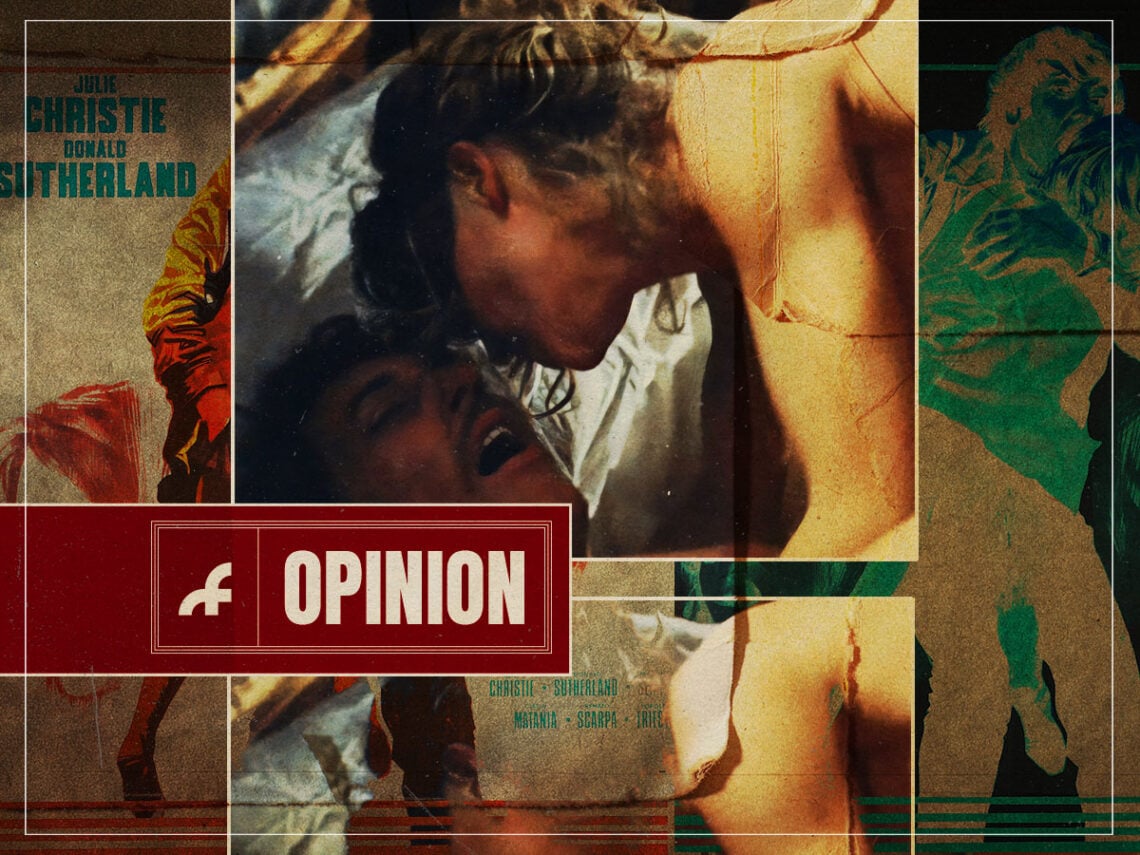
Hear Me Out: ‘Don’t Look Now’ has the best sex scene in cinematic history

Nicolas Roeg’s 1973 film Don’t Look Now is difficult to categorise. Part horror movie, part tragedy, part mystery, it stars Donald Sutherland and Julie Christie as John and Laura Baxter, a British couple who travel to Venice following the sudden death of their young daughter so that John can help restore an ancient chapel. When they meet an elderly woman who claims that their daughter is trying to contact them from the dead, Laura’s grief is turned to hope, while John, dismissive of the strange woman, begins to have terrifying visions of his own. The film is known for its innovative use of editing and the visual motifs that appear throughout the story. The colour red—the shade of the raincoat worn by the couple’s daughter when she died—crops up in seemingly every frame, while John’s visions are an early example of precognition editing, in which the future is revealed in flashes throughout the movie.
Another element that Don’t Look Now is known for is an infamous sex scene between the Baxters that takes place about a quarter of the way through the film. Its frankness horrified ratings boards when they saw it, causing the US to slap it with an R rating and the UK to give it an X certificate. The controversy was only intensified when rumours swirled that the sex was unsimulated. In 2011, producer Peter Bart added fuel to the fire by stating in his memoir, Infamous Players: A Tale of Movies, the Mob (and Sex), that he had been on-set and was shocked to see that “they were fucking on camera”. Given the salacious title of his book, perhaps it isn’t surprising that Bart would want to follow through with some spicy gossip, but as far as everyone else involved with the film was concerned, there is no truth to it. Only Christie, Sutherland, Roeg, and cinematographer Anthony Richmond were on set and denied his assertion.
The reason the speculation arose in the first place is that the scene is remarkably intimate. It takes place after the couple has spent the day together in Venice and after Laura has had her first encounter with the elderly woman. Laura and John have been together all day, but there is an almost shy distance between them. Following the loss of their daughter, they are coping in different ways, and their emotional bond has thinned, even if they show no signs of actual tension. When they return to their hotel room, John takes a shower while Laura takes a bath. Alone in the bathroom together, they seem comfortable in their nakedness, a couple who has been together long enough to feel no sense of embarrassment or automatic arousal in their natural state.
They lie in bed, reading the newspaper together. Laura is dressed, and John is still naked. When she tentatively runs her fingers down his back, he starts to undress her. The ensuing scene lasts for more than three minutes and, according to Sutherland, was filmed in only 15 to 20-second takes, with Roeg instructing the actors on how to reposition after each one. Instead of simply showing a longer take from an objective vantage point as if the audience were positioned next to the bed, the camera is with the couple, alighting on different sections of their bodies, taking a perspective that is private rather than voyeuristic. What makes this scene the greatest depiction of sex in film history, however, is how Roeg inter-cuts the sexual intimacy with shots of the couple getting dressed afterwards.
It’s one of the rare instances in the film when precognition editing is used to promote a sense of warmth and intimacy rather than dread and tragedy. Even in other films that use this editing style, such as The Shining and Arrival, it is employed to unsettle the audience and stoke a sense of eeriness. This one three-minute period, however, demonstrates, in a way that dialogue couldn’t, the comfort and tenderness that remains between the couple even if they can’t articulate the grief that still hangs around them. Adding to the effect of the editing is the use of sound. Instead of using heavy breathing or moving bed sheets, the sequence is completely silent except for the soft, melancholy notes of an oboe, adding to the sense of privacy and seclusion.
Even now, more than a half-century after Don’t Look Now was released, this scene is unprecedented. For decades in the early part of the 20th century, sex on screen was expressly prohibited, and when the Hays Code was finally scrapped in favour of the ratings system in the late 1960s, filmmakers were eager to shock conservative audiences with the horniest imagery they could pull together. With the ongoing obsession with unattainable beauty and fantasy, sex in the movies continues to be dominated by gauzy, sanitized, utterly implausible sequences of pseudo-intimacy.
On the converse side, some filmmakers use these scenes as a way to provoke through explicitness, sometimes by capturing unsimulated intercourse. For all its merits, even a film like Yorgos Lanthimos’ Poor Things fails to use sex in a meaningful way, instead treating the scenes first as a training montage of sorts and then as a comedic interlude – a quick opportunity for Lanthimos to add a bit more of his characteristic absurdity to the proceedings.
In contrast, the sex scene in Don’t Look Now is still (sadly) just as subversive today as it was 50-plus years ago. It doesn’t aim for shock value or titillation. It tells an integral part of the story. In musicals, it is the songs that express the part of a narrative that cannot be adequately conveyed through dialogue or literal action. In Don’t Look Now, it’s a scene that is both explicit and impressionistic, a roadmap to how sex can be used cinematically to reveal depth of character and story that even the most expertly crafted script cannot. It’s our loss that no filmmaker has met its high watermark since.
