


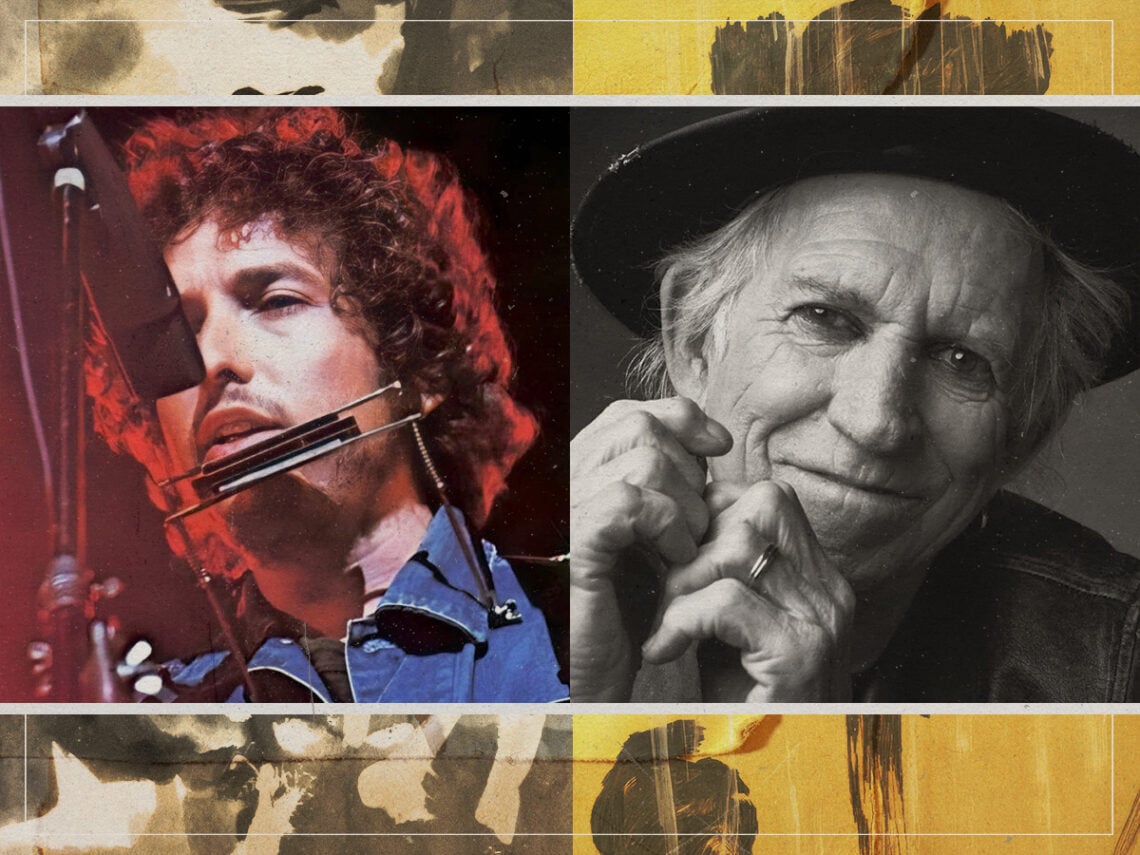
The three Bob Dylan songs Keith Richards thinks form a trilogy

When The Rolling Stones formed in 1962, Bob Dylan was already making his first steps as an acoustic folk musician. After idolising Woody Guthrie for several years, he was a competent guitarist and harmonicist with a nasal, yelping voice primed for countercultural revolt. Though his style differed from the Stones’ electric blues, this gulf would soon narrow.
After capturing the hearts and minds of a young generation horrified by the Cuban Missile Crisis with poignant politically-trusted songs like ‘Masters of War’ and ‘With God on Our Side’, Dylan began to reconnect with his teenage fascination with rock ‘n’ roll. Starting with Bringing It All Back Home and a divisive performance at the Newport Folk Festival in 1965, the young star began to “go electric”.
Despite a minority of alienated folk purists, Dylan’s embrace of folk-rock garnered an even greater global audience for Dylan. The more textured, electric sound coincided with a peak in Dylan’s creative songwriting in a trilogy of albums: Bringing It All Back Home, Highway 61 Revisited and Blonde on Blonde. These albums featured songs with more abstract, Beat Generation-inspired lyricism and a more generalised portrait of the status quo.
While Mick Jagger and Keith Richards paid attention to Dylan’s early material, they could make more of a connection with his blues-infused folk-rock. Jagger has long been a fan of Dylan’s work as a budding singer and lyricist and believes that the Highway 61 Revisited closer, ‘Desolation Row’ is among the finest songs ever written. “Desolation Row’s lyrics are just so interesting and diverse. It isn’t a real street so you create your own fantasy,” he once said of the song. Adding, “You can listen to it all the time and still get something wonderful and new from it.”
Similarly, Keith Richards was a fan of Dylan from the get-go. However, in 1966, he seemed to target Dylan’s seemingly nonsensical lyrics and their blind, young disciples. “Whatever these sweet young things who dig Dylan say, I bet they don’t understand much of what he is doing,” Richards said. “We play a lot of his LPs, Brian and I, and quite a lot of his lyrics don’t mean anything to us. I have nothing against Dylan or Donovan but I’m sick to the back teeth about the characters who are just climbing on a craze that think they can make quite a fortune.”
Over time, it appears that Dylan’s abstract lyrics began to click for Richards. “I love Bob,” he professed in 2015 before praising the old-timer’s remarkable work ethic. Four years prior, the Stones’ guitarist took part in a feature with The Guardian to discuss ‘Girl From the North Country’ as his favourite song of Dylan’s. As a classic from the folk era, this suggests that Richards still favours Dylan’s more tangible songwriting.
“It’s got all the elements of beautiful folk writing without being pretentious,” Richards noted. “In the lyrics and the melody, there is an absence of Bob’s later cutting edge. There’s none of that resentment.” The Stone also revealed that he was a big fan of the reimagined version of the song, a beautiful duet with Johnny Cash, which Dylan released on his 1969 album Nashville Skyline.
Still, as far as Richards is concerned, there’s nothing quite like the original from 1963’s The Freewheelin’ Bob Dylan. He recalled listening to Dylan’s classic second studio album and noticing – or quite possibly imagining – a link between three different songs. “In a way, I see ‘Girl From the North Country’, ‘Boots of Spanish Leather’ and ‘To Ramona’ as a trilogy,” Richards continued. “Is Ramona the girl from the north country? Is she the same chick who sends the boots of Spanish leather? There’s some connection between them.”
Richards could well be onto something there, given that the fingerstyle guitar progression heard in ‘Boots of Spanish Leather’ is almost identical to that in ‘Girl From the North Country.’ “It’s like an extension of the same song,” Richards added. “Before he went electric and submitted himself to that relentless discipline of a rhythm section, there was a beautiful flow in Bob’s songs that you can only get with just a voice and a guitar.”

Never Miss A Tale
The Far Out Bob Dylan Newsletter
All the latest stories about Bob Dylan from the independent voice of culture.
Straight to your inbox.