


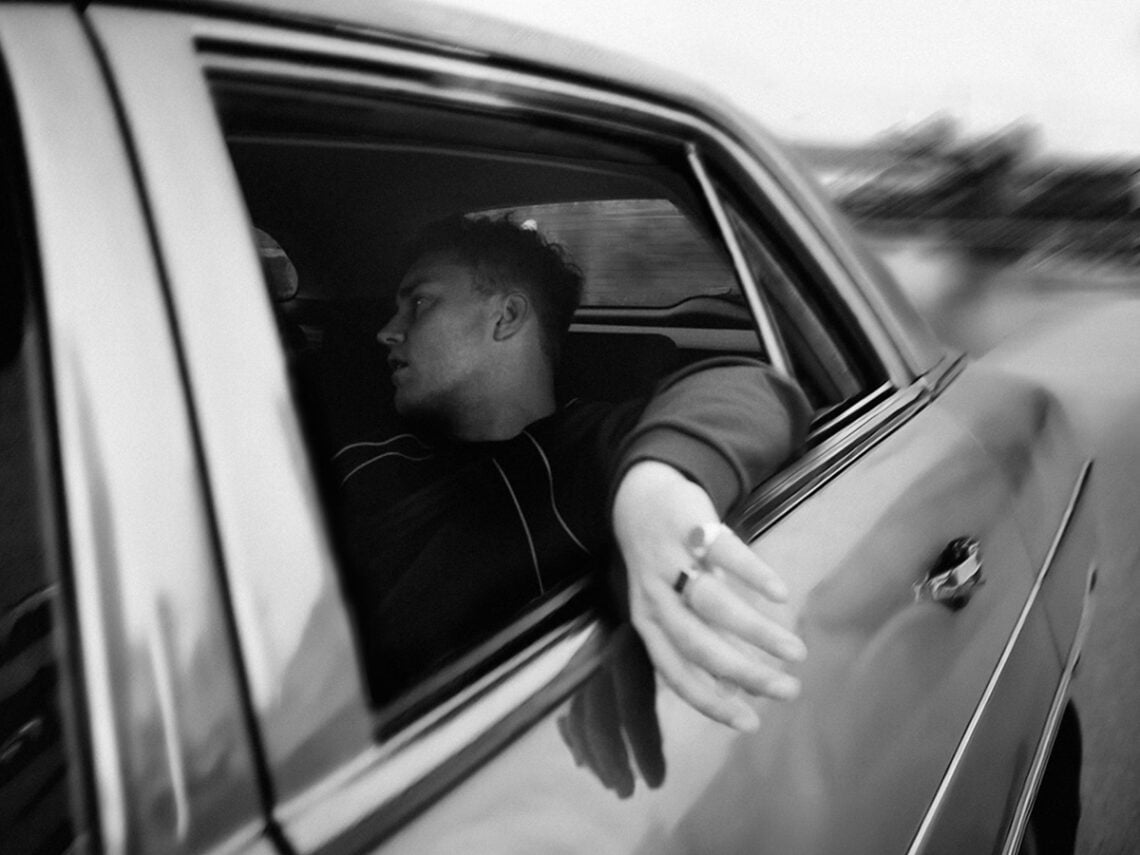
The third chapter in Sam Fender’s story: How visual culture helps set an artists album apart

When word spread last year that Sam Fender had been in the studio with Adam Granduciel from The War On Drugs, my immediate reaction was a sense of excited intrigue. Graduciel has, at least in my rotation, cemented himself as one of music’s most sensitive songwriters with a sharp ability to melodically articulate what is being expressed within his in-depth narrative storytelling. Something Fender has similarly begun to show signs of mastering in his relative career infancy.
The pairing of two stellar artists provokes an instinctual response of excitement, which usually hints that musicianship has doubled. And in the case of Fender’s third album, People Watching, you could quite fairly say it does. It is indeed an album that weaves a rich tapestry of storytelling, set in the ‘crippled island’ of Britain that only compounds Fender’s reputation as one of our generation’s most important storytelling voices.
He grapples with very real issues, be it societal or introspective, without danger of signalling virtue or playing enlightened, and instead bravely plants his own painful narrative in the middle of any given song to sonically extend an arm of understanding. It’s something Granduciel did most notably in The War on Drugs’ Lost In The Dream record that brazenly drew upon his own experiences of suicide to create an emotionally complex record of psychedelia-smeared country-rock.
As far as a third record goes, it’s positively a success for Fender. Given a four-star review by Far Out’s Lucy Harbron, and more generally, set to be the album that will soundtrack a summer of stadium shows and most likely a Glastonbury headline performance, People Watching has done no damage to Fender’s position as prince of modern British rock. But in the same breath, has it necessarily added anything?
As I look to answer that very question, I feel a growing sense of conflict as a fan. Somewhere between my desire to listen to something familiarly evocative and progressively challenging is someone who ultimately wants to see an artist I admire express themselves naturally, unbound by the constraints of pursuing either.

But ultimately, as stunning a body as it may be, I couldn’t help but consume the record as an extension of his previous work. Granduciel’s sonic influence was apparent, and there had felt like an added depth to the overall craftsmanship of his previous work, but ultimately, it felt as though it was delivered on the same palette.
Herein lies the root of my conflict. Fender’s artistic magnetism lies firmly in his humility, more than just the everyman but truly representative of a very real and honest reality we live in, his songs and persona are brimming with earnestness. And I would be reluctant to change that. But truly great artists, with the same cultural footprint as Fender have moulded their deep-rooted portrayal of emotion in more adaptable visual concepts.
Irreverent as it may be, there’s no coincidence that the record that thrust Fontaines D.C. to stratospheric stardom was the one showcased with the five-piece wearing vibrant, saturated colours and goggle-eyed sunglasses. It might seem futuristic, but it’s a creative methodology that runs right back to 1965, when The Beatles reappeared on Sgt. Pepper’s Lonely Hearts Club Band colourfully clad in faux military uniforms to starkly convey they are no longer the mop-topped suit-wearing blues-rock boys of The Cavern Club. Sonic reinvention, of course, remains paramount, but understanding that through visual culture helps create a world in which the new sound can seamlessly transition.
On the surface, this idea might seem a stretch too far. Surely Fender can’t reappear on his fourth album in a three-piece leather suit or technicolour kilt? But the same school of thought was applied to a text-book clutching Grian Chatten, who, on the early Fontaines DC record, was dressed like your classic cardigan-wearing heartthrob. Ultimately, the transitions are supposed to be jarring and, by proxy, make the music more compelling.
It also breaks the self-fulfilling feedback loop that an artist can fall danger to with growing success. As Fender’s star continues to rise, so does his responsibility to continually narrate the British experience. While fans patiently wait for his next single while picking up the pieces of the broken Britain he grapples with, the idea of campaigning a new album that’s centred around a fuzz pedal and electric drum kit would seem all the more daunting. There’s undoubtedly something in the physicality of styling yourself so alien to your past incarnations that makes stark changes more understandable.
My want for artistic difference is deeply rooted in my belief that Fender can achieve it. He’s undoubtedly a generational voice, and on People Watching, he has shown glimpses of his knack for traversing deep sentimental expression over multiple instrumental compositions. And after three albums, I think he’s fulfilled his duty to fans who desperately want him to articulate modernity with accessible rock, with the rousing singalong chorus and emotive 12-string-guitar melodies. So how about we let him exercise selfishness on the next record and take us to a place we don’t yet know that we need from him?
