


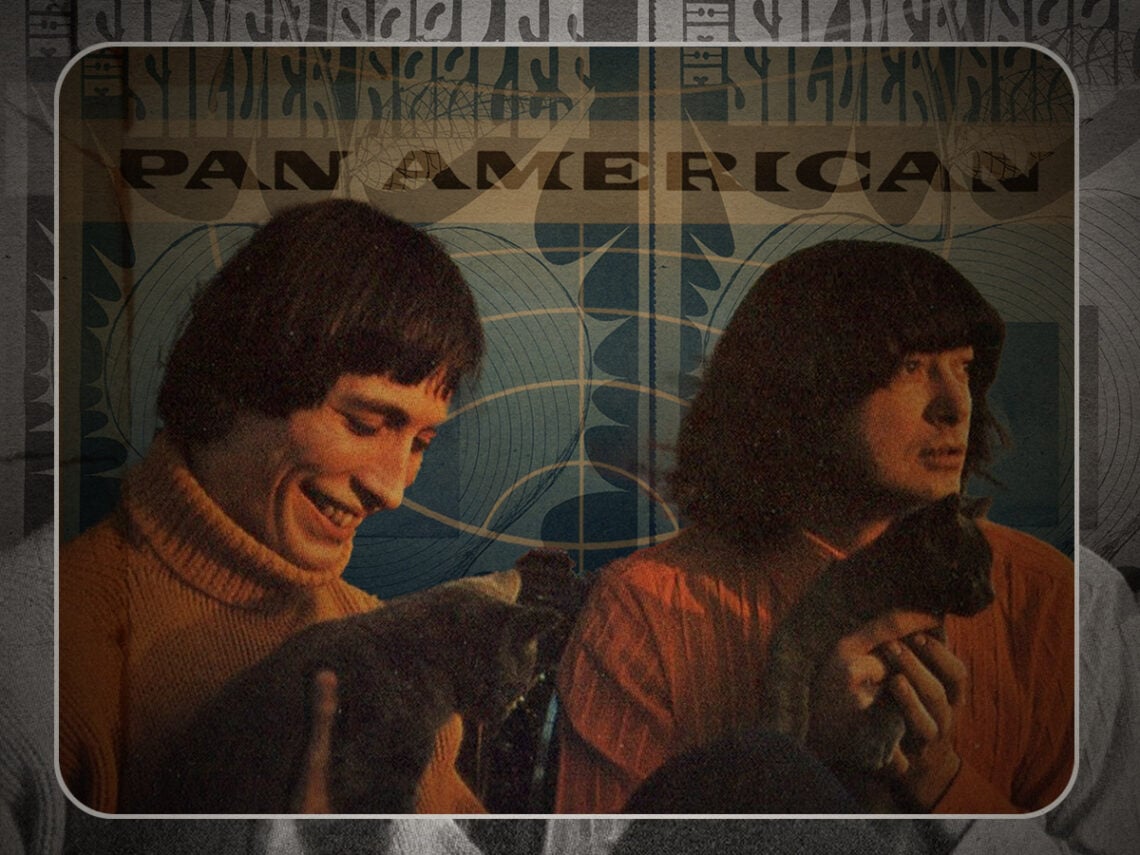
The surprising early influences on the music of Silver Apples

“I had never listened to electronic music before,” Silver Apples co-founder Simeon said in 2000, explaining that his band’s experimental records of the late ‘60s were created without any foreknowledge of the earlier pioneers of machine music, “I was strictly a rocker”.
While the mononym version of Simeon came up in New York’s East Village, hanging out with artists and beat poets, he had grown up in the south as Simeon Coxe, a wide-eyed, curious kid from Knoxville, Tennessee, who moved to New Orleans in the late ’40s after his father returned from serving in World War II.
“I grew up in New Orleans listening to Fats Domino, Little Richard, Big Joe Turner, and the like,” recalled Simeon, who died in 2020 at the age of 82, “They all did concerts in the Black, rhythm ‘n blues clubs there and I sometimes would be the only white boy in the place, but it was wonderful.”
While Simeon appreciated jazz music, as well, it was New Orleans’s sometimes overlooked but hugely influential rock ‘n’ roll scene, focused on the clubs of North Rampart Street, that inspired him far more, particularly Fats Domino tunes like ‘The Fat Man’, ‘I’m Walkin’, ‘Ain’t That a Shame’, and ‘Blueberry Hill’.
Arriving in New York in the early 1960s to pursue art, Simeon eventually joined a fairly straightforward blues-rock outfit called the Overland Stage Electric Band. At this point, he was showing no particular sign of wanting to diverge from the R&B influences that had lit his proverbial fuse. Then, as could easily happen when living in Greenwich Village at the time, he made friends with an eccentric musician, specifically an odd fellow who liked to sit in his apartment and play along to Beethoven records with a bizarre electronic instrument called an oscillator.
One night, after that friend had passed out, Simeon took the opportunity to play the oscillator himself, this time with a rock album as his backing music. From there, “I was hooked,” he told the Knoxville News-Sentinel in 2015.
At first, Simeon tried to convince his mates in the Overland Stage Electric Band to adopt the theremin-like device into their sound, but this eerie, electro version of sci-fi psychedelic was slightly too far ahead of its time. “They hated it,” he said, “There was absolute rebellion in that band. It was, ‘Either that thing goes, or we quit’”. Hence, he opted to accept their resignations and carry on with the oscillator, ultimately forming Silver Apples with the lone band member who chose to stick with him, drummer Danny Taylor.
“I wanted to see if it would be possible to make music with feeling, using only oscillators and drums with vocals,” Simeon said. To achieve this, he also adapted a set of oscillators into something more akin to a Rube Goldberg device, an early synthesiser of his own creation, designed out of necessity, which he named after himself: the Simeon. “I did it by trial and error,” he told Perfect Sound Forever in 2000, “I have no technical training, so I asked a lot of questions, made a lot of mistakes, and burnt up many a circuit board in the process”.
The two albums Silver Apples released in the late ‘60s were moderately successful and well received by the same sort of audiences embracing the weirder musical corners of The Velvet Underground and Pink Floyd. It was several decades later, however, long after their break-up, that the band really began building a mythical status among appreciators and purveyors of electronic music, leading to the surprise reunion of Silver Apples in 1997, and a welcome collection of new music. None of it sounds like Fats Domino, mind you, but he is in there somewhere in the DNA of the music, weaved into the circuits.
