


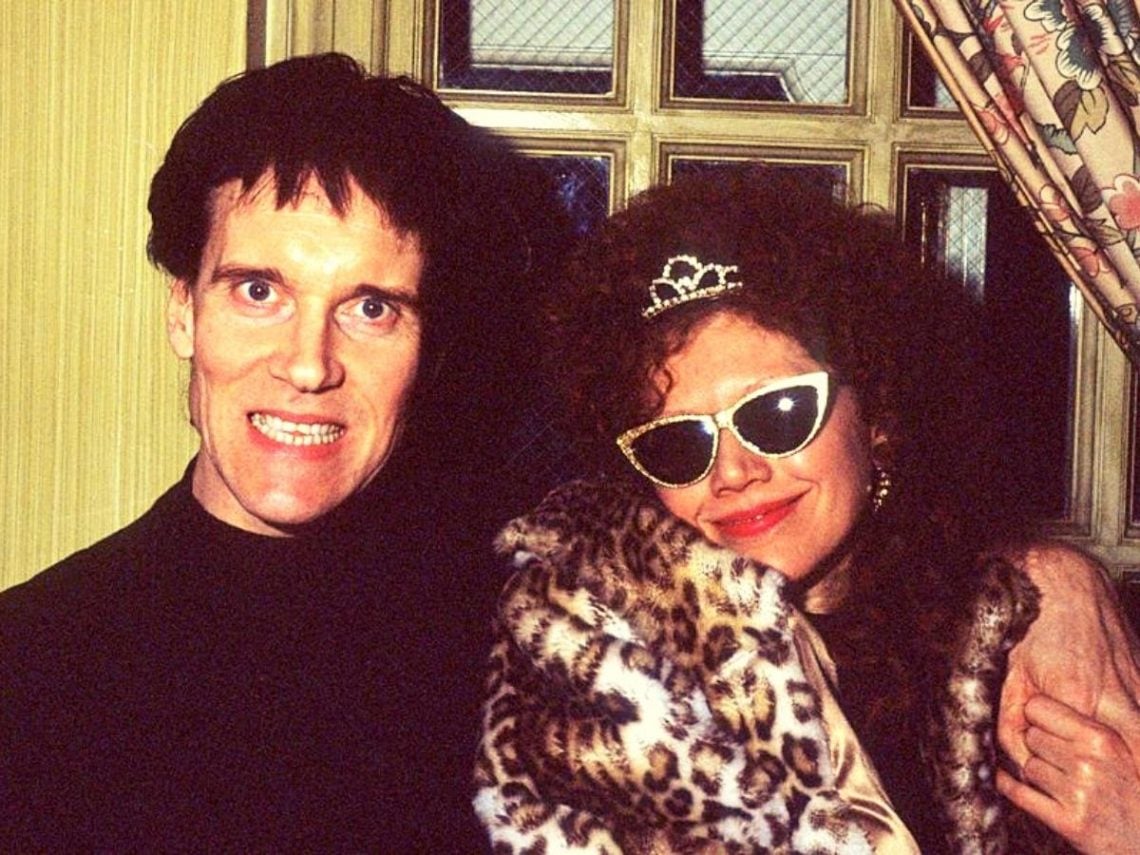
The story of Lux Interior

Barreling through the streets of Sacramento, California, a young Erick Lee Purkhiser looked out over the tops of his sunglasses onto the road ahead. Bedecked in dust and the blistering West Coast sunshine, spots a figure in the distance – her red hair standing out against the stunning blue skies – a hitchhiker. Nowadays, we are taught to be wary of strangers, especially hitchhikers, but this was the early 1970s, the hangover of America’s brief flirtation with ‘peace and love’ had not entirely eroded. So, easing his foot off the accelerator and pulling over, Purkhiser and his riding buddy beckoned this mysterious redhead into the car; the decision would change the trajectory of their lives entirely, eventually leading to the formation of psychobilly icons The Cramps.
Both Purkhiser and the roadside redhead, who turned out to be Kristy Wallace, were studying at Sacramento State College in the early 1970s. Waltzing around campus in daring, colourful clothing, tight jeans and homemade outfits, Erick had been a figure of some intrigue for Wallace. Finding themselves taking the same classes, the pair began to forge a romantic relationship. Make no mistake: this is not the beginning of some clichéd American college romance, complete with trips to a roadside diner for milkshakes and picnics by the river; this was the raw and activistic beginnings of one of punk rock’s most individual voices.
Adopting the monikers of Lux Interior and Poison Ivy, the punk rock power couple moved to the unlikely musical haven of Ohio, forming The Cramps in 1973. Calling The Cramps a punk band doesn’t really cut it – the group were so radically different from anything that the blossoming world of punk was offering at the time. Taking inspiration from the obscure garage rock and rockabilly records of the 1950s and 1960s, Lux Interior and The Cramps carved out their own unique sound: sleazy, distorted, jarring and utterly addictive.
Relocating to New York in 1975, the group found fame within the early punk rock scene of the city but, amid a backdrop of groups like The Ramones, Blondie and Television, nobody could put on a show like Lux Interior. The Cramps became legendary for their unpredictable and ferociously energetic live performances, which saw the frontman possessed by some higher spirit. To watch Lux Interior on stage was to witness something otherworldly, almost akin to seeing a man transform into a werewolf right in front of your eyes (if the werewolf was also wearing the tightest leather trousers known to mankind).
Coining the term ‘psychobilly’ to describe their unique blend of rockabilly and blistering punk rock, The Cramps were pivotal to the development of punk. A great deal of importance has been placed on the CBGB scene, with the East Side club responsible for spawning the careers of everybody from Talking Heads to Bad Brains, but The Cramps were a different brew altogether. Many of the groups in that scene were inspired by each other, seeing what other bands were getting up to and wanting a piece of it. Whereas, with Lux Interior and Poison Ivy, you get the sense that the pair would be doing the same thing regardless of the setting. They treated the small stage of CBGB as if it was the biggest venue on the planet, and they blew their contemporaries out of the water.
Perfecting his frightening art of performance within the sweat-stained walls of the CBGB club, soon it was time to take Lux Interior international. On The Cramps’ first tour of the UK in 1978, the group performed as an unlikely supporting act for The Police. While it is objectively funny to imagine an audience geared up to hear the anaemic tones of Sting only to be greeted with a sweating maniac in leather trousers screaming at them, this was not the audience that best suited The Cramps. So, returning to the States, Lux masterminded a plan for the group to play a free concert at the Napa State Psychiatric Hospital in California. Grainy video footage shows the seemingly endless energy of Lux Interior only matched by the patients of the hospital – it was Johnny Cash at Folsom Prison for the punk generation.

After years of perfecting their craft, The Cramps released their debut record, Songs the Lord Taught Us, in 1980, exposing their uniquely sleazy take on punk rock to a global audience. Quickly swapping the concrete jungle of New York for the sun-soaked West Coast, the group wasted no time in following up on the debut, releasing Psychedelic Jungle in 1981, followed by Smell of Female in 1983. The artwork that adorned the covers of The Cramps releases was as kitsch and provocative as the band themselves. Often featuring the striking image of Lux Interior, with his sunken cheeks and wiry jet-black hair, the frontman embodied everything you could possibly want from a punk rock frontman.
Though the group were often noted for their blistering covers of old school rockabilly tracks, their defining sound came with the single ‘Human Fly’, released on the EP Gravest Hits. The song perfectly toes the line between the early rockabilly and garage sound and this new generation of punk rock, even paying tribute to the iconic garage track ‘96 Tears’ by Question Mark and the Mysterians in the lyrics “I got 96 tears and 96 eyes”. ‘Human Fly’ also exemplifies the influence that horror films had upon Lux Interior, who penned many songs surrounding the supernatural, scary monsters and super creeps. Unlike the dour stylings of horror punk groups, which took heavy influence from video nasties, Lux’s approach was much more raw and endearingly kitsch.
The punk rock scene is often viewed, in hindsight, as a flash-in-the-pan. In the UK, the punk movement lasted all of two years before something new came to take its place. Although American punk enjoyed more longevity, evolving into hardcore and then post-hardcore, many of those early punk groups failed to last. But alas, as we have discussed, The Cramps were not an ordinary punk band – Lux Interior was not an ordinary man. With the punk power couple of Interior and Poison Ivy the only continuous members of the band, The Cramps enjoyed a long and illustrious career in the music industry, always remaining fearlessly individualistic.
Another unlikely occurrence for a band of their ilk was charting singles, yet The Cramps managed to bag themselves a fleeting bit of commercial success. In fact, the bizarre style of Lux Interior managed to infiltrate the UK singles chart in 1990, with the seminal track ‘Bikini Girls With Machine Guns’, heavily inspired by the exploitation film Faster, Pussycat! Kill! Kill! as well as early films by John Waters. So, while the youth of Britain were hopped up on E’s in fields out in the arse-end of nowhere, Lux Interior could still be found tearing up a stage with his superhuman energy, clad in high heels and leather, deep-throating a microphone without a care in the world.
The Cramps’ flirts with commercial success were few and far between, but the impact of the band remains unrivalled within punk rock. Everybody from Minor Threat to My Bloody Valentine owes a debt to the pioneering sounds of Lux Interior and The Cramps, for without them, the alternative music scenes of the past four decades would have been considerably duller.
Continuing to write, record and perform well into middle age, Lux Interior’s need for performance was akin to a junkie’s need for smack – it was the only thing keeping him going. It’s possible that the frontman had so much energy pent up inside of him that, if he did not let it out on stage night after night, he would spontaneously combust. At one time, it seemed as if Lux would live perpetually, as though he was some sort of unhuman alien sent to Earth to shake things up a bit.
Tragically, this was not the case. Lux Interior passed away on February the 4th, 2009, as a result of a sudden and shocking aortic dissection. Interior was still performing alongside his wife, Poison Ivy, up until 2006, allowing them the claim of being one of punk music’s longest serving groups. Leaving behind nine studio albums and a countless array of live bootlegs, the music that Lux Interior masterminded will remain vitally important and beloved for years to come. No aortic dissection could truly extinguish the vibrant flame of Lux Interior.
