


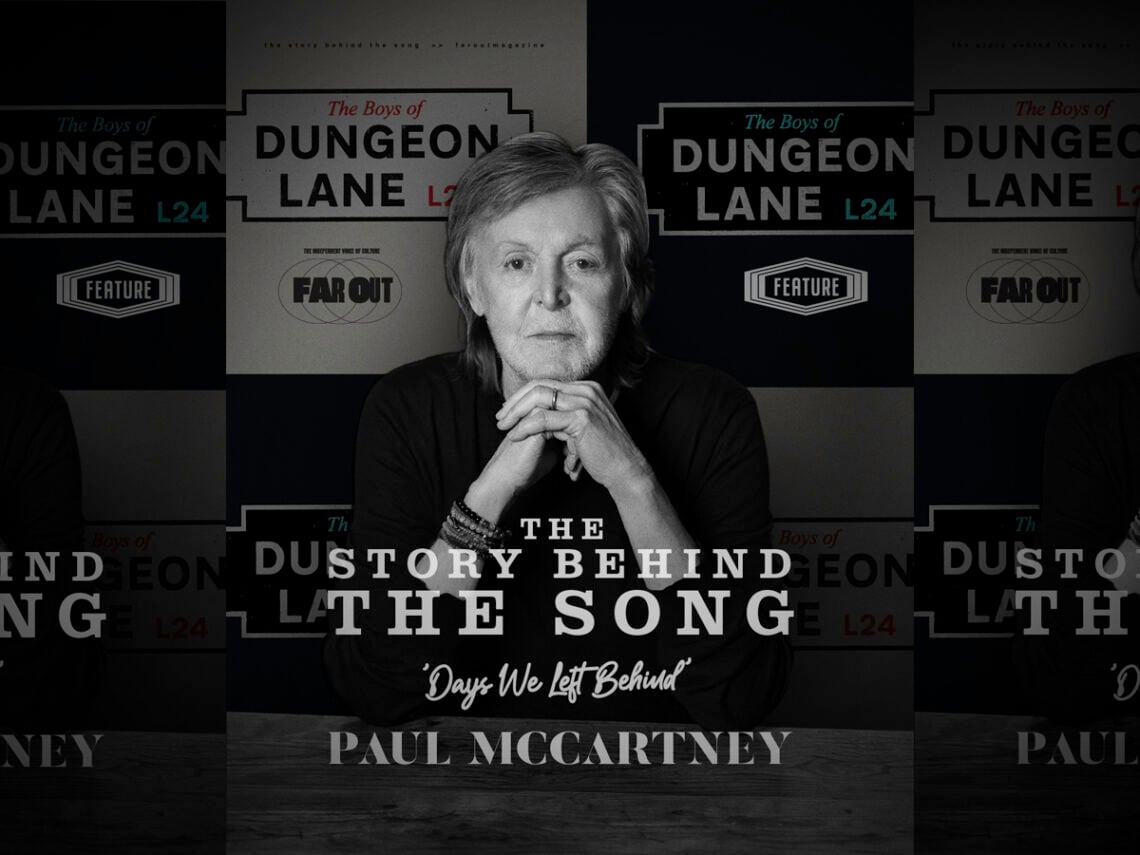
The Story Behind the Song: Exploring Paul McCartney’s return with ‘Days We Left Behind’

When you leave home at 18, and only two years later, you’re on the brink of superstardom hitherto unknown in human history, it stands to reason that your thoughts will often drift to what you left behind.
The intertwined subjects of Liverpool and youthful reverie have often been key tenets of Paul McCartney’s poetic muse, and on his latest single, ‘Days We Left Behind’, he pairs them almost like never before. Yet, ‘almost’ proves the operative word in the previous sentence. Because while this song might be a brand-new release, and it carries the weathered wistfulness of a man who has relaxed into being 83, it actually dates back to 1991.
McCartney first mentioned Dungeon Lane in the demo ‘In Liverpool’, a rare and unreleased track that he later performed at The Liverpool Sound concert in 2008. In that version of the song, he sang, “Walking with the boys of Dungeon Lane / Aimlessly towards the cast iron shore”. While the track has changed significantly from then, the line becoming, “See the boys of Dungeon Lane / Along the Mersey shore”, the lineage is clear.
Back then, this reference to a nondescript street in the Speke, a stone’s throw from his Forthlin Road childhood home, was a fleeting thread in a tapestry of memory. But over time, the significance of Dungeon Lane seems to have increased for the former Beatle.
With ‘Days We Left Behind’ serving as the origin story for the concept of his forthcoming album, the phrase The Boys of Dungeon Lane gave it its title. It’s often the case with growing older that you come to realise something small amid a welter of chaotic life was actually an encapsulating centrepiece. Like a diamond from coal, while the rest of the world forgot about ‘In Liverpool’, it seems McCartney couldn’t shift the sentiment he had unearthed when he first crafted the demo.

The focus is the same strange alchemy of the ageing mind that elevates the trivial into the totemic: silly things like playing kerby on Dungeon Lane that rarely announce their central significance to your whole life until you’re old and grey enough to notice what the strange checkpoints of crystal-clear childhood lodged in your memory represented, while everything else from those days is imbued with a sepia haze.
With that in mind, it seems doubly fitting that McCartney also returned to an unshakable lyric amid the thousands he has written, given what he has said about ‘Days We Left Behind‘. “This is very much a memory song for me,” he confirms in a press release. “I was thinking just that, about the days I left behind, and I do often wonder if I’m just writing about the past, but then I think how you can write about anything else? It’s just a lot of memories of Liverpool.”
He’s written about Liverpool and the past plenty of times. However, unlike the observational vignettes of ‘Penny Lane’, where characters drift in and out of frame and the filter is far more vivid, ‘Days We Left Behind’ feels grounded in lived-in experience, misted with the fog of time, but more inhabited all the same than the stylised recall of ‘Eleanor Rigby’ and the likes.
With the song, McCartney places himself squarely within a bygone Merseyside (that still looks much the same) and revisits the sights, scenes, and formative friendships that would come to shape his life, and oddly enough, the direction of modern music itself. Therein lies the beauty of the song and McCartney at his best: no matter how grand the consequence, at the heart of his music is daft lads having a daft laugh.
You get the sense, perhaps more clearly than anywhere else in his entire back catalogue, with ‘Days we Left Behind’ that same man who changed the world irrevocably could spit in 17 different ways back in the Speke during the halcyon days of his saliva-based youth.
There’s a self-awareness to that. “How can you write about anything else?” he muses. But that’s particularly important when it comes to McCartney. Nobody wants to hear a song about his property portfolio. Yet, he goes beyond just talking about a past we all know. The only territory left to explore for an artist whose life has been so thoroughly documented is memory. In the process, he gives us something new and unknown. He always has.
That sentiment sharpens ‘Days We Left Beyond’ and ensures it is free from self-indulgent nostalgia. In fact, he never even intended to make the song (or the album, for that matter). It just so happened that five years ago, Paul met producer Andrew Watt for a cup of tea, and amid the exchange of enthused ideas, McCartney happened upon a chord that he didn’t recognise.
Maybe there was something about this moment of discovery that took him back to his youth when everything seemed new, because while that mystery chord might feature in the forthcoming song ‘As You Lie There’, it wasn’t long before the Beatle was reprising lines from ‘In Liverpool’ for further tracks in a rocking chair revisitation of youth.
And from that point, a single remembered phrase from a dog-eared demo became an album about memory.
