


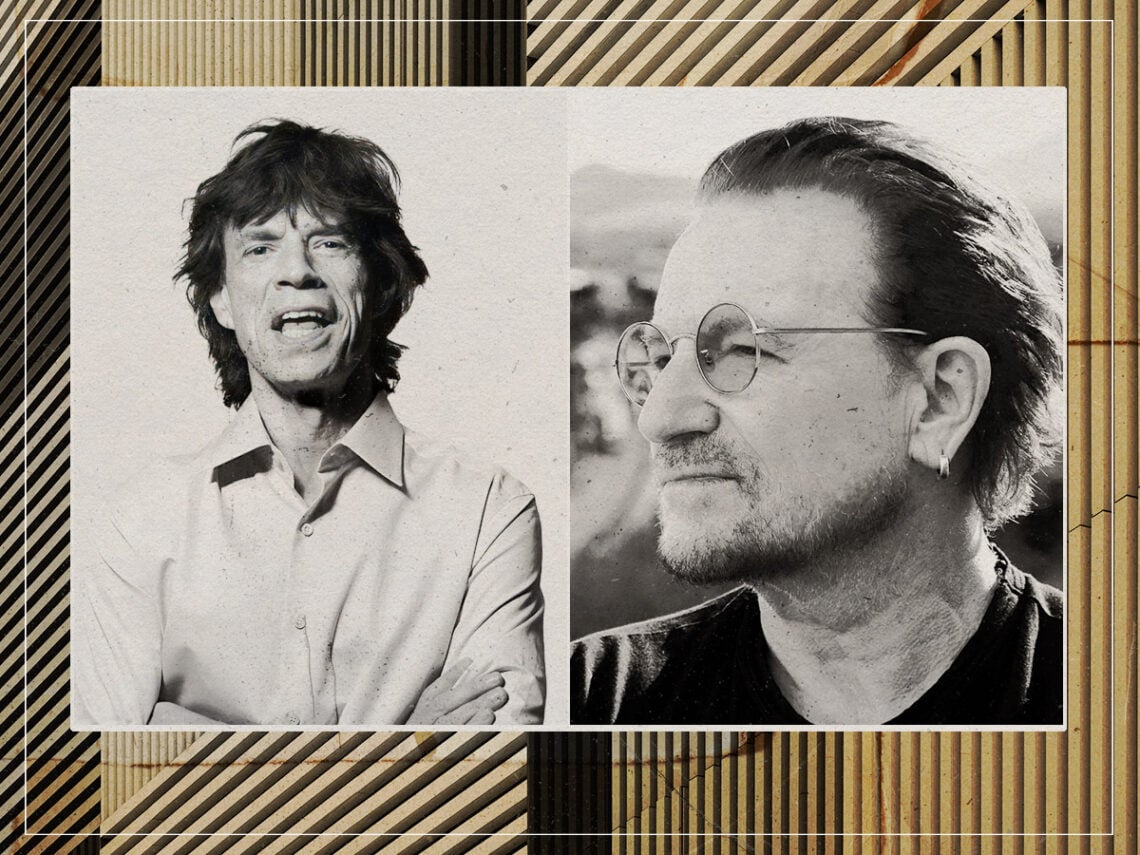
The song Mick Jagger wrote with Bono in mind: “Spiritually inspired”

It was cold backstage on The T.A.M.I Show on October 28th, 1964, but Mick Jagger sat there shivering for a different reason. The Rolling Stones’ frontman had just peeked through the curtain to catch a glimpse of who he had to follow. James Brown was hopping around, wiping the proverbial floor with everyone on the bill.
Marvin Gaye had to console Jagger on that fateful day, bravely encouraging him to follow Brown’s brilliance by famously saying, “Just go out there and do your best.” From that moment on, Jagger knew that his ‘best’ had to be better. He learnt dance moves from Tina Turner. He took a leaf out of Roger Daltrey’s book and worked on his fitness. In short, he wanted to craft himself into the ultimate showman.
There are many folks who think he achieved this with aplomb. Daltrey is one of them, dishing out the rare compliment, “You’re never going to out-front Mick Jagger. He’s the best frontman there’s ever been.” However, one of Jagger’s key facets was that he was also distinctly himself. The pouting, the chicken-adjacent movements, the snarling, basically pissed-off attitude – all of it was deeply individualistic.
This set a precedent for future frontmen to simply try to be themselves and make a show of it. Unfortunately, Bono grabbed that advice with both hands. Jokes aside, the strapping Irish singer is as distinct as any in classic rock. With his wrap-around shades and a sense of spiritualism so intense even the Dalai Lama would flinch, the U2 singer is a stand-out show in rock ‘n’ roll.
So, when Jagger was crafting his solo album, Goddess in the Doorway, he found himself writing a tune that he thought was more Bono than Jagger to begin with. Speaking to Paul Du Noyer, the ‘Sympathy for the Devil’ singer explained that it was a no-brainer to ask Bono to collaborate on ‘Joy’.
“That’s why I thought of him to be on it. I wrote it and thought this could be something he could do really well,” he recalled.
“He takes it on very quickly,” Jagger said. In no time, he ended up inviting all of his most spiritual friends to the studio for a musical soiree. “Pete Townshend plays on it too, and he’s another guy that’s spiritually inspired,” he added. While the Stones have certainly had a few tracks that deal with God and man, this one did so in a manner that felt far more flowery and barefoot.
Nevertheless, as with everything Jagger has done, there was a sense of timelessness to it. Once again, the pouting performer grounded the track in the roots of rock ‘n’ roll, explaining, “I like ‘Joy’ because it conveys the happiness in creation through gospel combined with rock, without being beholden to a gospel form. Making rock music into gospel is something I’ve never done before; I’ve always gone into gospel.”
