


‘The Slumber Party Massacre’: a feminist parody of slasher horror?

The slasher subgenre took off in the 1970s with movies such as Black Christmas, The Texas Chainsaw Massacre and Halloween reinventing the horror wheel. By the 1980s, slashers were extremely common, although only a handful were both critically and commercially successful, like Friday the 13th and A Nightmare on Elm Street.
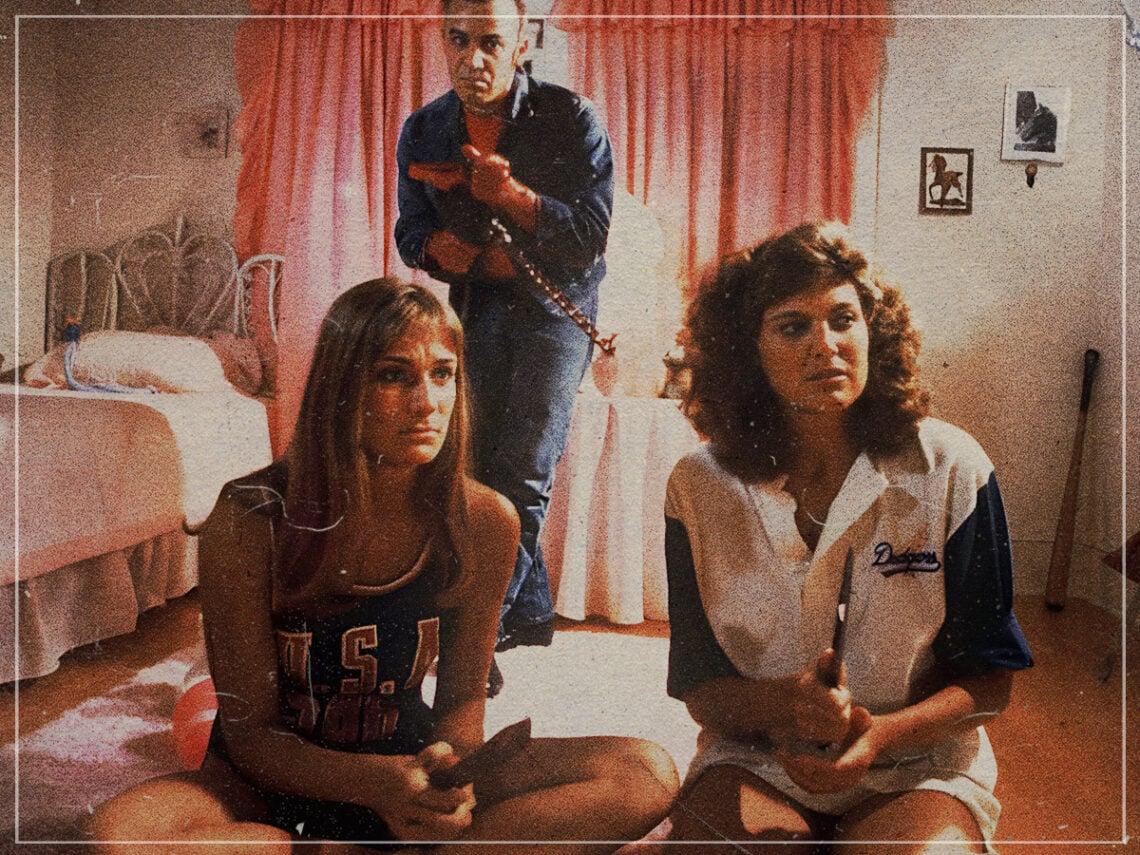
Many filmmakers attempted to cash in on the success of movies like Halloween, hoping to find similar praise by utilising the same tropes. From ‘the final girl’ to the ‘well-behaved babysitter’, a number of slashers from this period were devoid of originality. However, in 1982, Amy Holden Jones released a slasher which, on the surface, looked like any other low-budget post-Halloween horror: The Slumber Party Massacre. Yet it was penned by feminist writer Rita Mae Brown, who set out to satirically criticise both the patriarchy and slasher films through her screenplay.
Although the producers attempted to shape The Slumber Party Massacre into a less overt satire, Brown’s initial themes and ideas are still extremely prominent. Thus, the movie becomes an intriguing examination of gender politics, with the male killer’s large phallic drill penetrating his female victims in a symbolic act of rape. While this isn’t entirely subtle – sometimes the killer is filmed from behind, his drill dangling between his legs – it provides the audience with a harsh reminder of the terrifying and dehumanising nature of sexual violence. It’s a simple message, yet one that is executed brilliantly as the movie contrasts the camaraderie of the teenage girls with the leering gazes and unsettling behaviour of the male characters.
While the girls attempt to spend time together or alone, men consistently invade their spaces, whether that be through entering the house uninvited, peeping through the window, or slicing up their flesh. Every man has the potential to violate the women, with the killer becoming the ultimate destroyer of the girls’ freedom and security. Put simply, the killer represents patriarchy and the behaviour it enables, emphasised by his lack of disguise. The killer doesn’t hide behind a terrifying mask – he is just an ordinary-looking, albeit rather creepy, man.
However, the film often seems unsure of where it stands, moving between objectifying shots of the girls – naked in the shower or undressing at the slumber party – and powerful anti-patriarchal commentary. In this respect, the movie often feels slightly paradoxical. For example, the film opens with the lead character, Trish, discarding her childhood toys before getting dressed, her breasts exposed to the camera, indicating that she’s now an adult, contrary to her girlish room. It’s a purposefully clichéd scene which attempts to play into exploitative cinematic stereotypes, yet it essentially gives itself over to the male gaze anyway, with the camera’s lens ogling her just like the male characters we later meet.
The shower scene feels similarly uncomfortable, with the camera slowly panning down to the female characters’ backsides. Additionally, when the girls are changing into their pyjamas, some of their male friends peek through the window, hoping to catch a glimpse of nudity. While the camera frames the girls from the voyeuristic perspective of the boys, the scene still feels exploitative. There’s a fine line between visually poking fun at the male gaze and appeasing it, and The Slumber Party Massacre rests somewhere in the middle of the two camps, perhaps due to the production team’s interference.
However, the movie ends on a defiantly feminist note, with the surviving female characters symbolically castrating the killer by slicing his drill in half. The killer suddenly finds himself in a vulnerable position, eventually losing his hand before falling into the swimming pool. With a touch of humour, his stump appears over the edge of the pool, and he returns, not yet ready to die. In keeping with the final girl tradition, the girls successfully kill him. However, The Slumber Party Massacre allows more than one girl to survive, proving the importance of female friendship and support.
Can we call The Slumber Party Massacre a feminist film? The answer is not straightforward. Instead, we can identify many feminist elements within the movie, which makes it a compelling piece of slasher horror that stands out compared to many of its contemporaries. By subverting tropes such as the sexually promiscuous character dying or the killer wearing a mask, Brown and Jones offer up an insightful examination of gender while also providing plenty of gory fun.
Yet, it still has flaws, even when trying to subvert the male gaze. By lingering on the teenagers’ naked bodies with a fetishistic gaze, the movie only serves to objectively perpetuate the sexualisation of its young characters – something that is rampant in the horror genre. With that being said, the movie is still an enjoyable slasher which does a fantastic job of capturing gender and sexual politics, particularly at a time when women were often depicted as nothing more than helpless victims.
