


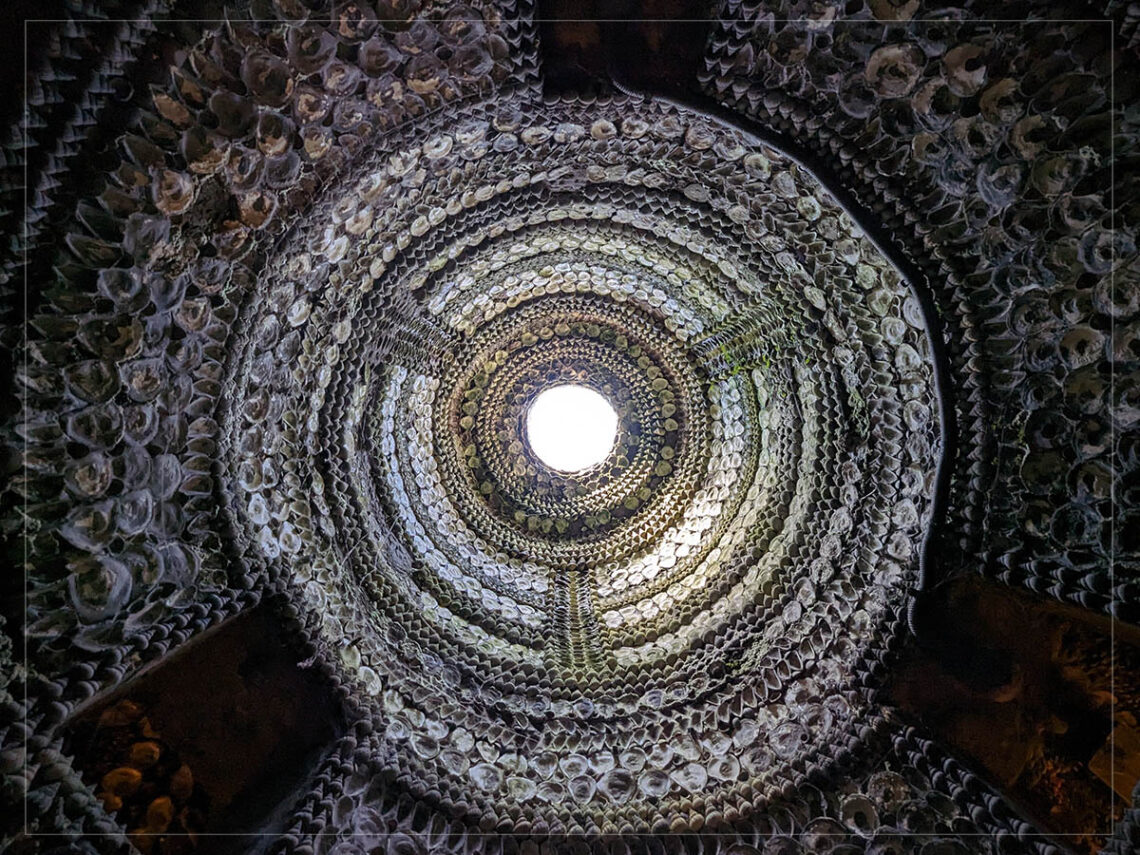
The Shell Grotto: The bizarre British mystery that inspired David Bowie’s memento mori

Margate is known for a lot of things: the seaside, its fairground, and the Dreamland festival. But did you know that it was also the catalyst for the final sonic bow from the great David Bowie?
It may seem a bizarre setting for a man whose work ranged in such a transatlantic manner in its inspirations, across Berlin to London to New York. By comparison, Margate is of a much sleepier disposition; nevertheless, there was one specific landmark in the town that proved as spellbinding as all his others, and paved the way for his memento mori album, Blackstar.
The Shell Grotto is not only one of the most significant tourist destinations in Margate, but it is also perhaps one of the greatest architectural feats achieved, with its passageway covered entirely in mosaic shells. But the thing is, this is more than just an astonishing art spectacle—it’s also a mystery, because to this day, no one quite knows how it ever got there.
Claimed to have been discovered in 1835 by two local children, Frances and Joshua Newlove, the passageway became a symbol of innocent discovery and wonderment, not least for the question of how it ever came to be built and how long it had been hiding there in plain sight, which still remain unanswered today. As such, thousands upon thousands of people from both near and far have flocked to the grotto in the hundreds of years since, but in the mid-2010s, it also welcomed one particularly starry visitor.
Bowie was obviously known for taking his inspirations from obscure places. He was drawn to the fictional, the fantastical, and the beguiling, all of which the Shell Grotto presented in spades. As such, you can see why the place would be somewhere he was allured to, with all its mystical appeal and child-like amazement that equally rang true to elements of everyday life, not so dissimilar to the themes of his hits like ‘Life on Mars?’.
This was why, years down the line, he would often frequent the grotto in search of his next musical muse, and found it at the epicentre of what would become his final record, Blackstar. According to his biographer Lesley-Ann Jones in her book Hero, Bowie’s mind was flooded with ideas when he set his eyes on the beautifully intricate star panel which lines the wall of one part of the grotto, and as such, subsequently lined itself up as the basis of his goodbye.
This also manifested itself in ways much more nuanced than just the album title and artwork alone. When you consider the sonic direction of the record, with its roots in art rock, jazz, funk, and more, this was a mystic foray into untold lands for Bowie, much like the atmosphere cultivated in the Shell Grotto, with all its roads ultimately leading towards one guiding light.
Naturally, no one quite knows how much the Shell Grotto played into Bowie’s psyche when he would have obviously been more focused on creating his swan song and, pertinently, saying goodbye to the world. But what shines through from his connection to the Margate landmark is not just how inspiration can be found in the unlikeliest of places, but that the ‘Starman’ could live up to his name and find trails of his work in all corners of the world. The Shell Grotto may be magical, but it was the way he channelled it that really mattered.
