


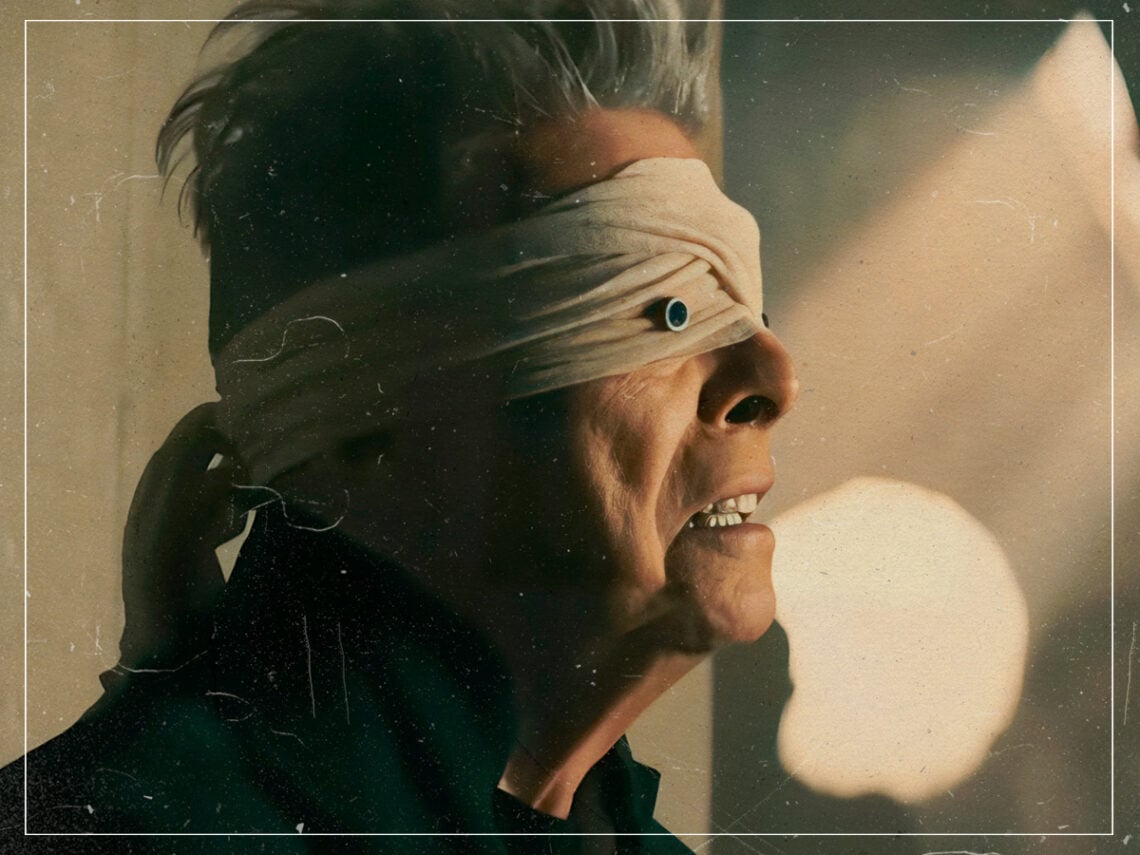
What does ‘Blackstar’ tell us about David Bowie’s darkest era?

At the time of writing, it’s ten months until we’ll have lived without David Bowie for a full decade.
That the great man passed in the early days of 2016, otherwise known as the year the rot gnawing at the world’s heart suddenly became impossible to ignore, has not gone unnoticed. We seemed to lose something when the Starman ascended. Not just his presence but something more profound. The fact that he departed while leaving us one of his absolute crowning achievements is a grace on his part that we have spent the past nine years proving we don’t deserve.
Perhaps that’s what makes Blackstar such a fitting parting gift. Even without the context, the record is a haunting, unsettling listen. From the lyrical themes of mortality and Bowie’s trembling, almost uncomfortably intimate delivery of them, to the constantly shifting musical backing, it’s an album that only lets you get comfortable enough to wrong-foot you again. Whereas 2013’s The Next Day was such an intentional throwback to his 1970s imperial phase that the cover was literally just “Heroes” with a sticker over it, Blackstar comes across more like what those albums must have been like to hear for the very first time.
This is music that, in the year 2025, still sounds otherworldly and of the future. Bowie himself was inspired by the sounds coming from hip-hop’s cutting edge, with Death Grips and, in particular, Kendrick Lamar influencing the album’s jazz-inflected, shape-shifting sound. Speaking to Nicholas Pegg for his book The Complete David Bowie, producer Tony Visconti talked up Lamar’s masterpiece To Pimp a Butterfly as a cornerstone for the album. He said, “We wound up with nothing like that, but we loved the fact that Kendrick was so open-minded and he didn’t do a straight-up hip-hop record. He threw everything on there, and that’s exactly what we wanted to do.”
That a musician pushing 70 was willing and able to make such progressive, exciting music, informed by the most boundary-pushing sounds of the day, is part of what makes this album such a miracle. However, it’s not what makes Blackstar such a harrowing listen. In the early summer of 2014, Bowie was diagnosed with cancer. Most of the album was written and arranged after this discovery, while Bowie received treatment for his condition. Despite the treatment progressing well initially, he was still in an emotional state where lyrics like ‘Lazarus’ were being written. “Look up here, I’m in heaven / I’ve got scars that can’t be seen.”
Perhaps he knew what was coming. In November 2015, Bowie was informed his condition was terminal. In a truly frightening moment of art imitating life, the decision to end his treatment was made during the filming of the music video for the aforementioned ‘Lazarus’. On January 10th, 2016, Bowie’s team informed the world via his social media accounts that he died peacefully in his sleep. The sheer shock and unprepared grief that met the news spoke to one thing. This had been one of the best-kept secrets in the entertainment industry, and even though we’d had a half-century of his music, we weren’t ready for his departure.
While Blackstar was already rapturously received by fans and critics, the penny dropped with Bowie’s passing for what this album actually was. Bowie’s musical last will and testament. If we can understand one thing about Bowie’s darkest era from the music that he made during it, it was that he wanted to go out the way he’d been at his best. Looking forward, unflinchingly, to the future. On the one hand, that leads to the incredible, still unmatched musical creativity and vision. On the other hand, he was looking at his own personal future and seeing one thing in it come up faster than he probably ever thought it would.
The sheer bravery that must have taken is unimaginable. So, while his is a loss we’re still reckoning with to this day, that’s what we can learn from this masterpiece of a record. The hardship that humans face, especially in 2025, feels insurmountable. For all of us, it someday will be, one way or another. Whatever we’re going through, though, we can always find the strength to face it head-on, which is the truth about Bowie’s work as a whole, in a way. For such an otherworldly artist, Bowie was always a humanist—one who saw the depth and beauty in humanity and knew that we could join him one day among the stars.
