


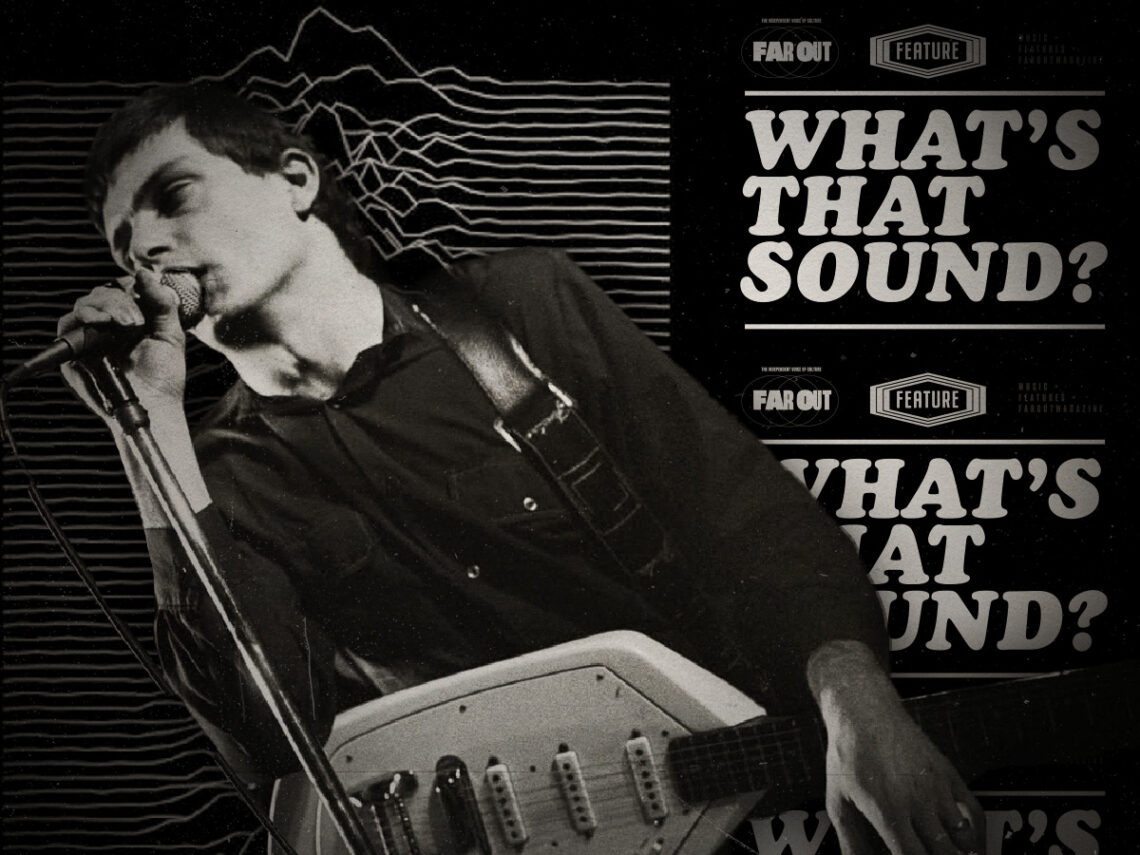
What’s That Sound? The glass shatters on Joy Division’s ‘I Remember Nothing’

“[Joy Division] were a gift to a producer, because they didn’t have a clue,” Martin Hannett once told writer Jon Savage, in 1994. “They didn’t argue”.
Joy Division’s brilliance certainly stands on its own, through Ian Curtis’ mournful poetry soundtracked by the punk-driven, early gothic stylings of Bernard Sumner’s guitars, Peter Hook’s bass and Stephen Morris’ drums. Yet, their sound was further brought to life through Hannett’s innovative vision. The results on Unknown Pleasures proved polarising for the band: Morris and Curtis were both pleased with Hannett’s work, while Sumner and Hook, on the other hand, remarked that they were disappointed with the results.
Hook likened Hannett’s production to Pink Floyd, as described in the Unknown Pleasures CD booklet, while Sumner explained to Mojo, “The music was loud and heavy, and we felt that Martin had toned it down, especially with the guitars. The production inflicted this dark, doomy mood over the album: we’d drawn this picture in black and white, and Martin had coloured it in for us. We resented it…”
Hook later acknowledged in Mojo Classic in 2006 that Unknown Pleasures had not come out the way that he envisioned, “But now I can see that Martin did a good job on it… There’s no two ways about it, Martin Hannett created the Joy Division sound.”
The recording sessions for their 1979 debut saw Hannett’s eccentricity as a producer reach full form. Rather than favouring the punk approach of raw simplicity in performance, he was thrilled by the possibilities of studio technology and its ability to facilitate an expansive sonic atmosphere. Thus, he utilised Strawberry Studios in Stockport to the fullest extent and, over the course of three weekends in April of 1979, he subjected Curtis, Sumner, Hook and Morris to a number of strange, unconventional production techniques.
When recording Curtis’ vocals for the wistful song ‘Insight,’ for instance, Hannett did so down a telephone line, in hopes of achieving the “requisite distance” between the singer and the instrumentals. Seemingly, his approach worked: his voice, slightly muffled though echoing across Hook’s driving bassline and synthesised notes that mimic laser beams, feels both distanced and intimate, elevating the overarching haunt in his delivery.
Hannett also incorporated various other sonic notes that, while random on the surface, served to amplify Joy Division’s already-distinct sound: the sounds of someone eating a bag of crisps, the whirr of the studio’s lift through a Leslie speaker and a backwards guitar can all be heard across the record. Being a firm believer in “sound separation”, Hannett’s production allowed each individual instrument, down to the pieces of Morris’ drum kit, to be prominent with every listen.

One particular song, the album’s closer, ‘I Remember Nothing’, is a languid tune that reverberates with Curtis’ layered vocals and a booming bassline, while a jagged guitar riff and the steady thump of the drums crawl through. “We were strangers… For way too long,” he sings in drawn-out lines, wailing for a love gone sour. His agitation builds with the lines, “Violent, more violent, his hand cracks the chair / Moves on reaction, then slumps in despair”.
The graphic image is punctuated by the shattering sound of a glass bottle breaking, done by Joy Division’s (and later, New Order’s) manager, Rob Gretton, and Morris. The fractured glass is coupled with a piercing electronic lash, violence personified. As Hook recalls, quoted by Savage in the Unknown Pleasures CD booklet, “Sumner started using a kit-built Powertran Transcendent 2000 synthesiser, most notably on ‘I Remember Nothing’, where it vied with the sound of Rob Gretton smashing bottles with Steve and his Walther replica pistol.”
“That was probably the biggest step that we took on our own into technology,” Morris enthused about ‘I Remember Nothing’, noting the influence of Sumner’s homemade synthesiser on the impromptu jam session that eventually became the song, adding, “It’s a brooding thing, it’s malevolence in a tune,” he described. “It was the beginning of Ian turning into a singer/guitarist because when we did it live, Bernard would have to play the synth. Ian wouldn’t go near the synth: he was frightened he’d break it.”
The fragments of shattered glass that are captured on ‘I Remember Nothing’ heightened the song’s ominous tone, closing Unknown Pleasures on a chilling note.
