


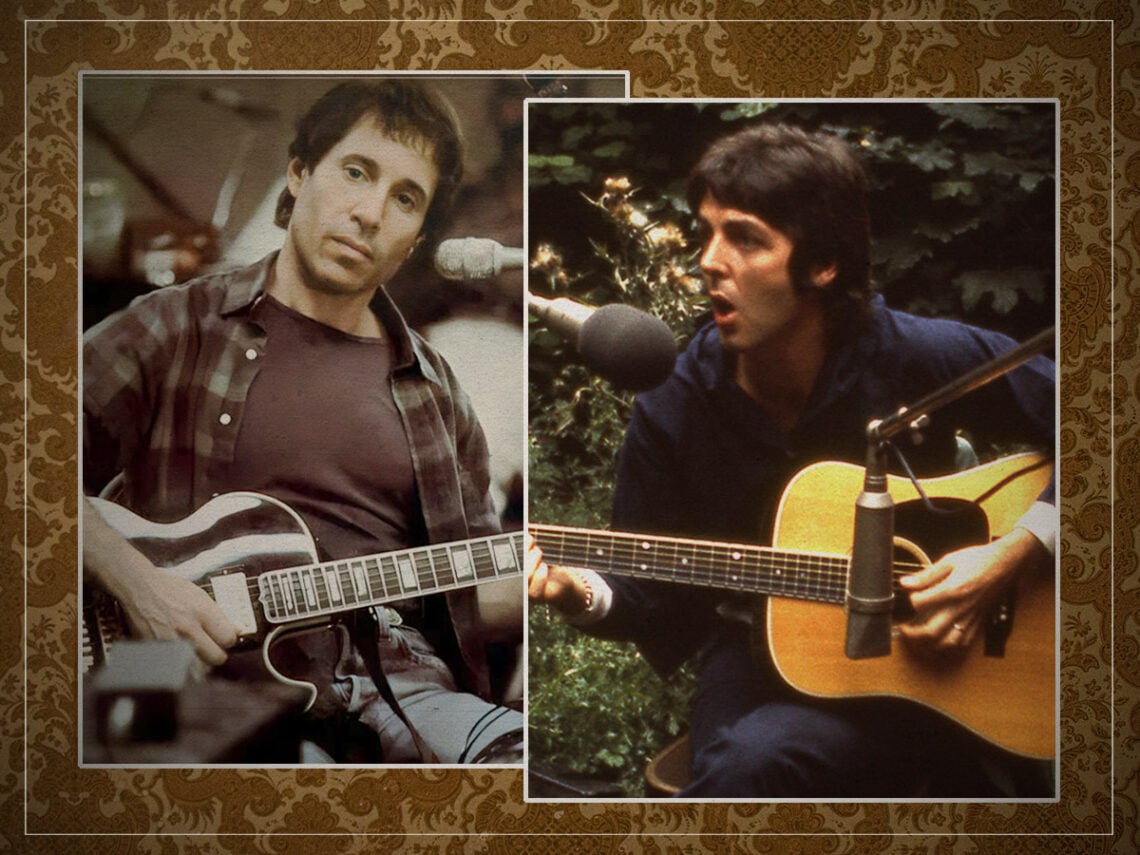
“It offends me”: The 1972 Paul McCartney song that Paul Simon couldn’t stand

The name Paul originally meant ‘small’ or ‘humble’. Well, aside from their namesake apostle, Paul McCartney and Paul Simon have done more work than anyone to eclipse that derivation.
Their work of revered majesty stands among the most seismically impactful in history. In fact, the only people who have ever really dared to deride them are their respective songwriting partners: John Lennon and Art Garfunkel. Just about everyone else has stood in awe.
Nevertheless, the two Pauls have largely had each other’s backs in this bitter battle. Simon placed McCartney in the highest tier of songwriters of all time, stating: “I’d put it at [George] Gershwin, [Irving] Berlin and Hank Williams. I’d probably put Paul McCartney in there, too. Then I’d have Richard Rodgers and Lorenz Hart.” Notably, Lennon was in his second tier.
And McCartney has also lauded Simon as a legend, heaping praise on the “classic line” from ‘America’ where the diminutive folk star croons, ‘his bow tie is really a camera’ and Simon’s impressive “body of work” in general. Like Dylan before him, McCartney reflects on Simon as another key contributor to the expansion of the scope of the modern pop song.
There were even stark similarities between ‘Let It Be’ and ‘Bride Over Troubled Water’, with Simon happily reflecting, “They are very similar songs, certainly in instrumentation.”

However, one of the Graceland singer’s great strengths as an artist is that he has always remained clear-eyed and distantly analytical. This has always allowed him the good sense to develop his own back catalogue, and avoiding any hero-worship has also meant he has a keen ability for detecting what not to do. One such lesson came his way when he deemed McCartney’s political track ‘Give Ireland Back to the Irish’ a hot piece of “garbage”.
Paul Simon’s brutal verdict on Paul McCartney’s 1972 political anthem
“First of all I think, if a musician is serious about his music, his obligation should be to become as fine a musician as he could,” he told Rolling Stone in 1972, championing the simple triumph of earnest integrity. “This country has a tremendous lack of people who are good in what they do, including musicians.”

The ‘Cecilia’ singer sensed a creeping preoccupation with image, headlines, and cash rising to the fore in the music industry. And he wondered whether even some of the art form’s leaders were succumbing to desire for attention. “This country places a tremendous priority on being successful, being famous or infamous, but it doesn’t give you a great reward for being good,” Simon continued.
Both McCartney and the diminutive New Yorker had risen to prominence amid the heady days of counterculture’s revolutionary look at peace and love could be manifested as a form of popular protest. However, with the dawning of the 1970s and the fading of that prelapsarian dream clung to so fiercely in the previous era, Simon began to focus on simply honing his musicianship rather than any secondary motive of ‘making a point’.
Thus, he never got on board with the Rock Liberation Front movement that tried to keep the ’60s dream alive (in a manner that was decidedly sellable to the masses).
“I think they are very illogical,” he said, opining that the only goal should be, first and foremost, to be ‘good’. “So, for a musician to be involved in politics, and of course, it’s up to the musician, I don’t see that one should be involved in radical politics any more than conservative politics, if that’s their inclination. I don’t see what one thing has to do with another,” he explained.

Clearly vexed by what was happening in ‘72, he bluntly continued, “The fact of the matter is that popular music is one of the industries of this country. It’s all completely tied up with capitalism. It’s stupid to separate it. That’s an illusory separation.” In essence, when you’re an integral cog in the machine, are you really best placed to poke holes in it?
With that in mind, the little folk singer figured that musicians have no greater obligation to be politically engaged than anyone else. And given the capitalist nature of pop culture, he even questioned the true sincerity of such acts. For instance, he questioned Lennon’s output, proclaiming, “First reaction, he strikes me as being very interested in being seen or heard.”
Positing that Lennon’s posturing may have an ulterior motive, he added, “Then I have to think, ‘What is he doing? What is the purpose of it? Is his purpose to get publicity for himself? Is his purpose to advance a certain political thought?’ I don’t know what his motivations are. Many things he’s done, I think, have been pointless. Some have been in bad taste. Others have been courageous. I think he’s generally a well-intentioned guy,” he reasoned.
Nevertheless, Simon’s contention was that good intentions are a poor substitute for good songs. A cause might be righteous, and a musician’s heart might be in the right place, but if the resulting art is ham-fisted, then sincerity becomes little more than a shield against criticism. Nobody wants to wag a finger at ‘Imagine’ for obvious reasons, but ‘The Boxer’ singer was happy to oblige.
As Simon explains: “I’m not saying that there is no places for a politically stirring song. ‘La Marseillaise’ swings pretty good, actually. And there’s nothing wrong with ‘We Shall Overcome’, right? So it can work. ‘Give Ireland Back to the Irish’ – that’s garbage,” he said of McCartney’s 1972 effort with Wings.
Whether or not you agree with Simon’s philosophical outlook on the intersection of politics and popular art, you’d be hard-pushed to deny that Macca’s bid to wade in on The Troubles is distinctly mawkish. Lyrics like “Great Britain, you are tremendous” seem so oddly off-kilter and hammy that certain verses are strangely reminiscent of some of Donald Trump’s obscene utterances.
The grasp on politics is also equally limp-wristed and platitudinal, plodding along the surface of the issue. In fact, for a protest song, the whole Wings track is all a bit la-di-da and jangly, as though it’s saying, ‘Hey, give Ireland back to the Irish, but not before this groovy middle eight by my friend Denny, hit it mateo’.
Although his heart was in the right place with this 1972 effort, McCartney going political is like Mary Berry rustling up a vindaloo. He’s always been a force for good, but everything is just a little too mild, milquetoast, and peculiarly maddening with the strange phrasing that rubbished this meek effort.
As Simon concluded, “I don’t say that someone can’t write a social song, or even a song that’s a political song, and have it work, as a song and as a political statement. But mass manufacturing of tunes, sort of ‘let’s knock off ‘Power to the People’,’ I find it in bad taste. It offends me. I don’t feel it talking to me at all.”
However, while those protest anthems might not have spoken to Simon, McCartney’s effort did reach number one in the Republic of Ireland and also in Spain, where Basque separatists also took to the song. So, while the sentiment might have been simplified and commercially inclined, if it did help to embolden a cause that McCartney believed in, then is that not part of the purpose of art?
