


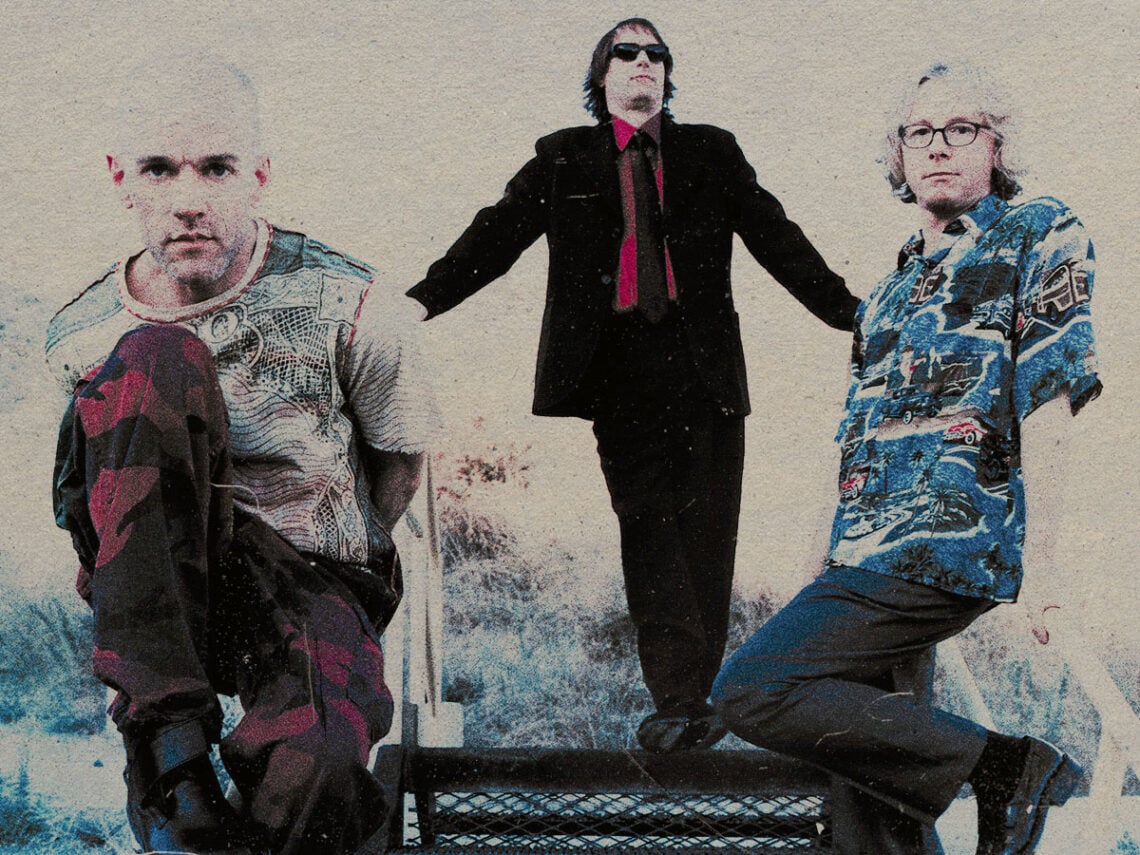
“I’m so proud”: The most complete REM record, according to Michael Stipe

At the halfway point of their career in the mid-1990s, REM had almost inadvertently scaled a mountain to become one of the biggest bands in the world.
Their original drive to subvert the dull norms of late ‘70s arena rock had now ironically led them to become an arena-sized act in their own right, boosted by the unexpected mainstreaming of all things “alternative” during the Papa Bush administration.
Of course, this was also the era when there was no greater offence an indie band could commit than to “sell out”, which could mean anything from pandering to a new audience or merely showing an interest in earning slightly more money for their work.
After leaving the independent IRS label for Warner Brothers in 1988, REM became one of the first and most conspicuous targets of this new witch hunt for sellouts. And while they survived the criticism pretty well by going supernova with the success of their biggest-selling albums, 1991’s Out of Time and 1992’s Automatic for the People, Michael Stipe and Co were nonetheless hounded by questions about cash and contracts.
It only got worse in 1996, when REM – coming off the comparatively disappointing response to their glammy Monster album – still managed to renew their deal with Warner for what was then a record-setting five-record, $80million contract. The alt-rock bubble was bursting around the same time, and critics smelled blood in the water by the time REM released their tenth studio album, New Adventures in Hi-Fi, in September of that year.

“There was a lot of misunderstanding about it,” Stipe told the Philadelphia Inquirer shortly after New Adventures had been deemed a “flop” by the industry. “People thought it was a live record, [that] it was something in between ‘real’ records. And a lot had to do with the [Warners] record deal, which was covered more than the music.”
“For me it brought home the bigger issue,” Stipe added. “At what point did everyone quit paying attention to artistry and start paying attention to how much something cost to make, how it did at the box office, how much people got paid to make it? . . . I anticipate the day that swings back and we start caring more about the advancements an artist is making.”
Unfortunately, one could argue that, 30 years later, we’re all still waiting for that pendulum to return. Stipe’s old gripe is very similar to ones many artists are making in 2025, reacting to the recent string of supposed high-profile flops in both the music industry and particularly in the movie business, as the media’s myopic view of art as a purely financial win-or-lose enterprise leaves very little room for risk-taking.
In Stipe’s case, he refused to let the outside narrative around New Adventures affect his own view of the album.
“I’m so proud of that record,” Stipe told Louder in 2021. “[New Adventures] might be as close as we came to being a four-piece rock band and I say that with no regret. It was Bill [Berry] and Mike [Mills] and Peter [Buck] performing at their very best as a three-piece and me doing what I do on top of that, creating a fearsome force.”
Part of the magic of New Adventures in Hi-Fi is that it was largely written and developed while the band were out on tour in support of their previous record, Monster, meaning that the songs were emerging organically on the road to serve their live show; rather than meticulously cooked up in an expensive Warner studio session.
Fans who jumped on the bandwagon during Out of Time didn’t necessarily gravitate to unorthodox singles like ‘E-Bow the Letter’ and ‘Bittersweet Me’, but time has been kind to the New Adventures, as it’s been increasingly viewed as one of REM’s best pound-for-pound records – and also an important separation point in their story, as it marked the band’s last album with original drummer Bill Berry, who retired after its release for health reasons.
“Looking back, it does feel like it’s pulling from all through our career,” Stipe said.
