


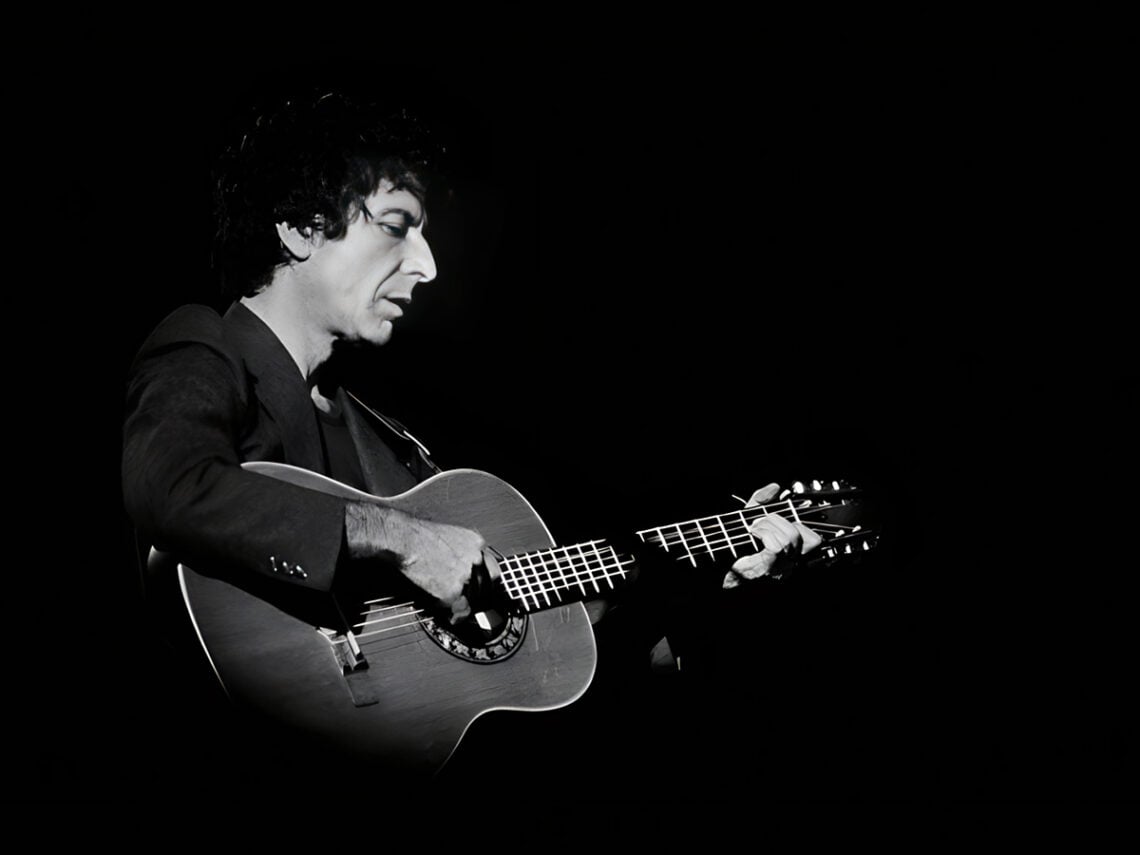
The never-ending impact of Leonard Cohen on new music

Chappell Roan famously says that she is “your favourite artist’s favourite artist,” but the reality couldn’t be further from the truth. It’s actually Leonard Cohen.
I appreciate that this comparison of a classic lyricist with a current chart star may have diehards screaming in horror and Cohen himself rolling in his grave, but the point to be taken from this is that he and Roan are not at all alike. No, but what they do have in common is an influence on other artists currently making their way through the canon, with the more prolific of the two wordsmiths obviously having a more transcendental impact than the other.
Despite Cohen having passed away almost ten years ago, it’s a testament to the man in both life and death that his music has bestowed upon the next generation, almost like a gift, with the poeticism of his wordplay striking inspiration into the hearts of musicians making waves across all genres, from pop to rock to country. Any musician would, of course, be happy with that legacy, but it seems an even greater triumph of Cohen’s that he appears as present in the psyche of the 2025 scene as he did in the 1960s.
Take his enduring magnum opus ‘Suzanne’, first released as a poem in 1966 before being recorded for Cohen’s debut album the following year, as the prime example. Those lyrics may now be closing in on being almost 60 years old, but their impact transcends to songs released as recently as within the past few months. Look at ‘Moth Song’ by Folk Bitch Trio, or ‘Cinder Block’ by Samia.
With the former, the recalling of the somewhat traumatic memories of enduring the death of a mother or grandmother, along with the blistering pain of unrequited love, it strikes a searing resemblance to the woman at the centre of Cohen’s ‘Suzanne’, who is famously “half-crazy but that’s why you wanna to be there/ And she feeds you tea and oranges that come all the way from China,” while the people left behind in ‘Moth Song’ are “half crazy/ That’s why I want it more/ And I just will not be told/ I know what I saw.”
This notion of misunderstood women taking on a spectral presence in the lives of those who immortalise them in song is something which lies at the heart of everything Cohen in all of his writing; love and loss, trauma and grief, reckoning and healing. But there’s also a huge element of liminal space which is also forced into this, as shown by Samia’ ‘Cinder Block’.
Directly quoting lines like “I’ve touched your perfect body with my mind” from ‘Suzanne’ and “This is my hallelujah,” obviously referencing ‘Hallelujah’, Samia openly admitted that she lifted many of her interpolations in the song’s lyrics straight from poems to evoke a feeling of “treading water”. As much as it’s a case of sampling in its own kind, you’d think Cohen might have accepted it for his words weaving through to the present day.
In that sense, when Cohen died back in November 2016, no one could have known how the legacy of such a prolific musician and wordsmith would have taken shape in a modern landscape so different to the way he lived. But like all our dearly departed relatives, you hear him in the sounds, see him in the crowds, feel him in the lyrics. There’s no better mark of a life well lived.
