


The myth of Woodstock: Culture’s biggest sham, or a true revolution?

The myth of Woodstock persists nearly six decades after the festival occurred for a number of reasons, all of which point to the awe-inspiring fact that such an event took place at all.
When Woodstock comes to mind, we think of Jimi Hendrix’s rendition of ‘The Star Spangled Banner’ closing out the long weekend on a Monday morning. We hear Janis Joplin’s wails, and the shred of a young Carlos Santana’s guitar (the neck of which, in a drug-induced haze, he hallucinated was a snake), countless moments of counterculture iconography and music history alike define the legacy of Woodstock, a festival that truly could only have happened in 1969, and even the efforts to replicate it in 1994 and 1999 (especially the latter) held no candle to the authenticity of the original.
The fact that the festival managed to occur, despite literally every obstacle fathomable being set in its path, is a mysterious wonder. Such is a testament to the sheer will of the people behind-the-scenes, and the dedication of those across the country who flocked to New York state to witness the events, but in remembering such a miracle, often cast aside are the weekend’s most disastrous moments, begging the question of just how “peace and love” Woodstock truly was.
In the summer of 1969, word-of-mouth spread the news that a three-day music festival was headed to Bethel in upstate New York, from August 15th to 17th, and soon, a bright-red poster advertising the festival began to circulate, reading “Woodstock Music and Art Fair Presents: An Aquarian Exposition, 3 Days of Peace & Music,” alongside a roster of musicians and a cartoon of a white dove perched on the neck of a guitar.
This very imagery that defined Woodstock persists today as a reminder of the idealism behind the festival: symbols of peace and unity evoked to bring people together. Thinking of my initial impression of Woodstock – as a wannabe hippie teenager a decade ago who poured over the Jefferson Airplane, Jimi Hendrix and Janis Joplin’s music – I can’t help but be drawn to the aesthetics, as well: visions of paisley prints, tie-dye and fringe, waist-length hair and bell-bottomed denim as far as the eye could see from the rickety wooden festival stage. For many, this is how Woodstock’s legacy persists: in visuals, rather than in proper ethos.

While the roster of musicians that eventually performed at Woodstock is enough to make any music fan a bit envious that they were not around to witness it themselves, beneath the fanfare were numerous elements that foreshadowed a controversial weekend ahead.
The fact that a projected crowd of 50,000 people turned into an estimated 400,000 – eight times what the festival’s organisers were prepared for – meant that catastrophes were inevitable. For one, tickets were barely checked upon entry, as the $18 cost for 3-days’ / $6 for one day’s admission was foregone once the droves of people began to show up. In turn, food was scarce: three men known as “Food for Love” catered hot dogs, only to quadruple the price when they were running out of food (two of their three stands were burned down in retaliation). The Hog Farm Collective offered countless cups of free granola as a consolation.
One portable toilet was allotted for every 833 people, with queues lasting for over an hour. Traffic queues, in contrast, were so backed up on the freeway that cars were abandoned as festival-goers walked on foot to get to the entrance, while some musicians were flown in by helicopter. Mud soaked the festival grounds, while the weather was overcast and rainy for the entire weekend. Medical emergencies ran rampant, with incidents recorded across epileptic seizures, asthma attacks, heatstroke, various foot injuries (on account of most roaming the festival grounds barefoot) and a staggering near-800 cases of “bad trips.” Two deaths were recorded at the festival: one person overdosed, and one was involved in a tractor accident.
The darker aspects of Woodstock are often forgotten or disregarded entirely, in favour of the lighter, more optimistic moments that are suitable to the overarching ethos of the counterculture. But what was supposed to be three days of peace, love and music became unruly and mayhem, before it even truly began.
Roger Daltrey’s rose-coloured lenses were quickly torn away when, just before The Who were to take the stage at 5:00am Sunday morning, his cup of tea was spiked with LSD. “Looking out unto the predawn gloom of Woodstock, making out the vague shape of half a million mud-caked people as the lights swept over them, I felt in my sleep-deprived, hallucinating state that this was my nightmare come true,” Daltrey wrote in his 2018 memoir, Thanks a Lot Mr Kibblewhite. “The monitors kept breaking. The sound was shit. We were all battling the elements and ourselves. Music and peace.”
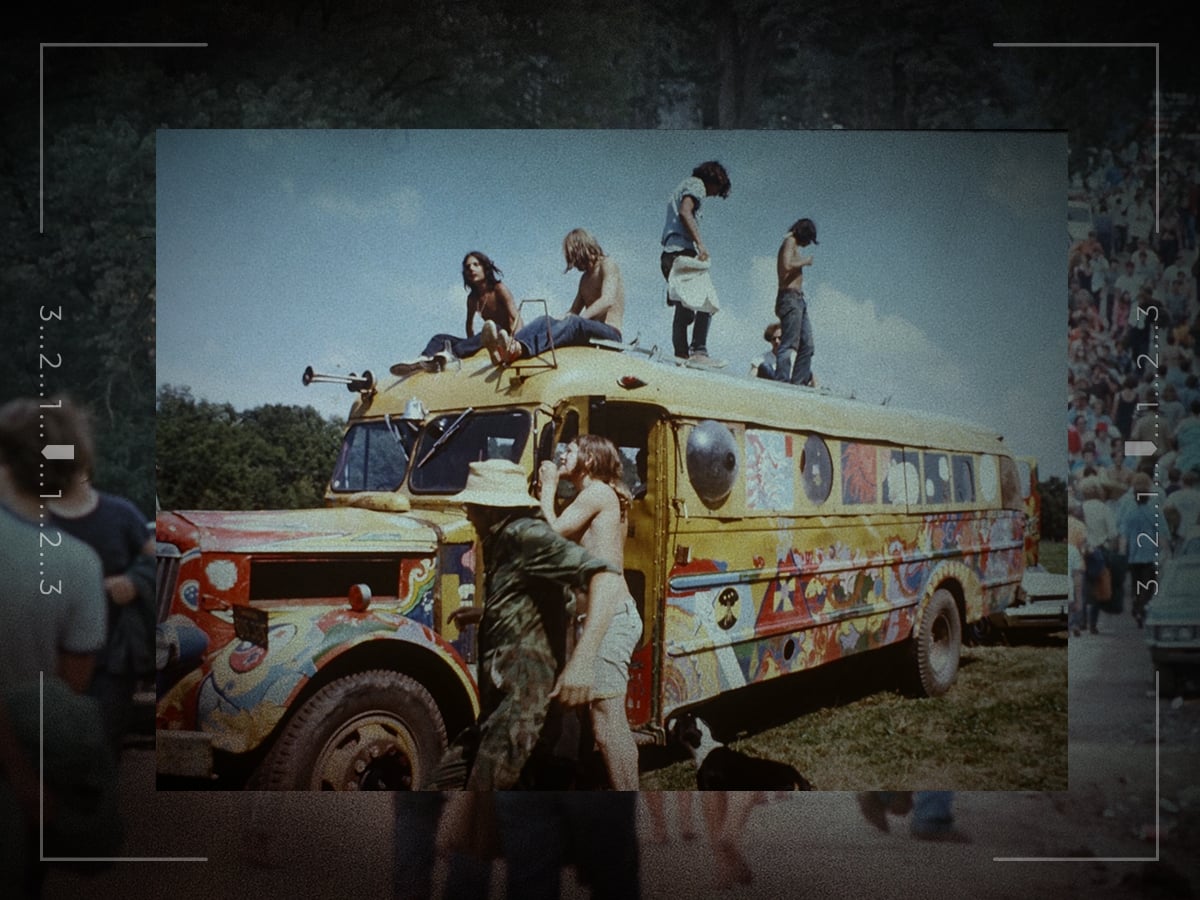
Had the counterculture become dominated by the ritual of taking psychedelics, in an effort towards “expansion” of the mind and radicalised ways of thinking? Maybe so, but in the context of Woodstock, the physical dangers of being on such drugs for days on end, coupled with its effects on the shifting of energy in the crowd, from optimism and excitement to paranoia, began to outweigh the intention of the festival, overall. If Woodstock was meant to be a revelatory moment in cultural history, why did it feel as though, beneath the guise of peace and love, there was hopelessness and danger?
Bob Dylan, for one, was outspoken about his disdain for the festival, as he famously, despite being a Woodstock resident at the time, did not attend or perform at the festival. Speaking with the Sunday Times in 1984, discussing the shift in American culture in the 1960s, Dylan said, “Like Woodstock – that wasn’t about anything. It was just a whole new market for tie-dyed T-shirts. It was about clothes. All those people are [working] in computers now.”
Despite Dylan being ever-so cynical, in a way, he was correct: again, the symbolism of Woodstock, rather than the sentiment behind it, overshadows its memory. For a festival occurring at the end of the 1960s, one of the most pivotal decades in America’s history, Woodstock had the power to make visible change – and in some ways, it did. The Women’s Rights movement, for instance, continued to make strides in the 1970s, as did environmental causes and the establishment of Earth Day in 1970.
“Woodstock offered an environment for people to express their better selves, if you will,” the festival’s co-founder, Michael Lang, surmised to Pollstar in 2019. “Give them that, and it seems to work. It was probably the most peaceful event of its kind in history.”
While the three-day weekend certainly was not all “peace and love,” the intention behind the festival does seem to have endured in our cultural consciousness.
