


The story of the four young men behind Woodstock

Much like its enduring British counterpart, Glastonbury, the tale of Woodstock begins with a benevolent dairy farmer.
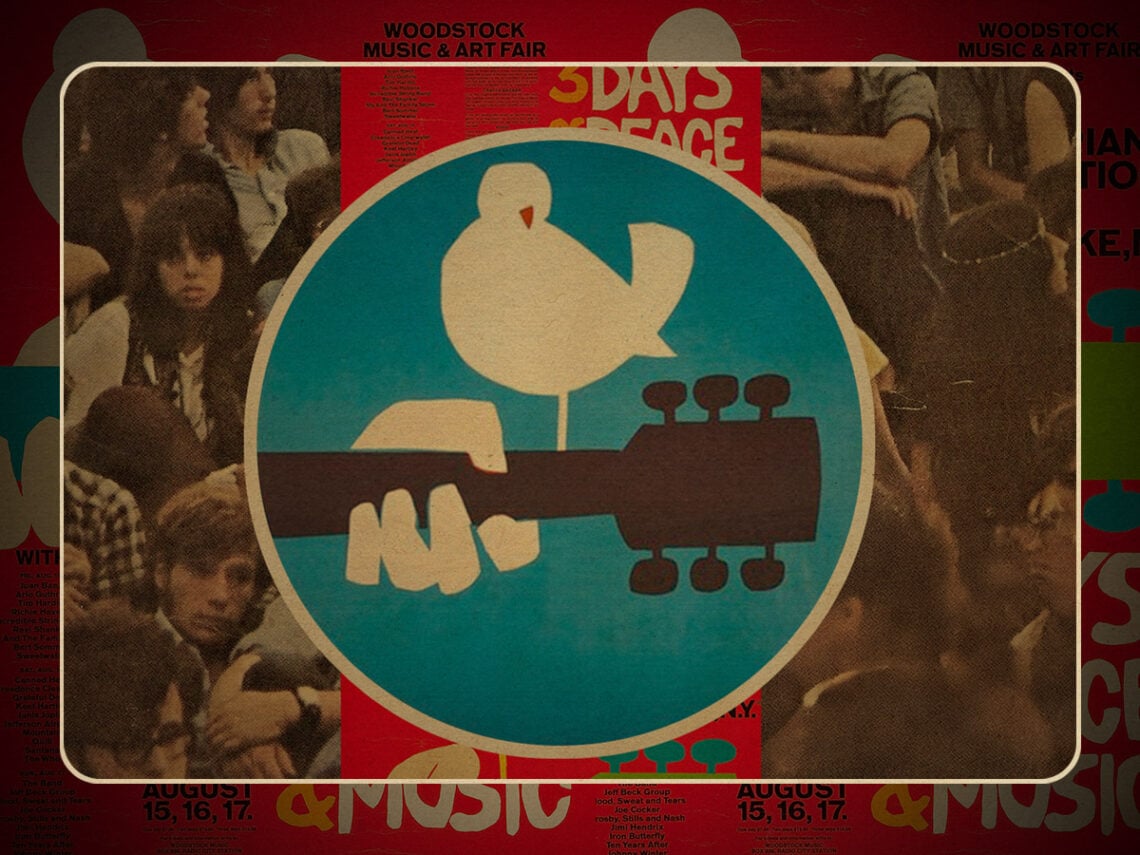
Initially advertised as the slightly less catchy “Aquarian Exposition: Three Days of Peace & Music”, Woodstock took place in August 1969 on Max Yasgur’s farm in Bethel, New York, 60 miles southwest of the town of Woodstock, and despite opposition from residents and a few choice signs proclaiming “Buy No Milk. Stop Max’s Hippy Music Festival”, permits were eventually granted by Bethel Town, and Woodstock would go on to become one of the most famous gatherings of all time.
Ironically, in later years, it was revealed that Yasgur was in fact a staunch conservative Republican who supported the Vietnam War, and it’s said that he felt the Woodstock festival could help business at his farm and tame the generation gap. His early death in 1973 prevented him from ever answering the lingering question of just why he agreed to allow the festival to take place at his farm, but business seems like a good place to start.
Woodstock was originally conceived as a for-profit venture, the brainchild of two pairs of partners, one of them being Joel Rosenman and John P Roberts, whom I like to think of as the early incarnation of Steve Jobs and Steve Wozniak. As a young man, Rosenman flirted with a music career and was even offered a recording contract by the head of A&R at Columbia Records, who’d heard him perform in Greenwich Village, but he turned it down, choosing instead the more virtuous path of venture capitalism with his friend John Roberts, whom he’d met on a golf course.
Roberts was, after all, the heir to the glamorous Polident/Poli-Grip denture adhesive fortune; hence, flush with capital, the duo embarked on the 1960s equivalent of launching a podcast: they began writing their own sitcom. The idea centred on two young male entrepreneurs with more money than ideas, getting themselves in trouble with silly business ventures, which was, of course, wholly fictitious. However, to save themselves from having to conjure up ideas for plot material themselves, they placed an advertisement in The Wall Street Journal identifying themselves as ‘young men with unlimited capital’ who were looking for pitches.
Having received many, many answers, varying from the absurd to the surprisingly tempting, our young venture capitalists realised that some of the suggestions were attractive enough to warrant evaluation as real investments, which meant the sitcom was shelved.
Among the respondents were our second duo, Michael Lang and Artie Kornfeld, with the former a seasoned promoter and the latter a seasoned music executive, who wrote to Rosenman and Roberts asking for funding to build a music studio in Woodstock, to encourage recordings by local residents Bob Dylan and Jimi Hendrix. Unpersuaded by the studio idea, our capitalists fired back with a counterproposal, a concert, to which Kornfeld and Lang agreed, and Woodstock Ventures was formed in January 1969.
Creedence Clearwater Revival were the first act to sign a contract for the event, and once the swamp-rockers had hauled open the floodgates, a whole host of other acts agreed to play, including The Who, Grateful Dead and Hendrix, making for one of the most legendary lineups of the time.
However, while this helped Woodstock reach an audience of nearly half a million, in doing so, it became a financial disaster, as the organisers lost control of site access. In the wake of the festival, approximately 80 lawsuits were filed against Woodstock Ventures, mostly by disgruntled local farmers, but fortunately, Kornfeld had had the foresight to persuade a kind Warner Bros executive to relinquish $100,000 so he could make a documentary about the festival.
The film financed settlements and paid off the $1.4million debt Roberts and Rosenman had shouldered from the festival, and the success of Woodstock also unexpectedly helped to save Warner Bros at a time when the production company was on the verge of bankruptcy. At present, Rosenman and Kornfeld are still alive, as Warner Bros edges toward a $62billion sale to Netflix, throwing the future of the cinematic media in jeopardy.
