


‘The Metaphorical Vehicle’: Sofia Coppola’s car window shots

All the best directors have signatures used as a way to show, not tell, what their characters are thinking. Stanley Kubrick had his maddening stare and Wes Anderson has his order and symmetry. But one of the most emotive is Sofia Coppola’s wistful car window shots.
Coppola’s debut short film, Lick The Star, saw the origin of several shots that would define her style. As if the director burst onto the scene with her visual identity already set and a self-assured certainty on how her work would forever look and feel, Coppola already seemed to really know herself since the beginning.
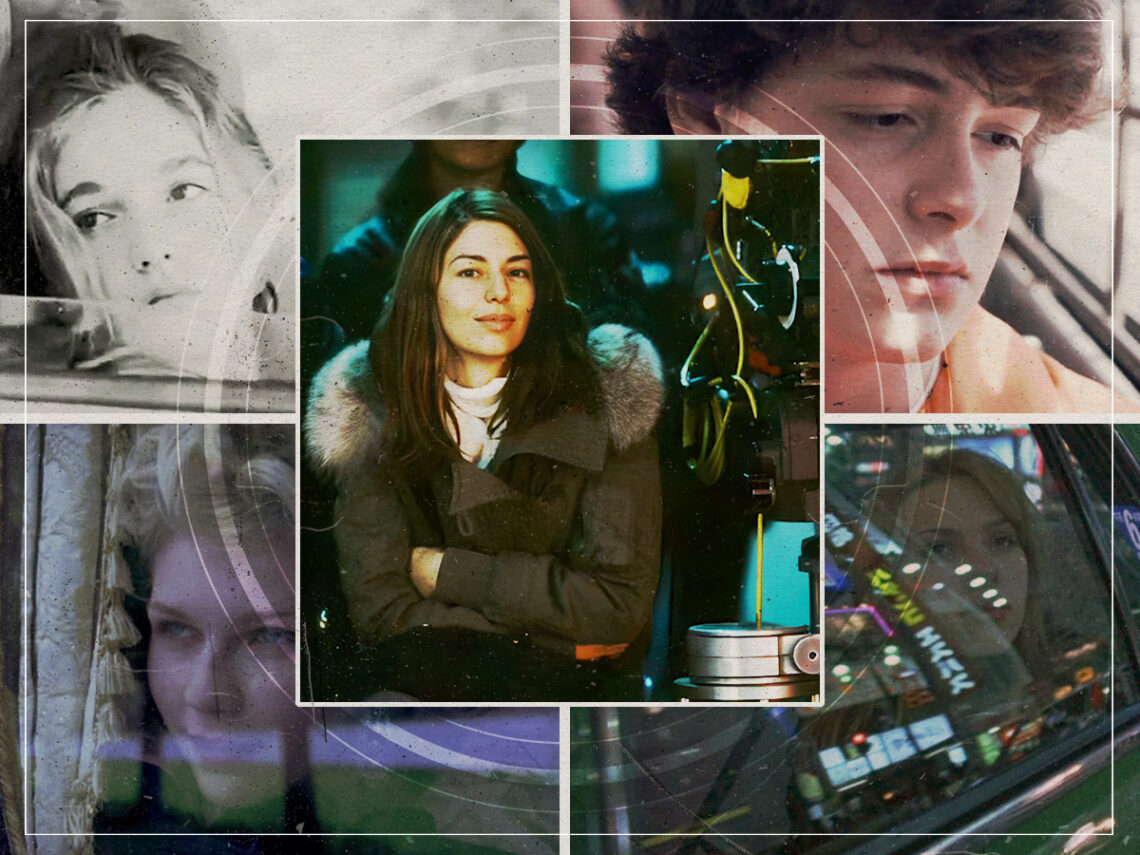
It’s a scene Coppola fans will recognise as it’s recreated nearly shot for shot in almost all of her movies. The image of Scarlet Johansson as Charlotte in Lost In Translation, gazing out the window as the bright lights of Tokyo go by, is one of the director’s most famous stills. Even in Marie Antoinette, the protagonist is shot looking out from the window of her regal carriage.
On the surface, the car window shots speak to the kind of romanticism and melodrama that all Coppola films buy into. Just as how everyone has found themselves listening to music and looking out the window, imagining their life as a music video, Coppola captures that very feeling. Turning the small-town suburban setting of projects like The Virgin Suicides or Lick The Star into cinematic backdrops, the car window is a portal turning the normal into the romantic, the sad or simply somewhere special.
But dig a little deeper, and Coppola’s car windows are a perfect metaphor for transience. Quite literally moving her characters from place to place, state to state, there has maybe never been a better-suited piece of imagery for the internal rollercoaster of change than a car window.
Let’s take The Virgin Suicides as an example. Waking up alone on a football field after being abandoned by the boy she likes, with the implication that she lost her virginity that night, Coppola doesn’t cut directly to the drama of the strict Lisbon parents seeing their daughter come home in the early hours of the morning. Instead, she dedicates an extended shot to watching Lux through a car window, with the moodiness of Air’s ‘Playground Love’ in the background and the shadow of dawn on her face.
The audience is invited into a moment of silent meditation as Lux travels to a life that will be vastly different, moving from the innocence of before to the punishments and rebellion that will come after she gets home. It’s a moment where the character’s internal monologue would no doubt be running wild. However, Coppola chooses to capture the hopeless stillness of it when there is nothing her figures can do to fight against change; they simply have to sit back, look out of the window, and deal with it.
In her latest movie, Priscilla, Coppola’s signature car shot plays a central role in character development. Once again used to represent change and contemplation, Priscilla gazes wide-eyed out of the window as a car drives her into Graceland, taking her away from her family and her teenhood into a different world.
But in the second notable car scene, in the film’s final moment, the feeling is more subtle. As she leaves Elvis, stating, “You’re losing me to a life of my own”, the audience last sees Priscilla in a car. Pulling out of the famous music note gates and away into a new life of her own making, she says nothing but simply drives as Dolly Parton’s ‘I Will Always Love You’ plays. Once again, it is a moment where Priscilla’s internal monologue would have been busy, spiralling around feelings of strength, fear, regret and determination. But the stillness of Coppola’s shot represents a beautiful and powerful surrender to change.
Not only are Coppola’s car window shots always beautifully done, but they’re also so rich with contemplation and feeling. A perfect metaphor for change, surrender and leaving one life behind for another, her cars operate on a philosophical and psychological level.
