


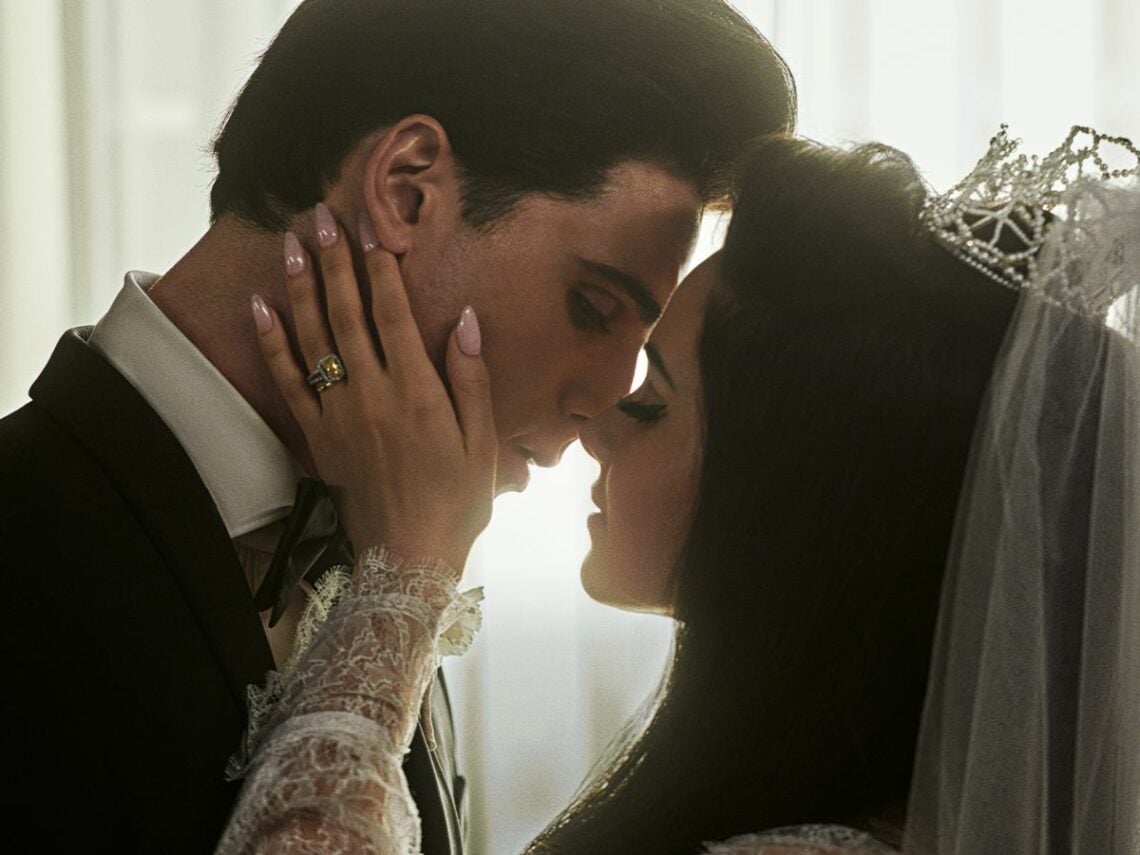
‘Priscilla’ movie review: Sofia Coppola shines the light on Graceland grooming

There’s a twinge of irony about the fact that the new Sofia Coppola movie, Priscilla, has followed on so quickly from Baz Luhrmann’s Elvis. Starring Cailee Spaeny in the titular role and Jacob Elordi as the ‘King of Rock and Roll’, Coppola’s film suggests that Priscilla Presley’s life was inextricably linked to that of her husband.
Where Lurhmann’s film went for spectacle (primarily succeeding in its mission), Coppola instead goes after the truth, basing the movie on Priscilla’s 1985 memoir Elvis and Me. As is often the case with Coppola’s work, Priscilla explores the nature of loneliness in affluence, isolation in the bright lights and, of course, growth from childhood innocence into femininity.
At 14, a chance meeting with Elvis at a West German US Navy base sees Priscilla Beaulieu immediately infatuated with him. After all, this is Elvis Presley, for Christ’s sake, the biggest cultural star of the 20th century. In Germany, Elvis exudes a loneliness that mirrors Priscilla’s own, and the two begin a courtship even at the reluctance of Priscilla’s parents. After some serious begging and arm twisting, Priscilla finds herself in the once inconceivable position of moving to Graceland with the singer, despite him being some ten years older – “Why our little girl?” Priscilla’s parents rightfully ask.
Back in Tennessee, though, we find that Elvis is no longer the sad, lonely and sweet boy with a lovely voice and sharp-as-a-knife jaw; he’s once again resumed his position as ‘The King’, the man who never loses, even for the sake of his suspected sweetheart. Priscilla finds that her days dreaming of laying in Elvis’ arms at the school desk were misguided. In reality, he’s a violent drug addict who lashes out one moment and drops his catchphrase – “I’m sorry, baby” – the next.
As Coppola’s movie unfolds, Elvis essentially manipulates and grooms this young girl into being his wife and keeps her behind the pearly gates of Graceland, away from his business and his adulterous movie productions, and even when Priscilla makes the transition from childhood to becoming a woman with needs who “wants to be desired”, he is still reluctant to touch her sexually.
Priscilla simply lives for Elvis, not with him. He is the one who decides they will marry; he is the one who will “become a Daddy” rather than the pair “becoming parents”. We find Priscilla drifting into rooms where Elvis resides as though she were already the spectre of Graceland, which essentially serves as her opulent prison, where she is eternally infantilised at the mercy of her husband.
Moments of happiness are captured on vintage film spools as memories preserved in the refines of the heart, and Coppola addresses the notion that she’s on the grounds of the iconic here. Props are given special reverence, highlighting them as the collectable memorabilia they will undoubtedly become.
Elordi purposely lacks the all-dancing, all-singing nature of Austin Butler’s Elvis portrayal from last year and in doing so, we’re afforded a closer and more intimate performance, though he still possesses the same unwavering charm and magnetism that both Butler and Elvis himself had. His version of Elvis, in all honestly, is quite silly, utterly unaware of his ridiculousness, say of a brief foray into counterculture – LSD, Eastern philosophy, books of which are later burned as “distractions” – and this feels closer to the truth and certainly more likely than the sympathy-garnering Elvis of Luhrmann’s film.
Spaeny does a brilliant job of portraying Priscilla, though, young enough to be able to capture the innocence of childhood and the pinch-yourself moments of being in Elvis Presley’s arms, but also having the maturity to make the transition into womanhood where she decides, at last, to live free from the grasps of men for the first time in her life.
As is often the case with Coppola’s films, Priscilla once again puts forth the idea that wealth and aspiration will always play second fiddle to what human beings genuinely want (regardless of their levels of affluence). All Priscilla wanted was to be loved and cared for, to live her own life in partnership with her husband, and what she got was a drug-addicted, self-obsessed, cultural phenomenon – a phenomenon that she would never entirely be able to remove herself from.
