


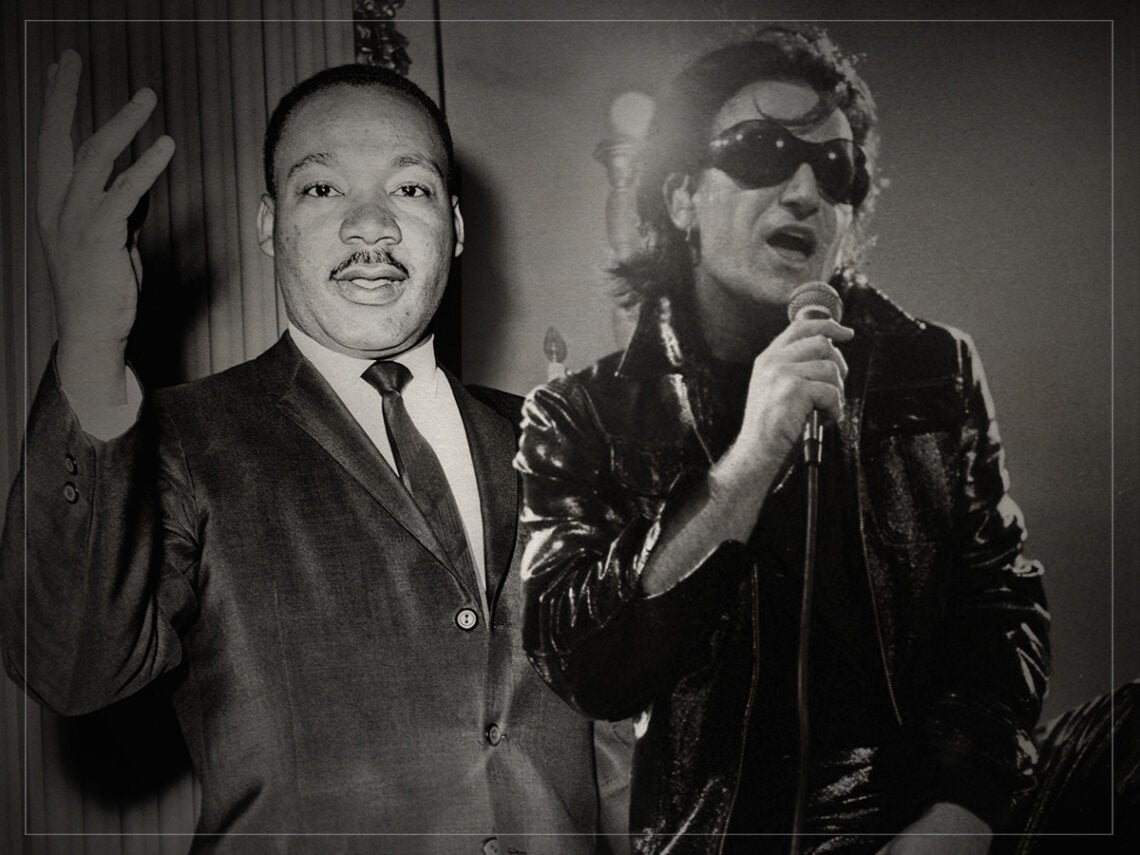
The glaring historical inaccuracy in U2’s tribute to Martin Luther King Jr

While love is a universal emotion and so rightly used as the most common subject matter in songwriting, it does get tiring after a while. Maybe it’s the cynic in me, but I quickly get fatigued of continued declarations of love and so passionately search for musicians who offer an alternative.
It’s what made punk and psychedelia such captivating genres, for it opened up a world where new subject matters could be explored with artistic integrity. Whether it was politics, religion or outright comedy, great musicians proved that exhausted tropes weren’t required to innovate in the space.
But it was a fine line to tread. Especially when it came to political art, there was a requirement for music to be considered impactful and, at the very least, accurate. But as music’s resident philanthropist, you would be forgiven for expecting Bono to hit those notes without any flaws. He regularly took U2’s music into activism, with songs like ‘Sunday Bloody Sunday’, ‘New Year’s Day’, and ‘Walk On’. And largely, they were created with the sort of careful nuance I previously mentioned was a prerequisite for anybody delving into that territory.
But on ‘Pride (In the Name of Love)’, he made a factual slip-up that has sadly haunted him ever since its release. The song was a tribute to the great Martin Luther King Jr, celebrating those who practiced nonviolence as a way of protesting for social equality and allowed the specificity of his story to foreground that.
“I remembered a wise old man who said to me, don’t try and fight darkness with light, just make the light shine brighter,” Bono once claimed in an interview. It was a realisation that allowed him to change the song’s stance from one of pointed anger to one of compassion. Explaining the subject, he said, “I was giving Reagan too much importance, then I thought Martin Luther King, there’s a man. We build the positive rather than fighting with the finger.”
So Bono went about paying tribute to the civil rights activist, with rather sweeping lyrics of his pride being everlasting. But to his detriment, he used one line to be specific about the shooting of King, which took place on a Memphis motel balcony on April 4th, 1968. Bono sings, “Early morning, April 4 / A shot rings out in the Memphis sky” despite King actually being shot at 6:01pm local time.
The U2 frontman has since acknowledged the mistake and has changed the lyrics during live performances of the song. Now, in a more considered tone, he sings “Early morning, April 4” removing any distractions for the listener and redirecting their focus to the all important storyline.
The song then featured on the band’s 1984 record The Unforgettable Fire, which came out three years before their iconic record Joshua Tree. But on the tour for that record, they began in Tempe, Arizona, where the governor was opposed to Martin Luther King Day being made a US federal holiday. Things escalated to a point where the band received multiple death threats, with one even outlining how he would shoot the singer upon arriving on stage.
Bono recalled in the band’s book U2 by U2, “One night the FBI said: ‘Look, it’s quite serious. He says he has a ticket. He said he’s armed. An he said if you sing ‘Pride (In The Name Of Love),’ he’s going to shoot you.’ So we played the show, the FBI were around, everyone was a little unnerved. You just didn’t know, could he be in the building? Up in the rafters? On the roof? During ‘Pride,’ I was singing the third verse, ‘Early morning April 4, a shot rings out in a Memphis sky.’ I just closed my eyes and sang.”
Sure, Bono may have made a lyrical mistake, but when it came to performing the song when it truly mattered, he delivered, and for that, the sentiment of the song can never be questioned.
