


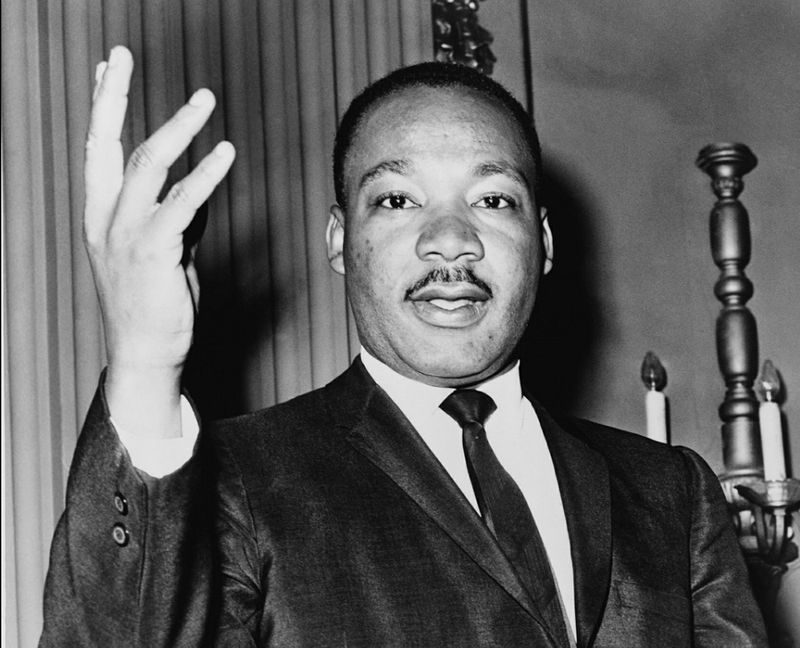
Martin Luther King Jr on the music that powered the ‘Freedom Movement’: “Speaks for life”

In such a monumental historical era as the American Civil Rights Movement, it’s easy to forget what a seismic role music had to play in soundtracking the beats of the revolution. But, in many ways, this should really come as no surprise – don’t we use songs in our everyday lives as emotional markers of our pain, our joy, and our strength? Martin Luther King Jr was no different. Through his plight for justice in the ‘Freedom Movement’, he said there was one particular genre that gave him the power to be “triumphant”.
From the period of 1954 to 1968, when the civil rights era was at its peak, concurrent was the popular rise of jazz music amongst the Black American demographic, with its musicians also often acting as public martyrs for the cause through their bold and unwavering lyrical commitment to desegregation. These were the likes of John Coltrane, Duke Ellington, Billie Holiday, and so many more, whose contributions to the world of jazz lit the sonic fire for freedom.
King, writing for the 1964 Berlin Jazz Festival, explained the eloquent power of the genre in rallying the population and giving them the capacity for emotional release. He said: “Jazz speaks for life. The blues tell the story of life’s difficulties, and if you think for a moment, you will realize that they take the hardest realities of life and put them into music, only to come out with some new hope or sense of triumph. This is triumphant music.”
But as he put it himself, more than just being a source of musical entertainment, jazz had the remarkable ability to channel the starkest of pain into its depths; it managed to be the mouthpiece for racism when others were not able to put it into words: “Long before the modern essayists and scholars wrote of racial identity as a problem for a multiracial world, musicians were returning to their roots to affirm that which was stirring within their souls.”
Adding, “Much of the power of our Freedom Movement in the United States has come from this music. It has strengthened us with its sweet rhythms when courage began to fail. It has calmed us with its rich harmonies when spirits were down.” The power of the songs he alluded to more than likely comes from those such as the aforementioned Coltrane and Holiday, both of whom, among many others, penned songs in direct response to specific moments in the movement. Coltrane’s ‘Alabama’, for example, from 1964 about the bombing of a church which killed two Black girls, was rhythmically inspired by a speech King himself had given. Every aspect of this era was connected, and each beacon stood on the shoulders of the other for power.
However, jazz spoke to a much wider scale than purely those who were fighting for justice. As King expounded later in the same essay, it was also a call to arms for the rest of the world. He said that despite the specific plights of Black Americans at the time, “There is something akin to the universal struggle of modern man. Everybody has the blues. Everybody longs for meaning. Everybody needs to love and be loved. Everybody needs to clap hands and be happy. Everybody longs for faith. In music, especially this broad category called jazz, there is a stepping stone towards all of these.”
There could never be a truer word said. Away from all the brash lights of rock and roll and the glamourous slickness of the pop canon, King really exposed the meaning of music laid bare – power. Jazz was a mouthpiece to the soul as well as an eye to the world in Freedom Movement America; the strength of that, much like Martin Luther King Jr himself, cannot be understated.
