


The one guitarist Stevie Ray Vaughan thought everyone should study: “A wonderful cat”

To be a true impresario is to seemingly arrive on a particular scene completely readymade for the job at hand. Across the many decades of rock music, many have been heralded as such a savant-like player of the guitar. But despite also being given the accolade, Stevie Ray Vaughan was a lifelong student of the blues.
To be a true great one must study, and Vaughan certainly did that. He immersed himself in music and became a student of the blues like a young fighter learning from the masters of kung-fu. With every night spent honing his licks, Vaughan would become a devastating deliverer of the blues.
Wearing his influences on his sleeve, he weaved the tone of his favourite guitarists into his own iconic sound but somehow constantly emerging reinvented, bringing old-school blues to the masses with his electric take on the genre.
The groundbreaking nature of his debut with Double Trouble, 1983’s Texas Flood, cannot be understated. He deftly bought blues to the mainstream while tipping his hat to the great forefathers of the genre, the likes of Howlin’ Wolf and Buddy Guy.
While Vaughan consistently used his platform to elevate older blues players, he once named his favourite younger player as Eric Johnson. The pair had grown up in the same circles in Texas, which in the early 1980s became something of a cultural mecca for blues. When they were teenagers, the pair even considered forming a band together, which speaks to their musical history.
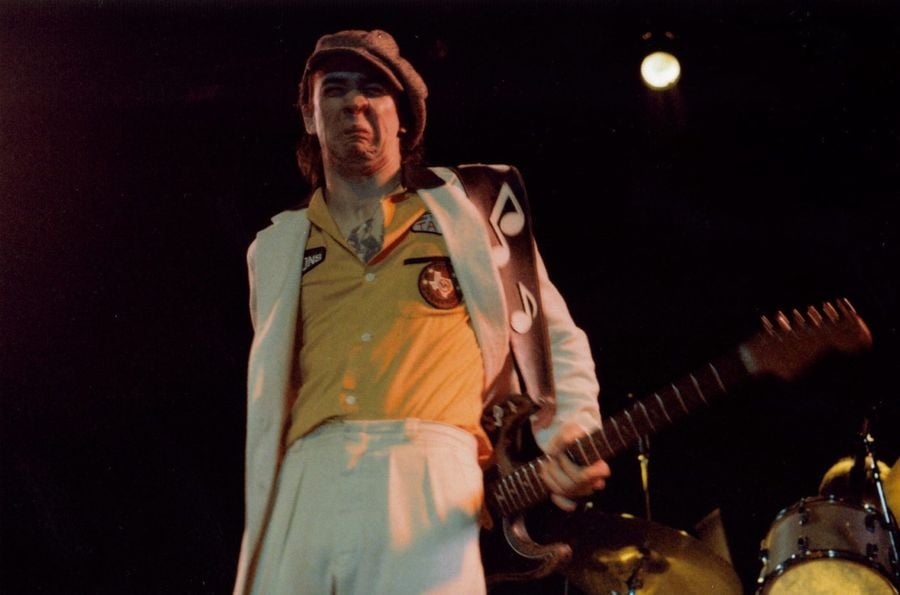
Vaughan spoke to Guitar Player in 1986, fresh off the success of Texas Flood, but still using his voice to praise his peers. “Eric is a wonderful cat,” he told the publication. “He’s always been one of my favourite people in the world, as well as one of my favourite guitar players. The guy has done more trying to be the best that he can be than anybody I’ve ever seen.”
The interview was right on the heels of Johnson’s debut album, Tones, which would see Johnson nominated for ‘Best Rock Instrumental Performance’ at the 1987 Grammy Awards for the atmospheric ‘Zap’.
Vaughan credits Johnson’s diligent nature for his sound, saying he played “all the time” and would always try to get his instruments in “perfect shape” before jamming. “He works hard on his tone,” said an emphatic Vaughan. “Sound, techniques. And he does incredible things with all kinds of guitars. Electric, lap steel, acoustic, everything.”
Johnson had, in fact, recorded another album before his official debut, but after various legal issues, Seven Worlds was released in 1998. But Vaughan had the chance to listen to the unreleased album and swore if it was released in the late ’70s, Johnson would have been hailed the new Jeff Beck.
“Few people understand that when the guy was 15, he was playing Kenny Burrell and Wes Montgomery stuff,” said Vaughan of Johnson’s innate talent for blues. “If the record that he made years ago, Seven Worlds, had come out at the time it was ready, instead of being held back for the reason of dollars and pennies – he would have been as big as Jeff Beck.”
Although Johnson was dogged by bad timing, his knack for blending modern jazz, fusion and rock in a blues-infused balm likely would have been a hit in the late ’70s. “The guy deserves a lot more recognition than he’s ever gotten,” Vaughan insisted. “Eric is an honest human being. He cares about everything. Just listen to him and learn.”
To be a player whom Vaughan notes needs to be heard and, above all else, studied by players everywhere is to be a truly incredible instrumentalist. For that reason alone, you should get yourself on to the sounds of Eric Johnson.
