


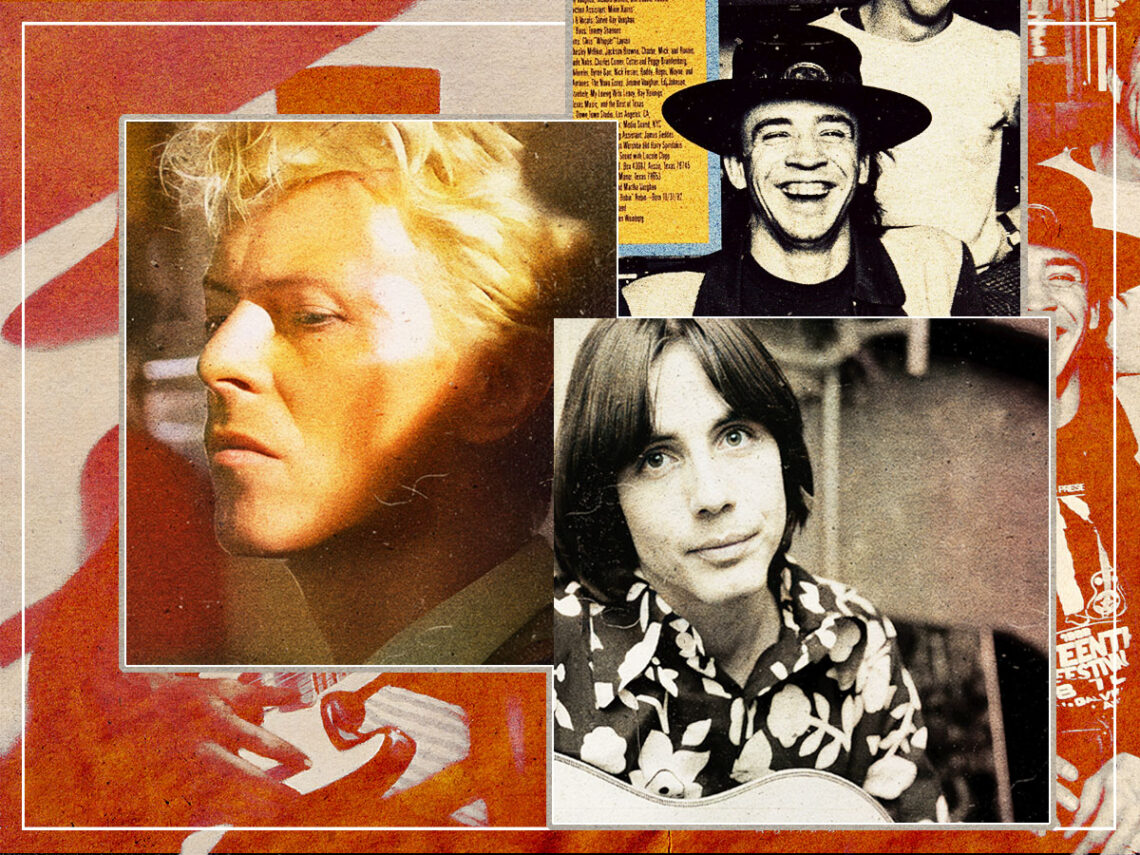
Jackson Browne, Bowie and Blues: The making of ‘Texas Flood’

Texas Flood was an album that categorically shouldn’t have broken through the pop culture periphery. Where record labels had previously dismissed blues artists as nostalgia acts, through a series of happy accidents involving David Bowie, Jackson Browne, and John Hammond – Texas Flood brought fresh energy to a long-forgotten form of making music. With Stevie Ray Vaughan on lead guitar and vocals, Tommy Shannon on bass, and Chris Layton on drums, the trio’s high-energy take on blues balanced technical finesse with raw, emotive playing, managing to breathe life into a genre that had been laying dormant since the sixties.
John Hammond was not only instrumental in producing the groundbreaking record, but was arguably responsible for the sixties revival of prewar blues artists that inspired the band, having entirely reissued and published the work of thirties blues legend Robert Johnson in 1961. During the brief 1960s blues-boom, audiences searching for a similar sound to Johnson’s found it in the weary drawl of singers like John Lee Hooker and Leadbelly, whose music spoke to a post-war solemnity and served as a painful reminder of America’s racist roots as the Civil Rights Movement raged on. But by the time of Texas Flood’s release, general interest in blues had long dwindled.
In its place was a newfound cultural optimism, which was reflected in the excessive displays of synth and hairspray championed by musicians at the time. Reagan had just announced the Strategic Defence Initiative whilst upbeat tunes from A Flock Of Seagulls and Hall & Oates dominated the charts. But people didn’t want to think about nuclear weapons, they wanted to dance. Disco and R&B were exploding. Yet in June 1983, seemingly from out of nowhere, Texas Flood broke the Billboard Top 200 on its debut, disrupting the steady flow of pop music to deliver an old-school sound that called back to blues greats like Howlin’ Wolf and Buddy Guy. And they delivered it to audiences intent on dancing their blues away, not listening to them.
When Shannon moved to Dallas after finishing high school, he discovered that while the blues doing well commercially might have been a distant memory, it was still raging away in clubs in the Southern state. “It was magical,” recalls Shannon. “In the late seventies, a lot of blues musicians that couldn’t find work anywhere else discovered Austin, people like Muddy Waters and Johnny Winter. Then, all these great musicians from Dallas moved to town, and it was one of the biggest blues scenes in the country at the time,” he says.
Andy Eledort, co-author of Texas Flood: The Inside Story of Stevie Ray Vaughan credits Shannon’s time with Johnny Winter recording 1968’s The Progressive Blues Experiment for helping to create the foundation of what the blue rock sound was, right on the heels of Cream and Jimi Hendrix. “We have to give Tommy a lot of credit,” says an empathic Eledort, who spent time touring and playing alongside Shannon in the nineties. “His bass playing is phenomenal. And he knew how to play in a trio, which was hugely important. The sound of a trio is very specific, with just one guitar, bass and drums. It’s where all your sound is coming from. And that’s what Johnny Winter’s sound was, and that’s what he created with Vaughan and Double Trouble – just guitar, bass, and drums.” Shannon had all the might of great bassists like Jack Bruce and John Paul Jones but traded the psychedelic sensibility favoured by English blues-rockers for hard, powerful blues fills.
But Layton was a latecomer, both to Texas and the blues. He came from Corpus Christi, where the in-crowd had just discovered Herbie Hancock’s Headhunters and were fond of jazz and funk. When he moved to Austin, he found himself sitting down with Paul Ray and The Cobras. Vaughan needed a drummer, but Layton had never played blues before. “Back then,” he tells us, “he wasn’t the guy that you might know now from records, but God, he just had this thing. I’ve never heard anybody like it – he was amazing.” After hearing Vaughan play, he decided then and there that he wanted to be part of his band. After a few line-up changes to the original Double Trouble, by 1981, the band had become a power trio, billed as Stevie Ray Vaughan and Double Trouble when they gigged around Texan clubs like Fitzgerald’s and The Fog. With Shannon and Layton making up the rhythm section for Vaughan, the marriage of Shannon’s deep, rock-heavy bass playing with Layton’s lighter, more jazz-driven drumming allowed the band total artistic freedom. It meant they could play intense, more modal blues as easily as they could veer into a charged-up rock sound.
“I always found it fascinating,” says Layton, “that Stevie liked that I didn’t have any preconceived ideas about what blues was, what it’s supposed to be, and how it was supposed to happen.” He remembers sitting on a curb in Portland next to the late Mitch Mitchell, drummer for The Jimi Hendrix Experience, laughing about the fact that Mitchell hated rock music, despite his band’s heavy output. “It didn’t matter that he was a jazz drummer,” says Layton. “I think that’s why The [Jimi Hendrix] Experience was so awesome. They did whatever sounded good to them, and they knew it was real without needing to define it.” The same kind of stubborn refusal to bow to expectations of genre meant, in the early days of gigging around Austin, the band still covered artists like Freddie King and Larry Davis, but never let themselves get wrapped up in the “pigeon-holed, traditionalist” ways of playing. Shannon never gave it much thought either, entirely unconcerned with what people thought he should sound like. “I’d been playing the blues for so long, I just developed my own style over time,” he says. “It just kind of came out from the inside.”
“Between Tommy and Stevie and I, we were kind of contrarians, to begin with,” says Layton. People would point out that pop and new-wave were in vogue, gently suggesting the sounds of Culture Club and The Psychedelic Furs spoke more to the hip and happening direction of music at the time, but the band wasn’t fazed. “We felt, what’s ‘happening’ is what we do with our lives and our music right now,” says Layton. “We ran into that a lot,” agrees Shannon. “But we just cut through all of the commercial stuff that was popular then, and stayed true to our own music.” Texas Flood is often credited with introducing new audiences to blues long after its commercial heyday had fizzled out; but while some critics would say this was alienating for new listeners, others would balk at their vamped-up, high-energy take on it, insisting it had strayed too far from its original influences. The blues have often been bound by this kind of purity culture, but the discernible listeners who could distinguish Delta blues from Piedmont blues would have instantly rejected Vaughan’s firebrand style of playing anyway. They were never playing to appease those people.
“As far as I’m concerned, the origins of that music go all the way back to being a release for field hollers, before people were even playing guitar. People sang and expressed themselves and that became a specific, cultural expression of Black America,” says Layton. “There are all kinds of influences, and there are all kinds of ways that idea has lived out. We were a product of all of that history, so we never identified ourselves. It was a practice that really spoke to us, that idea of actual emotional expression.” Rather than feeling stifled by the confines of the traditional, 12-bar structure, the band found the simplicity freeing. “We’d ask ourselves: ‘What can we do to express ourselves within this one simple idea,’ and then it became kind of limitless,” he explains.

They continued to experiment and refine their sound over the years they played the Austin circuit, eventually finding themselves playing at the Montreux Jazz Festival in 1982, thanks to a little intervention by producer and music industry heavyweight Jerry Wexler on their behalf. “On our first trip there, they put us on the wrong stage,” recalls Shannon. “We ended up on a stage that was meant for quieter, acoustic performances, and we played loud – real loud. People weren’t ready for that.” It was put off by Vaughan’s aggressive guitar licks and potentially the fact that the blues trio in front of them were all white – there were audible boos from the crowd.
Dejected, the band slunk backstage, baffled by the reception they got. “I’m not sure why, but David Bowie happened to be in the bar that night,” remembers Shannon. The mood was instantly lifted when a festival employee told them the English rockstar wanted to meet them. “He was obviously impressed with Stevie’s playing and came up and introduced himself. It wasn’t long after that he invited Stevie to play on his next album and join his band on tour.” Vaughan said yes, and although it was assumed it would never come to pass, it was the first in a series of fortunate moments that paved the way to Texas Flood’s eventual release.
After an introduction to Bowie salvaged the first night’s disastrous set, the band found themselves hanging around idle the next day, when their manager suggested they might as well set up their gear and play in the musician’s bar whilst Jackson Browne played a show upstairs. As Browne wrapped up his set with Late For The Sky, people started piling into the bar, until eventually Browne and his band joined the crowd of onlookers, compelled to walk right up to the front when he heard Vaughan and Double Trouble play. When they wrapped up, Browne was full of questions. “He was like: ‘Who are you guys? And where are you from? Can we jam with you?’” says Layton.
Both bands played until the sun came up the next morning, and it was then that Browne offered them a place to record a demo. “Jackson’s band was great, and he was so impressed that he invited us to California to record in his studio. I don’t know if he really expected us to take him up on his offer, but that invitation changed everything for us,” says Shannon. He promised the band that whenever they wanted it, it was theirs. They took that quite literally.
Layton was reminded of this at a NAMM (National Association of Music Merchandisers) show in the West Coast four years ago when he ran into Jackson Browne. “He was kind of pissed,” says Layton, with a laugh that somehow has a Texan twang to it. This was after Texas Flood: The Inside Story of Stevie Ray Vaughan had been published. “He comes up to me and says, ‘Hey man, that book came out and nobody ever talked to me.’”
I said: ‘Yeah, they did, the authors called me because they were trying to get a hold of you and didn’t hear back,’” (when I email Browne to verify this, I don’t hear back). Affecting the voice of a disgruntled Browne, Layton continues: “So Jackson says, ‘Well, they talked to all the wrong people because I’ll tell you what should have been in that book.’”

It wasn’t until Browne reminded him, that Layton remembered Vaughan had been busted for cocaine before they recorded Texas Flood. A pretty major term of his probation dictated he wasn’t to leave Travis County without talking to his probation officer, or he could have gone to prison. “Meanwhile,” says Layton, “we were in a run-down milk truck racing for the West Coast.” They’d hastily put together a few gigs to cover gas money and food before showing up at Browne’s door on Thanksgiving weekend, without so much as a call to warn him.
Their manager, Chesley Millikin, eventually called Browne to express the severity of the situation, telling him Vaughan wasn’t supposed to leave, he didn’t check in with his probation officer, and he’d be surprised if he didn’t get thrown in jail. “Funny enough,” says Layton, “Stevie always used to say he wanted us to play music like we were breaking out of jail.” Not only did Browne have a potential fugitive on his hands, but they’d shown up without any tape to record on. Exasperated, he told studio engineer Greg Ladanyi to use the two-inch tapes he’d been using to record pre-production on his own album, Lawyers in Love. After that, he told the band it was Thanksgiving weekend, they might’ve had free use of the studio – but he was heading home.
Over the few days it took to record Texas Flood, they recreated the feel of playing live, setting up in a corner in a small circle as they tore through their material. Shannon explains that Ladanyi was less than enthusiastic about this last-minute project, and it was initially a slow start. “He just didn’t understand our sound and how we liked to play, until he finally agreed to let our engineer, Richard Mullens, take over,” he says. “Once that happened, we got to work. We set up in the studio just like we set up for a show.” Mullens was an old friend of the band who’d often seen them play live and was only in town by a sheer stroke of luck, recording close by with Christopher Cross. Once he was bought into the fold, Ladanyi left after a dinner break, and things were back on track. They managed to record two songs in full that night, and eight the next day, newly emboldened by the addition of Mullens.
“As a rhythm section, I think me and Chris gave Stevie a firm foundation when we were on stage,” Shannon continues. “He was able to focus on his playing and knew that wherever he went musically, we’d be right there with him. I think that gave him a lot of confidence,” says Shannon. That’s what’s captured most purely on the album, which plays like a polished run-through of the sets they’d performed, penniless, in Austin for years. Even in the confines of this intimate setup, the confidence Double Trouble allowed Vaughan practically hums off his guitar. On the opening original track, ‘Love Struck Baby,’ he plays with an assured swagger befitting of his future stardom. His fretwork was fast – played with an urgency that lent itself to rock but never lost its Texan blues swing.
But they were consistently versatile across the album, able to drop the pace on the more introspective ‘Texas Flood’, a Larry Davis cover that sees Vaughan’s guitar practically wail. On the closing track ‘Lenny’, a dedication to Vaughan’s wife, the influence of Layton’s jazz-fusion roots drove the song to almost whimsical, romantic heights while somehow retaining a mid-tempo blues feel driven by his steady pedal. The tremendous feat of the album is that despite the blatant embrace of Vaughan’s direct influences – the scream of Albert King’s guitar or Howlin’ Wolf’s pleading vocals – the cover songs like ‘Tell Me’, ‘Testify’ and ‘Mary Had A Little Lamb’ never sound like cheap imitations. They remain an enduringly unique take on legendary blues tracks, showing the music industry blues had commercial viability and elevated the voices of the powerhouses they were tipping their hat to.

After running through the songs a handful of times each, they took the tapes and headed to Los Angeles to play a few gigs, when Layton was woken by a hotel phone ringing in the early hours of the morning. On the other side of it was David Bowie, who wanted Vaughan to play guitar on ‘Let’s Dance’. Stevie flew out to New York to join Bowie Vaughan and producer Nile Rodgers, who’d laid down all the tracks except the lead guitar. It was undeniably a pop song, but Vaughan’s solo on ‘Let’s Dance’ was played with the powerful twang of Albert King. It topped the charts in the US and the UK, and the radio play it got was most listeners’ first introduction to Vaughan’s electric style. Eric Clapton has said that hearing it on the radio first the first time made him stop his car as he was driving, desperate to know who was playing guitar on it. So when Bowie invited Vaughan on a year-long tour, it seemed clear he was headed for stardom. “Lucky for us,” says Shannon, “that never happened.”
Nobody knows quite why Vaughan never made it to the tour, it’s been speculated that it was a dispute about pay, or drugs – or the fact someone was miming Vaughan’s solo in the video for the single. Regardless, it gave Double Trouble an extra impetus to get their demo tapes out whilst everyone was talking about the man who quit Bowie. “I don’t know if Texas Flood ever would have happened the way did if Vaughan didn’t play on that song,” explains Paul. “It was huge, not only for raising his profile and for setting the stage for people wanting to hear him, but the song itself was a massive radio hit, and it effectively bought the sound of Albert King to a totally new audience.”
Seizing on this momentum, Layton and Shannon were back in Austin when they decided to urge their manager to call up industry titan John Hammond. At this point, Hammond was approaching his late eighties and didn’t have the ability to sign them himself. But after hearing the tape, he promptly called up old friend Gregg Geller at CBS Records, essentially demanding they give them a deal. Having discovered the likes of Billie Holiday and Bessie Smith, Hammond was such a trusted voice that Geller instantly signed them with little more than his approval to go off. “So we had a record deal and the tapes that would become the record,” says Layton, “and it was almost unbelievable how quickly things came together.”
Hammond then approached Lincoln Clapp to mix the album. “Of course, John Hammond had such a fabulous reputation that I said yes,” recalls Clapp. But it wasn’t without a bit of trepidation. “This was the early ’80s, after all,” he explains. “It was the disco era, and I was an R&B fan. That’s what I had done a lot of in New York, I’d worked with Aretha [Franklin] and Whitney Houston.” Nonetheless, he agreed to meet with Vaughan to discuss the direction of the album. Clapp was shown to a room in a hotel in New York and waited for the blues prodigy Hammond had promised. “I waited, waited, and waited,” he says. Finally, he decided that Vaughan was a no-show, and he had other things to do anyway. He got up to leave and headed towards the elevators when the silver doors slid open to reveal Vaughan. He was still relatively unknown at this point, and Clapp didn’t even know who he was looking at. “I saw the huge hat with all the medallions, a beaver tail hanging off it, and I thought, this has got to be the guy.”
Clapp soon got to work on mixing at Media Sound on West 57th Street. Just like its recording, the process was unusually quick, taking only three days. Sat at a 60-input desk with two-inch 24-track tapes, he remembers listening to the album for the first time, admitting that while was never a blues man, he was stunned by their electric sound. “This was the first time I’d heard any of this stuff,” he says. “I thought, my God, this is good. Sometimes it’s hard to make a trio sound huge, but Stevie just drove the band like crazy. He was filling in everything during the leads and the rhythm. I quickly became a fan and enjoyed it a whole lot.”

When Texas Flood and its two accompanying singles, ‘Pride and Joy’ and ‘Love Struck Baby’ were released in 1983, the album peaked at Number 38 on the Billboard 200 chart almost overnight, going double-platinum in the US, which was entirely unheard of for a blues album. “It was like all the pieces fell into place,” says Aledort. “It’s kind of amazing that they broke through after slugging it out for so long, being broke and living on couches when things weren’t looking too promising.” But those nights on couches playing gigs for less than $200 are exactly why Layton scoffs at the idea that Texas Flood was an overnight sensation.
“There was a whole bunch of life experiences that went into producing this thing before it was even an idea,” he says. “That’s why I think how we actually ended up getting there, making those tapes is far more interesting than the making of the record.” But journalists have always persisted, trying to distil the details of the recording setup down to a fine science. He understands why they want to know these things, because people were so puzzled by the album’s success that it might start to make sense if they knew exactly how the studio was set up. The kind of mics they used in Jackson Browne’s studio, the street it was on, how many takes it took: “All of that shit,” says Layton, “doesn’t matter at all.”
Playing their music their way was always the most important thing, whether it was to a crowd in a run-down bar in Austin or when they jammed together for hours, so their success took some adjustment. They played a show at the Palace in Hollywood right after the album’s release. “When we got to the club, people were lined up around the block. We thought that they must be there to see some famous band, but when we asked someone in line, they said they were there to see us. We couldn’t believe it,” remembers Shannon. It remains a landmark moment for him, who remembers the flash of realisation that they had created something really special. Audiences continued to pack out shows and queue around the block for a chance to get tickets, and the bands’ musical peers were just as impressed as the fans flocking to sold-out shows. Fellow Austin native and Grammy-award-winning guitarist Eric Johnson remembers opening a few shows for band soon after the album’s release: “I just thought, wow, these guys are blowing up,” recalls Johnson. “It was like watching a rocket, the way they’d just go for it, and it was beautiful to see. [Vaughan] had all the pieces together – the configuration of him and Double Trouble, it was like a magic alchemy.”
An outpouring of admiration from the guitar world gave way to grief in 1990. Clapton had invited Vaughan and Double Trouble to support him over a string of shows in August at the Alpine Valley Music Theatre, where he would introduce Vaughan as the world’s greatest guitar player. Just minutes after playing a blistering set that many involved called the performance of a lifetime, Vaughan was tragically killed in a helicopter crash.
Johnson explains that the entire music world was rocked, with an outpouring of tributes coming from the likes of Bonnie Raitt, Buddy Guy, and countless others who had not only jammed with Vaughan but had loved the music he left behind. “I think everybody was shocked,” says Johnson. “It was so sad, but he left a beautiful, rich legacy of music that touched a lot of people.” In 1996, Johnson penned a heartfelt tribute to Vaughan, recording ‘S.R.V’ with Vaughan’s brother, Jimmie as a guest soloist. “I just wanted to pay tribute to a great player who really kept the dream alive,” says Johnson. “It was just a tribute to his genius, the sincerity of his playing and the power of it. I had the fortune to get to know him and hang out with him a little bit, and I was wanting to tip my hat to that.”
The tragedy of losing Vaughan still haunts Shannon and Layton, who both describe it as the darkest period of their lives. But Texas Flood will always remain a snapshot of them at their best, on the brink of stardom, just playing the way they liked. It was a philosophy that undercut the entire album – no frills, no following the crowd, just a trio from Texas playing old-school blues because it spoke to them. “The message of the album is in the music itself,” says Shannon, although hearing it will always be bittersweet. “I’ll still go back and listen to it every now and then, or I’ll turn it up when a song comes on the radio all these years later.” Layton did a lot of introspection to get to a place where he can listen to the record again and fully appreciate the good times. It would always be hard to wrestle with what could’ve been, especially alongside a monumental talent like Vaughan, for whom the possibilities seemed almost endless. “Today, I can listen to it and focus on what actually happened. We made a record and were fortunate enough to have played together. And it was awesome,” he says.
That record revolutionised the commercial landscape for blues players, easing the road for bands like Los Lobos and The Allman Brothers by proving a stripped-back, vintage sound could be wildly popular. Vaughan and Double Trouble always played with authenticity and power, and it was clear audiences responded to that. When they recorded the tapes, they didn’t know it would eventually become their debut, and that naivety speaks to the legitimacy of their talent – able to spearhead a blues revival off the back of a rushed 72-hour recording, on tapes they had to borrow. But Texas Flood isn’t just an artefact of Vaughan’s early career; it’s him captured at his most alive.
Brimming with electricity and anguish, listening to it forty years on is a reminder of the devastation of his loss, coupled with the sheer joy of hearing him play with his friends. The beauty of the music endures, equal parts painful and profound. It’s exactly what the blues is about.
