


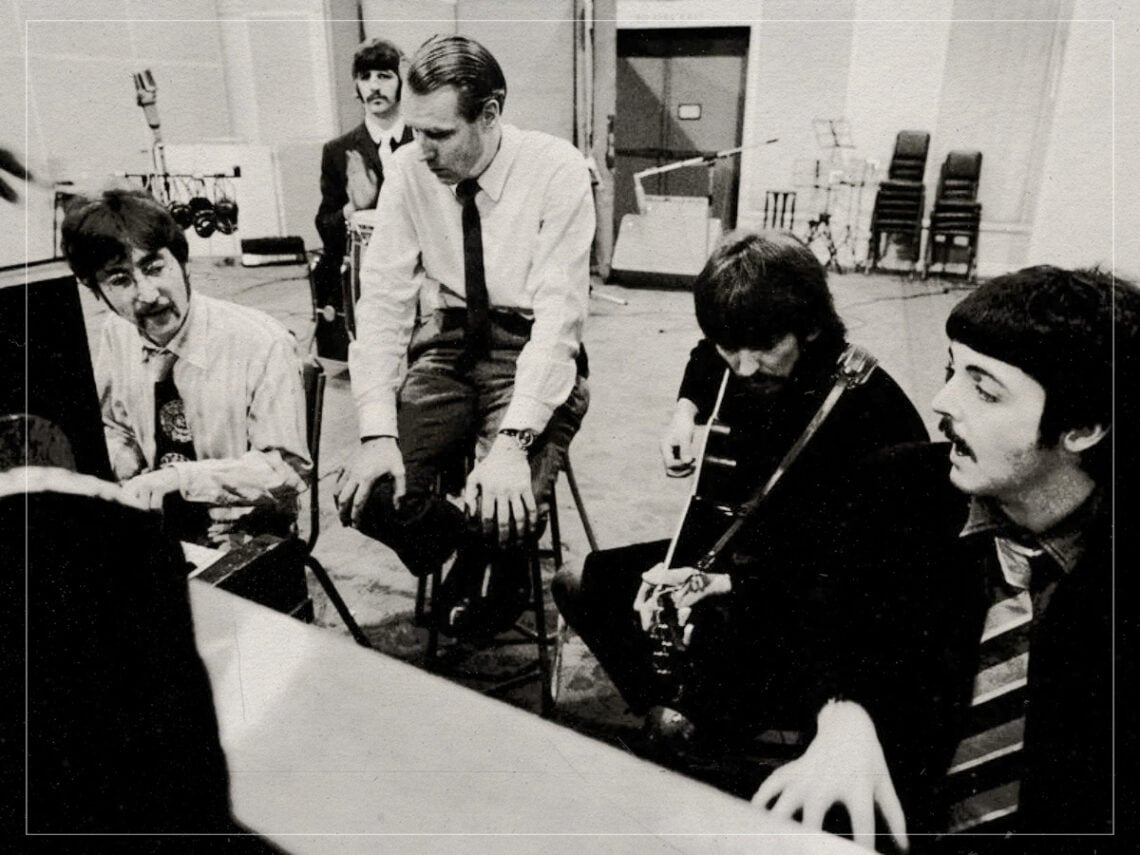
The glaring Beatles error George Martin could never unhear

In not much more than a decade, The Beatles managed to write around 230 songs, depending on who you ask. That’s roughly 21 a year. Considering that they now have 21 number-one singles to their name, you wouldn’t be far wrong if you said a tenth of their work was chart-topping. Needless to say, that’s an absolutely mind-boggling feat.
Considering that they were also fearlessly pushing boundaries while they were at it, adding orchestration to rock ‘n’ roll, getting experimental with new technology and avant-garde quirks, the popularity that they secured is even more miraculous.
Naturally, such a full steam ahead pursuit left a few little errors in the works and ungrounded rumours that session musicians occasionally cleaned things up abound. But, in truth, it’s incredible that four young lads and their trusty producer, George Martin, didn’t happen upon more mistakes in this whirlwind of their work.
We accept fatigue as a drawback in basically every professional realm, but The Beatles worked so tirelessly that questions about what a song or record might sound like if they had a few more hours on their side very rarely arise. They worked at a breakneck pace, but more often than not, achieved a degree of perfection in the process.
Alas, there is one rushed error that stuck out to the late George Martin that he feared could not be unheard. He feared the slip-up would spring out of the mix, be quickly identified by the masses, and mar a classic forevermore.

So, which Beatles classic has the glaring mistake?
It’s a marvel of music that it’s never the same twice: every song is a fluid piece of art, and every masterpiece you’ve ever heard might have sounded different on another day, another take, a different draft of lyrics, another millimetre adjustment to a microphone’s placement, and so on. This very notion struck John Lennon when they were recording the masterful ‘Strawberry Fields Forever’.
Listening back, Lennon liked the opening section of one take, but the finale of another. Given that there is quite a distinct divide in musicology and instrumentation between the intro and crescendo of the song, the bespectacled Beatle suggested that their deft producer splice the two tapes together.
He undertook this difficult task with great skill, perhaps just a tad begrudgingly. The fact that this splicing was hitherto unknown to millions of fans and the song is deemed a masterpiece is evidence that he pulled it off. He managed to tie two disparate takes together, and the song went rocketing up the chart, inexplicably, settling in second behind ‘Release Me’ by Engelbert Humperdinck. (There’s no accounting for taste, ay).
But Martin wasn’t happy with the result, nevertheless. He opined, “There are two things against it. They are in different keys and different tempos. Apart from that, fine.” He ironed out these issues by marginally speeding up the first tape and ever so slightly slowing the second to create a seamless marriage while adding a flourish of instrumentation to mask where they meet.
This alone was a pioneering way to look at music. Only a handful of years earlier, not even stereosound existed. This seamless splicing and tempo shifting was practically black magic.
Nevertheless, if you listen closely enough, you can just about hear the slight transition at the 60-second mark. While this has subsequently been ironed out further on recent remasterings, it hid in plain sight for years.
The backstory also helped to spawn what is now a common practice in music. With splicing now a simple digital process, it is growing easier by the day to stitch sonics together thanks to the same AI that helped to bring us ‘Now and Then’, completing an apt circle and showcasing the band as eternal pioneers rather than a force tied to the 1960s.
While people were busy listening out for “I buried Paul” (which is actually Lennon shouting “Cranberry sauce”), the evident mix at 59.05 was lost in the welter as just another supreme orchestral arrangement development by the band, which, in a way, it was. So, it might be an error, but would ‘Strawberry Fields’ have been as good without it?
