


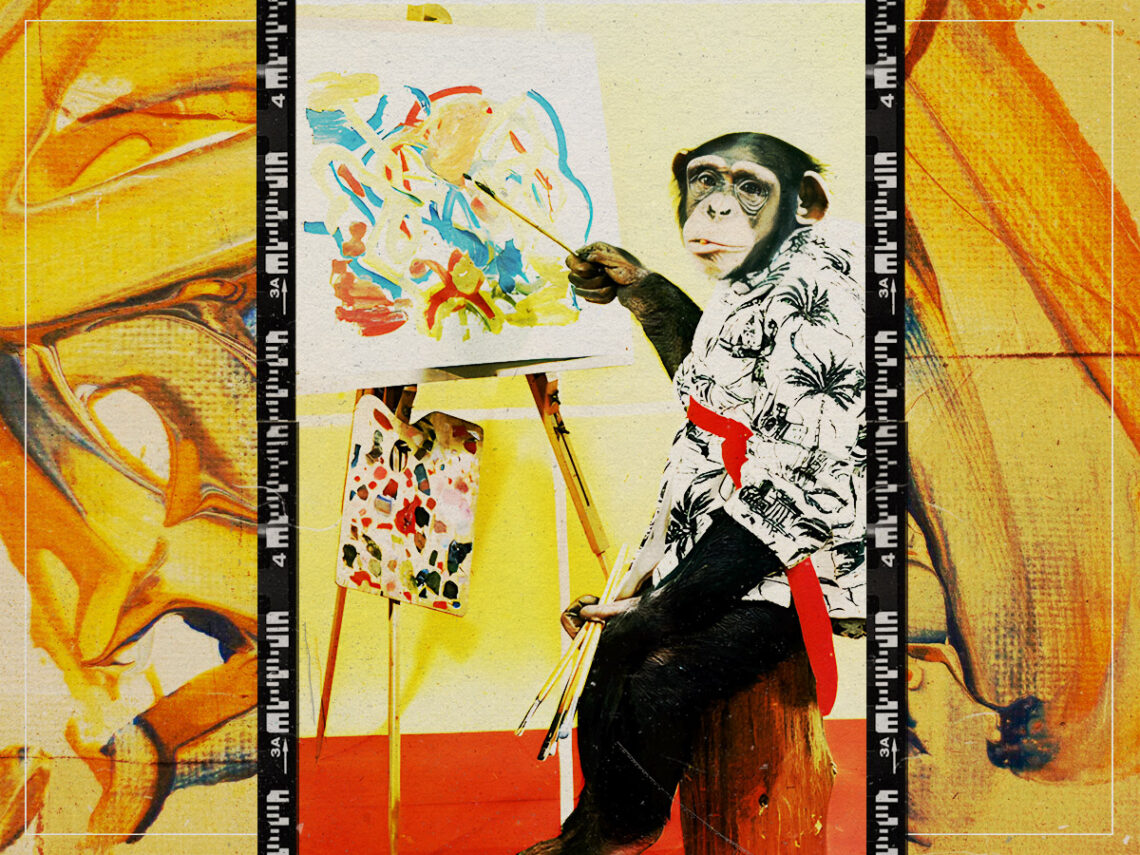
The first-ever inter-species art show

Getting an animal acclimatised to its enclosure is a hard job. Replicating the space of their natural environment is a round-the-clock effort involving regulating the temperature and giving them space to roam and feel some sense of mental stimulation. But since the 1950s, zoos across the world have also been providing animals something they’d never get in the wild: access to art.
Painting lessons are a bit of a double whammy, given they keep the animals happy and the pieces the animals create are great fundraising fodder. Until the mid-2000s, their rudimentary works weren’t considered much beyond that – until they were shown in the Art by Animals exhibition.
It was a collaborative effort between a graduate from UCL Slade School of Fine Art and UCL’s Grant Museums of Zoology, begging the question: if paint is put in front of an animal, and it curiously rolls around in it for a bit before wandering off to chew some grass or something, is that art?
On the eve of the 2012 exhibition, the manager of the Grant Museum of Zoology, Jack Ashby, was asking himself the same. “While individual elephants are trained to always paint the same thing, art produced by apes is a lot more creative and is almost indistinguishable from abstract art by humans that use similar techniques,” he said.
The elephant art was said to stand out, with Boon Mee’s flowerpot painting being quite good by human standards. This apparently stoked a bit of debate in animal art circles, who have all denounced elephant art. Elephants are highly receptive and can be coached to flick brushes with their trunks when handlers stroke their ears differently, which is not from the heart enough to satisfy the purists.
As a newbie to animal artwork, I think Boon’s output highlights yet another question. Is it entirely fair to make these animals paint? Boon was rescued after spending 25 years as a logging elephant, picking up massive logs with her trunk for years to make the lives of humans easier. There’s something uncomfortable about her newfound freedom being spent trotting out paintings so gallery-goers can ooh and ahh.
But maybe that’s cynical. Aside from the moral issues elephant art poses, the ape art seems to be imbued with a natural, carefree energy. Co-curator Mike Tuck referenced Digit Master, a swirling mix of colours done by a chimpanzee, as an example of a genuine emotional outpouring.
“It was painted using his fingers, and the marks are quite clear,” he told UCL News. “To me, it seems to be a very joyful work, which suggests that the sensation of moving the paint was a pleasurable one. It is so close to the painting of a child.”
