


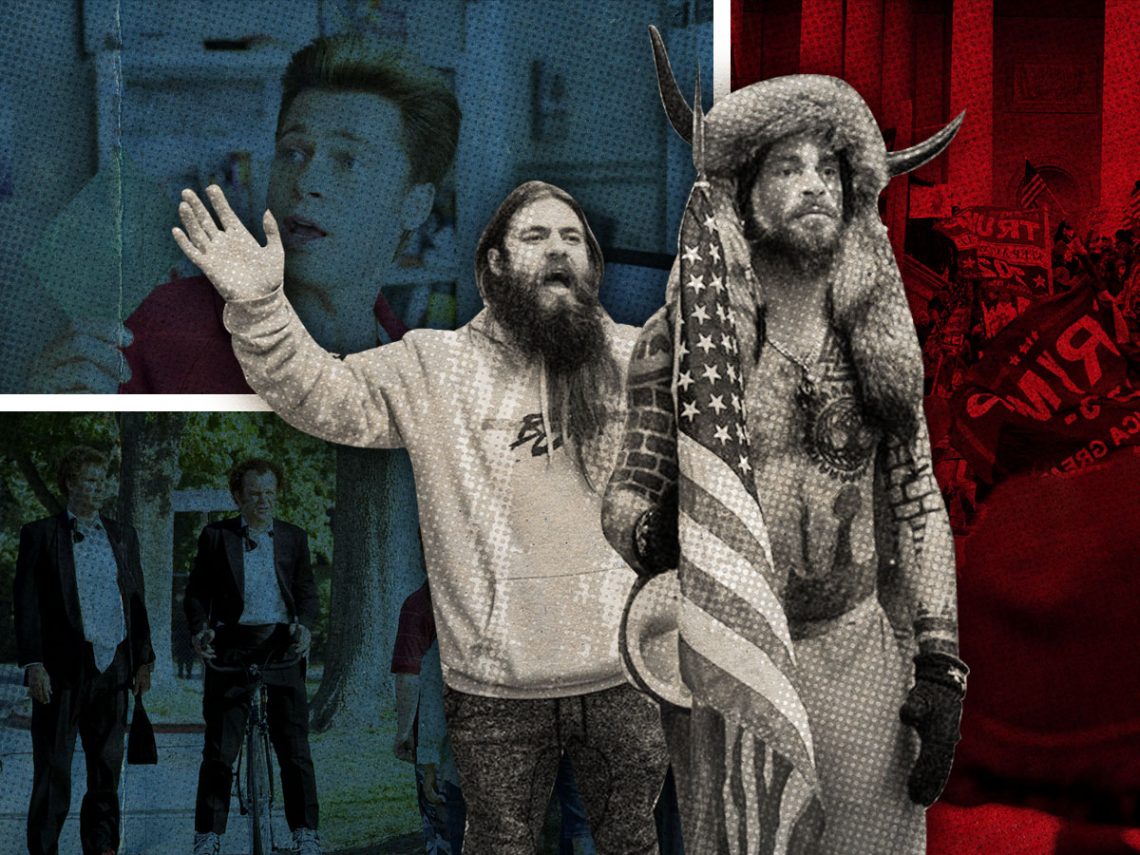
Exploring the films that predicted the rise of QAnon

Not long back, QAnon would’ve been a vague term parked on the fringes of society. It would’ve been the nerdified punchline to a joke among folks who had wandered to the far-flung reaches of the internet and returned with a booty of quirky oddities. But recently it has snowballed to such an extent that it became the movement at the centre of the storming of the US Capitol building.
This avalanching in from the edges to the heart of society might have blindsided many, but there are films that seem to have perfectly encapsulated the collision of conspiracy and fantasy, as well as the characters prone to the indoctrination of the online cult, long before it came to fruition in the American houses of power.
There was a time not long ago when conspiracy theories were limited to finding the Lost City of Atlantis, UFOs and mystic creatures. Government cover-ups were a mutually exclusive realm. The former was a fun world of escapism, while the latter was a serious and dark business left to the professionals. Now, the Venn has a far bigger intersect and QAnon is at the centre.
Essentially, the QAnon phenomenon ran parallel to Donald Trump’s ascendancy. Supporters of the former president relished in his radical ways. He defied the political norm, and in an age of apathy, that was enough to get him elected. However, when he was in power, he wasn’t the answer to his voter’s prayers. The great anticipation of rolling heads, crushed cabals, and the grand reveal of sworn secrets never materialised—at least not from within the White House.
However, online a vocal voice on forums was waging war with the Satanist-worshipping paedophiles in government, business and media. Ardent followers believed that this was Donald Trump himself. They posited that he was still shackled by the status quo within conventional lines of politics which explains why his actual impact in power was less radical than expected, but he escaped their scope by leaking conspiracies online. Clearly, fantasy has a large part to play here but it gripped enough fanatics to impeach the mainstream.
When writer-director Adam McKay was recently asked whether the Step Brothers duo of Brennan Huff (Will Ferrell) and Dale Doback (John C. Reilly) would be into QAnon by The New York Times, he answered: “No question about it. They’d be way into it, and they’d be torturing [Richard] Jenkins and [Mary] Steenburgen’s characters with it, and they would eventually be having meetings at the house and somehow QAnon would drift into Jenkins’s work life and the Q Shaman would show up at Jenkins’s workplace. They also would have loved Trump.”
Throughout Step Brothers, the goofball stay-at-home sons exhibit an infatuation with popular culture. At no point do they ever engage in political discussion. But since the film was released in 2008, those two worlds have also collided. Thanks to the rise of social media, and the volatile world of Twitter, in particular, politics is now pop culture. Thus, it’s no surprise that McKay believes that two adults who spend their lives online would’ve been sucked into this world.
Essentially, it’s fun—it’s fantasy politics. Unlike the daunting task of tackling conventional political history to gauge our current state of affairs, QAnon’s alternative fiction is a luring rabbit-hole that offers piecemeal revelations that draw you further into the unfounded world of fan-theory. It might be grounded in the world of politics, but it thrives on all the same tenets that made the Step Brothers duo obsessed with all their other favourite pursuits—the drip feed of constant entertainment, and blurring of interfaces that allows fans to be part of the discussion.
Furthermore, as McKay muses, it would also allow Brennan and Dale a chance to explain away their own unfortunate realities. This is the crux of most conspiracies. As Kurt Vonnegut wrote: “True terror is to wake up one morning and realise that your high school class is running the country.” In essence, there is no shady cabal in cahoots with the anti-Christ, just the same regular bastards you went to school with. However, if you’re sat at home covered in Cheeto dust like Dale and Brennan, it’s almost more comforting to think that your disposition is beyond your control owing to the might of a global conspiracy.
It’s Dale and Brennan’s isolation that creates the pivotal arc of the film. Initially, they are so subsumed by their own sheltered existence that they can’t deal with each other. This is indicative of how staunch the QAnon society is. Secondly, when they come together as a duo, they deepen their rabbit-hole obsessions and sense of delusion. Then we see them enter the real world and their beliefs quickly become grounded. It is here that the reality dawns: the real way we’re being screwed is that despite an honest living we still have to celebrate toilet roll bargains at the grocery store (just maybe not in the air-punching manner of Brennan). The prognosis of their entire arc is how the internet can truly induce a detachment from reality.
While Step Brothers might provide the insular tale of QAnon, the Coen brothers showed us how it plays out in the real world with Burn After Reading. The masterful brothers have always been inspired by Noir. Back in the day, noir novels and movies were bleak depictions of corruption whereby grouchy PIs uncovered crooked cops, wayward businessmen, and the dark underbelly of America while sipping whisky and chocking down cigarettes. But yesterday’s PIs are today’s investigative journalists, and the amateur sleuths are online dealing in rabbit-holes.
This has created chaos. QAnon’s strange storming of the Capitol building is a perfect pastiche of this. The world is messy right now and we simply don’t know what is happening—that creates a tinderbox of paranoia. And it is this mania that the noir reappraisal of Burn After Reading helps to illuminate. Here you have people out of their element meddling in affairs beyond their comprehension but just do enough to prove maddening to many.
Once more, there’s just enough actual madness to make Chad (Brad Pitt) and Linda’s (Frances McDormand) unearthed ‘conspiracy’ seem founded, but in actuality, it is just an extension of the tangled web of lies, fuck-ups, and computer mishaps that our modern society has become. But in the process of uncovering a glorified red herring, they wreak untold havoc by foisting fragile lives with their misguided yet probing ways.
And rather masterfully, as is always the case with the Coen brothers, they show how humanly this upheaval can simply arise from relative innocence. Stuck in a dogged routine, the characters are simply titillated by this mystery and see it as a way to escape mundanity as much as they see it as an avenue to get rich. In a manner most-likely inspired by Charles Portis’ novel The Masters of Atlantis, they show that the blinded notion that you’re onto something is a dangerous folly to befall the best of us because in the confusing modern world, it’s far too easy to be misplaced.
The comical final result is a CIA honcho trying to piece the whole conspiratorial meshuga together, only to waft it all away and bask in the profitable chaos.
