


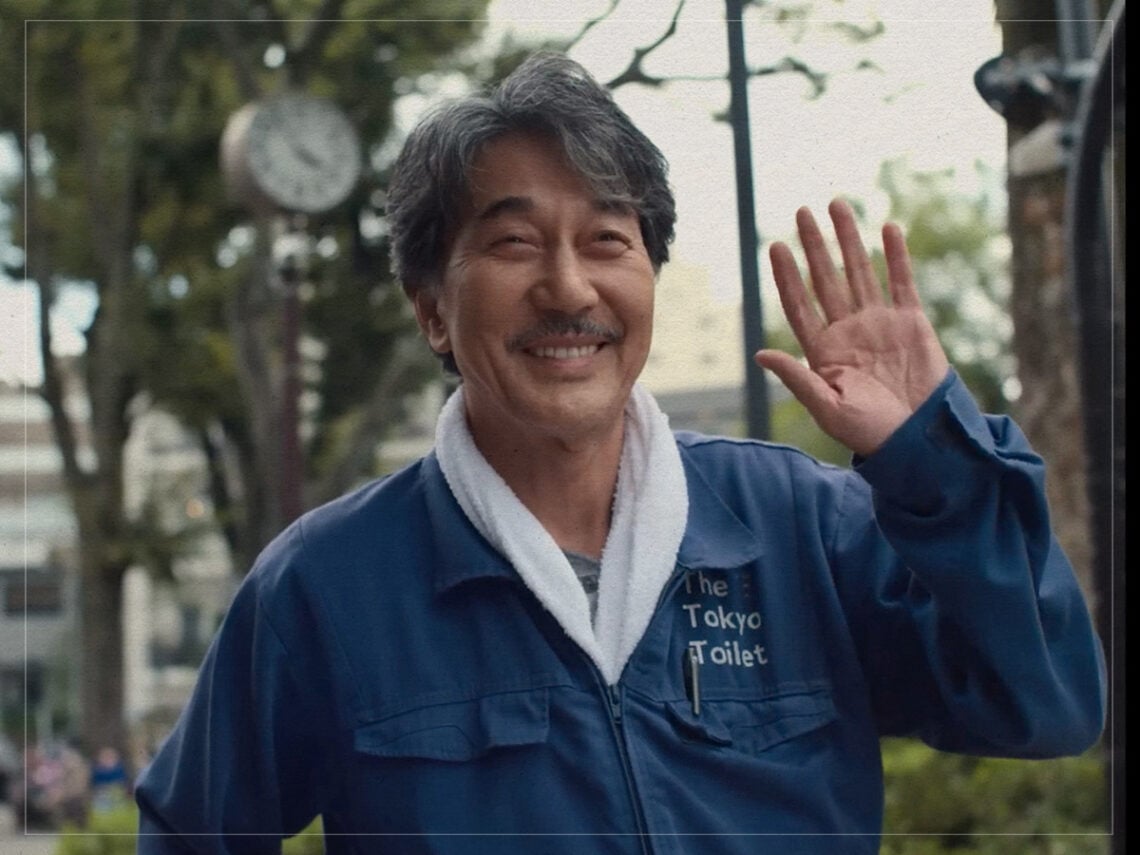
‘Perfect Days’: The film that means something different in every country

The official synopsis for Wim Wenders’ film Perfect Days, from 2023, reads: “Hirayama cleans public toilets in Tokyo, lives his life in simplicity and daily tranquillity. Some encounters also lead him to reflect on himself.”
It’s as vague as a synopsis can get, yet there isn’t a great deal more to it. It is a pastoral Test Match of a film. Unfurling beautifully over two hours, Perfect Days is a study in minimalism. Not much happens, but a whole lot is conveyed. Interestingly, in the years since the film’s release, it has become clear that what exactly is conveyed is geographically dependent.
In America, a land where achievement is championed en masse, many of the polemics penned in response argue that it is about “pathetic cope”, documenting a man “wasting his days” and “hanging on by a thread”. In internet speak, ‘cope’ has become a noun that the New York Times defined as “the act of believing what makes you feel better”.
In the view of many Americans, reflected in reviews from US publications and on various popular messaging boards, Hirayama is a perfect example of a man deluded by his own ‘cope’. And the tears he sheds at one point are seen as proof of how quickly this mechanism can be eroded by the slightest impeaching pressure.
As a Brit, that’s not how I read the movie at all. And once again, the majority of reviews in British publications and messaging boards reflect this.

I saw a man who has found an inviolable degree of enviable content in his life and work, and the scene where tears are shed over Nina Simone’s ‘Feeling Good’ – in one of the best moments of acting of all time – are a reflection that even choosing peace and inner happiness comes with drawbacks.
Meanwhile, in Hirayama’s homeland of Japan, the film was seen as an extensive meditation on various cultural traditions. Ikagai, for instance, is a local philosophy that translates to a “reason for being”. Within this, there are said to be four main pillars: your true passion, your specific skills, your contribution to society, and your vocation.
In modern capitalism, many of these pillars are blurred, fractured, unattainable, or reduced to a mere function, yet Hirayama seems to have found his own way to achieve a degree of satisfying Ikagai through repetition and the most Japanese of all things: quiet dignity. He might not be hailed as a hero because of this, as a smattering of South American readings have framed him, but he is seen as a credible symbol of meaning and happiness borne from ritual.
This outlook also pairs with another Japanese tradition explored in the film: Wabi-sabi. This is defined as “a traditional Japanese aesthetic philosophy that finds beauty in imperfection, impermanence, and incompleteness”. Once again, it is split into pillars. Wabi refers to “rustic simplicity, humility, and living in harmony with nature. It’s about finding a quiet, austere beauty in objects that are handmade or asymmetrical.” And Sabi is “beauty that comes with age, wear, and the passage of time”.
“He is happy because he knows not to consume more than he needs.”
Wim Wenders
In an almost heavy-handed way, nothing embodies this quite like a love for cassettes and photos of ever-changing tree canopies, as per his two main passions in the film. There is an undeniable charm and beauty to that. However, I do know a few more stiff-upper-lipped Brits who might also see that aesthetic pursuit as marginally performative.
Not to perpetuate further stereotypes than this piece already has, but Wim Wenders’ own interpretation of his film is perfectly Germanic in its simplicity. “We made this film in a world where everybody wants more than they have,” he told Cinema Express. “In a society where people constantly desire more than what they have, the protagonist in Perfect Days chooses to live a simpler life.”
He continues, “He is happy because he knows not to consume more than he needs. So I think the film’s conflict is between a world in which we all want more and a character who says I don’t want more. I don’t need more. I’m happy with what I have.”
Whichever way you look at it, these varying views are what make Perfect Days a quiet masterpiece. It’s like Joe Root’s cover drive in film form, a fitting metaphor given it’ll be lost on most people. By stripping everything back to bare essentials, Wenders creates a cultural inkblot test. Hirayama can be read as spiritually enlightened, quietly heartbroken, aesthetically performative, or a failure coping. None of those interpretations are entirely wrong. (I mean, I think a couple of them are, but that’s beside the point. If anything, that enforces the point).
Perfect Days seems deliberately constructed to expose how instinctively we project our own national values, anxieties, and ideas of fulfilment onto a life so simple it leaves interpretative space around every gesture. Whether he’s achieved ultimate freedom or hangs from a thread above an abyss of failure really depends on the lens through which you view the film – and that lens is shaped by the society you live in as much as your own personal philosophy.
