


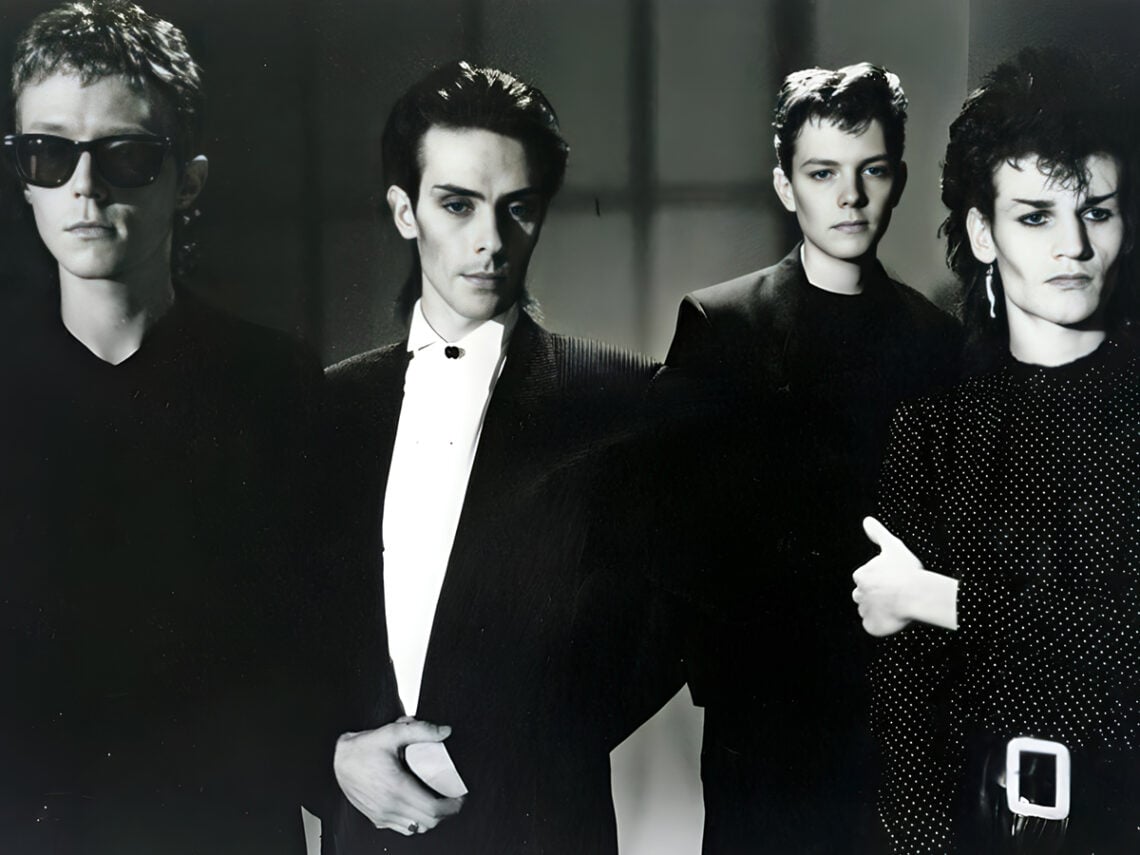
The fateful tale of the first Bauhaus demo

No band sits down in a studio for the first time and decides to invent a new genre of music, and Bauhaus was no exception.
Singer Peter Murphy was only 21 years old when he laid down the vocals on his band’s first-ever demo, ‘Bela Lugosi Is Dead’. It was a great example of a total lack of experience having tremendous benefits creatively, as Bauhaus’s attempts to re-create the sort of soundscapes they loved in dub and reggae music, combined with a youthful fascination with Hammer Horror movies and the occult, were carried out to their logical fruition, with no concerns about wasting tape or being too self-indulgent.
Clocking in at nine and a half minutes, the original demo of ‘Bela Lugosi Is Dead’ would, for most seasoned bands, have been a stepping stone, something to tweak and refine over subsequent visits to the studio. The Northampton-based Bauhaus had only decided to become a band six weeks earlier, however, and this, again, proved to be a great advantage brought on by relative ignorance. They chose to release ‘Bela’, in its raw entirety, as their first single, and the punk label Small Wonder was bold enough to back the idea, pressing ‘Bela Lugosi Is Dead’ on a 12-inch vinyl in August 1979.
It’d be nice to say the experiment immediately paid off, but the single failed to chart and didn’t really take its place in history until the helpful aid of hindsight came into play.
By the mid-1980s, as the concept of gothic rock had entered the mainstream public consciousness, led by the likes of Siouxsie Sioux, The Cure, Sisters of Mercy, and The Mission, ’Bela Lugosi Is Dead’ was re-assessed as the arguable origin point for the phenomenon. Bauhaus hadn’t reinvented the wheel musically, by any means, but they’d basically done for vampires what Led Zeppelin had done for hobbits.
“White on white translucent black capes,” Murphy sings, “Back on the rack / Bela Lugosi is dead. The bats have left the bell tower / The victims have been bled / Red velvet lines the black box”.
It sounds frightfully serious; a vivid description of the funeral of the famed actor who portrayed Dracula on screen, but did Murphy, the ‘Godfather of Goth’, actually have his tongue planted in his cheek the whole time?
“In the early days, we used a lot of imagery that was reminiscent of surrealist films like [The Cabinet of Dr] Caligari,” Murphy told Musician magazine in 1990, “It wasn’t exactly gothic. That was more of a media animal; a myth that took over. Bauhaus was very playful in the sense that we weren’t too precious. A song like ‘St Vitus Dance’ was meant to be British ironic humour like Monty Python. And ‘Bela Lugosi Is Dead’ was the most hilarious song you’d ever imagine! An 11-minute soliloquy about Bela Lugosi! We did it seriously, and that was hilarious, too. I’d affect a vampire on stage and frighten people. It was incredibly funny.”
The question with Bauhaus, and with the history of goth rock, really, is whether the audience is in on the joke or not. It’s easy to take Christopher Lee seriously in a horror film while simultaneously being aware that he is an actor engaged in a kitschy bit of fun. Plenty of goths probably saw Peter Murphy in a similar way in the early 1980s, but quite a few, to be sure, were hoping he might be an actual vampire.
