


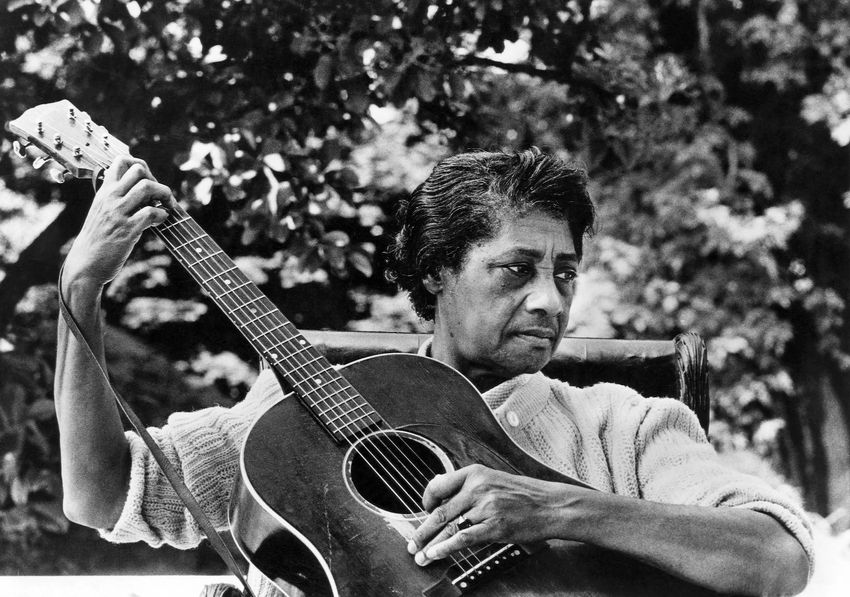
The Elizabeth Cotten song that inspired the Grateful Dead

When folk and blues pioneer Elizabeth Cotten was inducted into the Rock and Roll Hall of Fame as an Early Influence in 2022, many people had one question: who is Elizabeth Cotten? Not as well-known as canonised players like Robert Johnson and Blind Willie Johnson, Cotten had pioneered her own style of alternate picking on the guitar that eventually became known as “Cotten Picking”.
Through songs like her original ‘Freight Train’, plus a host of classic traditional covers, Cotten made a small name for herself as a teenager in the North Carolina area before retiring to a life of domesticity. It wasn’t until she became a maid for the famous Seeger family (which included legendary folk advocate Pete Seeger) that Cotten relearned her own signature picking style.
Beginning with 1958’s Folksongs and Instrumentals with Guitar, Cotten continued to record and perform until her death in 1987. Her songs circulated around the burgeoning folk movement of the late 1950s and early 1960s, with everyone – from bluegrass players like Doc Watson to folk singers like Joan Baez – covering her material. Bob Dylan was a fan, and out on the West Coast, a young folkie by the name of Jerry Garcia began learning some of Cotten’s repertoire as well.
During his early days around the Palo Alto folk scene, Garcia had befriended poet and occasional musician Robert Hunter. Hunter often played bass, mandolin, or guitar in Garcia’s bands but was never proficient enough to keep up with Garcia’s own prodigious playing. Instead, Hunter went on a journey of his own, eventually making it back to the Bay Area toward the latter half of the 1960s to reconnect with Garcia and his new electric rock band, the Grateful Dead.
By 1971, Garcia and Hunter had established a songwriting partnership that dominated the Dead. The pair wrote nearly every song that appeared on the albums Aoxomoxoa and Workingman’s Dead, and Hunter became the in-house lyricist for the other singers in the band during the making of American Beauty. Hunter’s singular connection with Garcia made him one of a small handful of collaborators who entered Wally Heider Studios in the summer of 1971 to help Garcia record his debut solo album, Garcia.
Hunter and Garcia were responsible for all of the songs that contained lyrics on Garcia, while the experimental instrumentals were composed with the only other musician that appears on the record besides Garcia, Grateful Dead drummer Bill Kreutzmann. With most of the songs having been written and composed spontaneously in the studio, Hunter was required to furiously jot down lyrics as fast as Garcia and Kreutzmann were recording backing tracks. For one song, Hunter took inspiration from a classic track of Cotten’s.
‘Shake Sugaree’ was the title track from Cotten’s second collection of recordings, originally released in 1966. Written by Cotten and sung by her then 12-year-old great-granddaughter, Brenda Evans, ‘Shake Sugaree’ was one of many songs to contain the name ‘Sugaree’ before Hunter wrote it down for Garcia. Both would have been familiar with the song, but Hunter was coyer about crediting ‘Shake Sugaree’ directly.
“‘Sugaree’ was written soon after I moved from the Garcia household to China camp,” Hunter wrote in the liner notes for the 2004 box set All Good Things: Jerry Garcia Studio Sessions. “People assumed that the idea was cadged from Elizabeth Cotten’s ‘Sugaree’, but in fact, the song was originally titled ‘Stingaree’, which is a poison south sea manta. Why change the title to ‘Sugaree’? I just thought it sounded better that way. It made the addressee seem more hard-bitten to bear a sugar-coated name. The song, as I imagine it, is addressed to a pimp. And, yes, I knew Libba’s song, and did indeed borrow the new name from her, suggested by the ‘shake it’ refrain.”
Check out both ‘Shake Sugaree’ and ‘Sugaree’ down below.
