


When Joan Didion called The Doors and Jim Morrison “the Norman Mailers of the top 40”

When you think of Joan Didion, who rose to prominence for her nuanced, coolly removed criticism of American culture, music journalism may not immediately come to mind.
Among the likes of Truman Capote’s lavish infamy and Hunter S Thompson’s heady gonzo journalism, Didion pioneered New Journalism, an approach that analysed politics and popular culture with a balance of personal reckoning and acute dissection.
She began her career writing for Vogue in the 1950s, winning their essay contest during her undergraduate studies, then evolved her work the following decade, finding a niche in discussing the countercultural 1960s, ripe with fascinating subjects amidst political upheaval.
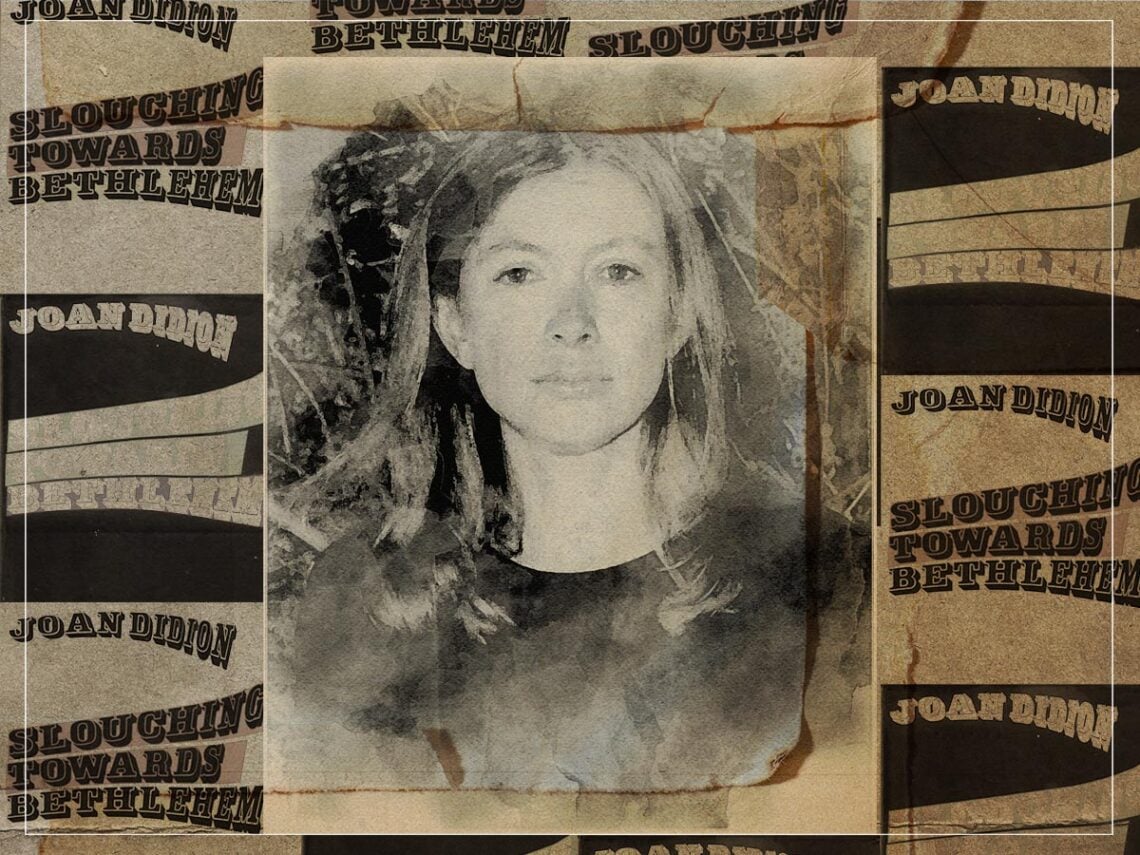
In 1968, the publication of her first collection of essays, Slouching Towards Bethlehem, solidified her as one of journalism’s most compelling voices, unafraid of placing herself within her stories to locate the heart of her fascination, whether it involved criticising politicians or diving into the underground of San Francisco’s Haight-Ashbury communes. Her second collection, 1979’s The White Album, holds one of her best criticisms, as she writes of being in the studio with The Doors as they recorded their third album, 1968’s Waiting for the Sun.
Taken from the collection’s titular, autobiographical essay, Didion’s section on The Doors accomplishes, in just a few paragraphs, an evocative example of music journalism. With the writer being known for her impartial voice, part of the essay’s charm is her evident adoration for the young rock band.
She describes in precise detail her place in the studio, surrounded by the band, their equipment and their cast of onlookers. “The Doors were different, The Doors interested me,” she wrote, “The Doors seemed unconvinced that love was brotherhood and the Kama Sutra. The Doors’ music insisted that love was sex and sex was death, and therein lay salvation. The Doors were the Norman Mailers of the Top 40, missionaries of apocalyptic sex.”
Her comparison of the band to Mailer, a writer preoccupied with his questions of life’s existential and philosophical meanings, is apt, as the band’s songwriter and vocalist, Jim Morrison, fashioned The Doors to answer his own questions of a similar nature. His poetry functioned as an attempt to seek deeper meaning, and music became a means of conjuring possible answers.

Writing and performing with an unrivalled intensity, Morrison veered into infamy with his erratic persona, one that succumbed to addictions far too soon, leading to his premature death in 1971, at just 27. Didion managed to pick up on this imbalance between the frontman and his bandmates from the beginning, and, as she writes of being in their studio, the discomfort leaps off the page.
Didion describes their dynamic as one of an “uneasy symbiosis”, amplified by Morrison’s absence for the majority of the session. Ray Manzarek, John Densmore and Robby Krieger seem to dance around each other, awaiting their unofficial leader’s presence.
Even without being there, Morrison takes up space, particularly in Didion’s mind, calling him a “peculiar character of which was to reflect either an ambiguous paranoia or a quite unambiguous insistence upon the love-death as the ultimate high”, with his persona as a young, mysterious film-school graduate-turned rockstar poet as tending “to suggest some range of the possible just beyond a suicide pact”.
Despite her preoccupation with The Doors as a symbol of rock ‘n’ roll’s potential to delve into the esoteric and literary, Didion’s experience seems to have resolved the mystique that had inadvertently followed the band since their inception, as when Morrison finally arrives, she noted, no one acknowledges him; if anything, the tension in the room only grew.
No one directly acknowledged her, either, and she was left to her own devices, instead choosing to count the knobs on the electronic console, take note of the abandoned paper bags with half-eaten food and chronicle the surface-level conversations taking place, both saying nothing yet holding weight in their relative mundanity.
“My leg had gone to sleep, but I did not stand up;”, she wrote, ”unspecific tensions seemed to be rendering everyone in the room catatonic”.
With little to dissect from her experience with the band, Didion allowed the lack to speak for itself. While she maintains her love for them and their message, she is nuanced enough to recognise that, beneath their personas, they remained a young band marred by ego and the pressures of the limelight.
