


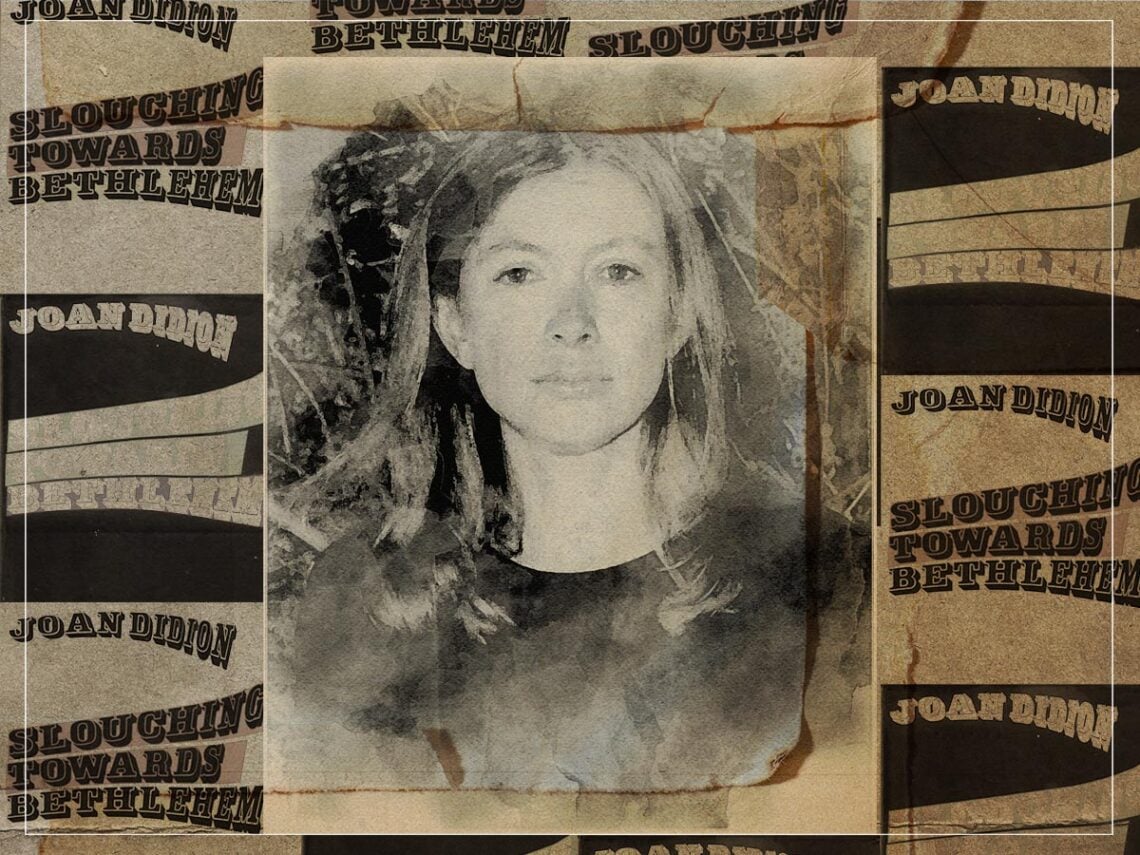
‘Slouching Towards Bethlehem’: Joan Didion’s brave look at the dark side of the 1960s

“The centre was not holding.” That was Joan Didion’s opening comment on the counterculture of the 1960s. She was the best person to write about it as, while she was in it, living in Los Angeles and partying with the new stars of the time, she wasn’t really a part of it. Didion was a journalist, a straight-laced writer at heart whose nature could never quite get on board with the hippie culture. So, from her position on the fringes, she had the best viewpoint to write about it, and she did so with honesty, bravery and a willingness to say it how it really was.
Her essay The White Album would become her best-known work in this vein. In that, she writes about the brutal and bloody end of the era when the Manson Family tore through an LA suburb and, in her words, “No one was surprised.” To her, the dark finale had been prophesied the whole time, based on the natural fact that what goes up eventually comes down. And, given the dizzying heights and the levels of hedonism the 1960s reached, she always had the inkling that gravity would bring it crashing down fast, hard and violent.
That was a theory that eventually others would reach, too. By 1969, The Rolling Stones were singing about it as ‘Gimme Shelter’ became a strangely prophetic anthem as Jagger sang “a storm is threatening my very life today”, howling that murder was “just a shot away”. Following events like the Manson murders and the Altamont Free Festival deaths, 1969 and the end of the decade of free love and fun left the countercultural crowd reeling. When the collective trip ended or took a bad turn, they all saw the signs that Didion had picked up on years back and was one of the only people on the scene brave enough to talk about.
Her 1968 essay Slouching Towards Bethlehem acts as a harbinger. In the piece, Didion heads to Haight-Ashbury to be a roving reporter at the scene’s epicentre. At the time, the area of San Francisco had become a mecca for hippies. But while rose-tinted nostalgia remembers it as a place where music, love and history were made, Didion wrote of the reality. Haight-Ashbury was a place where a generation of teenagers reported mission could be found crashing out in all variety of risky and exploitative circumstances and where the disintegration of traditional social fabrics in the name of free love was genuinely, actively and legitimately dangerous.
“It was a country of bankruptcy notices and public-auction announcements and commonplace reports of casual killings and misplaced children and abandoned homes and vandals who misplaced even the four-letter words they scrawled. It was a country in which families routinely disappeared, trailing bad checks and repossession papers. Adolescents drifted from city to torn city, sloughing off both the past and the future as snakes shed their skins, children who were never taught and would never now learn the games that had held the society together,” she writes, starkly and seriously, “People were missing. Children were missing. Parents were missing.”

But the reason why Didion is so perfect for a story like this and why she endures as the most reliable narrator of the 1960s is that she was neither in it nor out of it. Didion was hanging out with the Mamas and Papas and was in their circle of 1960s new stars. She liked the music and the energy of the time, so the origin of this essay is a genuine curiosity and desire to flock to the area like the rest of the generation. “When I first went to San Francisco in that cold late spring of 1967 I did not even know what i wanted to find out, and so I just stay around a while, and made a few friends,” she wrote. The essay is merely her travelogue, wandering around the area. But she’s outside of it just enough, to be honest. While her ‘60s peers might have feared being labelled a square, it’s clear that Didion’s loyalty lay with the story and with the truth, not with any subculture.
As she travels through the area, she meets a cast of different characters. The same figures wander in and out of the narrative like a burn out who tells Didion, “I been out of my mind for three days” and has no memory of how long he’s been in the area as he travelled up from New York and had been lost since. Naked men found crashing on a stranger’s couch tell her he “lives free of all the old middle-class Freudian hang-ups.” A man called Max celebrates his “triumph over ‘don’t’” with those ‘don’t’ that he’s done being “peyote, alcohol, mescaline and methadrine.” A gaggle of teenagers who she feeds in the park proudly tell her about how they’ve run away from home and are now wandering around, homeless, but in their eyes, free.
Through all these interactions, she writes without judgment. But in the non-flouncy style of her descriptions and her refusal to glamourise the scenes, she writes of the area for what it is, which is essentially a wasteland of missing kids and addicts. As the stories spiral on and on, they get darker and darker. Still, Didion just reports what she sees, passing no judgment but laying it out how it is with no psychedelic sheen.
Then, it breaks. “I got something at my place that’ll blow your mind,” one of her new friends, Otto, tells her. When she gets there, she sees a child sat on the floor of a living room, acting strange. “Five years old”, Otto says to her proudly, “on acid.” Didion makes no comment in her commentary; she just describes the scene. But notably, that’s the end of the essay. After that, she packs up and goes back home, sits down at her typewriter, and writes the first sentence: “The center was not holding.” She wrote the essay’s stark description of the countercultural meca as a kind of hell, where people had “aborted themselves” and, with that, aborted the care that comes with order and tradition.
She published the piece in 1967 in The Saturday Evening Post originally, then in 1968 in her essay collection, one year before the Manson murders and one year before the decades dark ending came about, though she’d seen it coming right there in that living room.
