


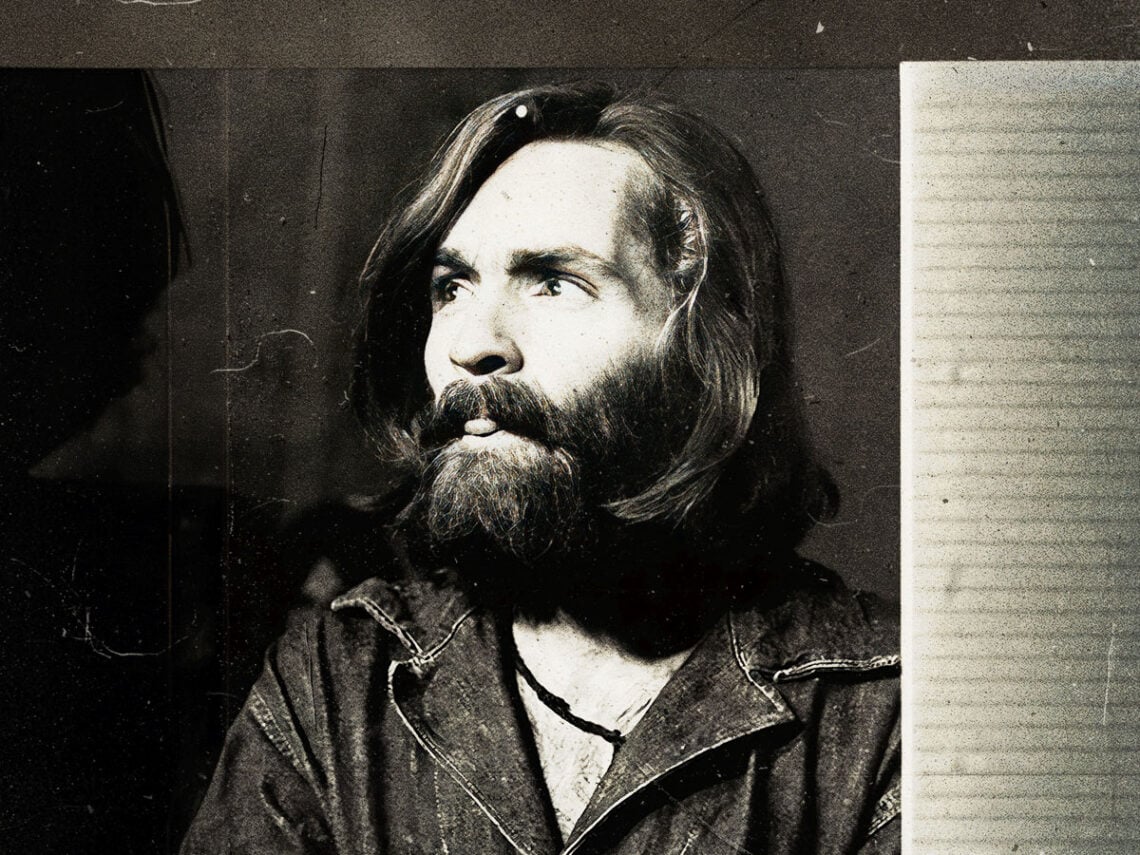
Exploring Charles Manson’s strange enduring legacy over music and pop culture

Charles Manson was the most notorious figure to emerge from the 1960s. The cult leader enticed vulnerable young men and women to join him in a commune in California, where Manson would provide his followers with drugs, subsequently coercing them into carrying out criminal acts.
The Manson Family spread terror over California in the late 1960s, with the cult leader capitalising on the free-love hippie movement to attract people to his dark underworld. According to Rick Allen Ross, “Charles Manson wasn’t really part of the counterculture,” and he “had no particular interest in it”. However, “he saw it as a vehicle to manipulate and control people, and he harvested people from that movement”.
The Manson Family’s most infamous crime occurred in 1969 when he instructed several followers, including Tex Watson and Linda Kasabian, to kill everyone inside actor Sharon Tate’s residence at Cielo Drive. They succeeded, slaughtering Tate and her unborn child, as well as four others, including Jay Sebring, her ex-boyfriend and hairstylist. The next day, the cult members went to the house of Leno and Rosemary LaBianca to continue their murdering spree.
In her essay collection, The White Album, Joan Didion explained: “Many people I know in Los Angeles believe that the Sixties ended abruptly on August 9, 1969, ended at the exact moment when word of the murders on Cielo Drive travelled like brushfire through the community, and in a sense this is true. The tension broke that day. The paranoia was fulfilled.”
In many ways, the Manson murders signalled the end of the optimistic countercultural movement pioneered by hippies earlier in the decade. The terror the criminal mastermind instilled in people was palpable, causing many residents to flee California out of fear of the Manson Family’s presence, proving that the hippie movement wasn’t as promising as it appeared.
However, despite his notoriety, Manson’s influence over pop culture, particularly music, has endured for decades. The cult leader was not just a deranged criminal who believed The Beatles’ ‘Helter Skelter’ predicted a race war, but he was also a fledging folk musician. A chance meeting with The Beach Boys’ Dennis Wilson led the pair to work together, with Carl and Brian Wilson producing some tracks for Manson before the events of 1969.
Manson didn’t have much success with his music career, although the Beach Boys reworked one of his songs, ‘Cease to Exist’, into ‘Never Learn Not To Love’. The song appeared on their 1969 album 20/20, released a few months before the Tate-LaBianca murders. Manson had a pretty tumultuous relationship with the Beach Boys, even leaving a bullet in Dennis’ bed after the band changed his song without his approval.
While his criminal endeavours distracted him from becoming a successful folk artist in the Los Angeles scene, these very crimes eventually led him to become a cult (excuse the wordplay) musician, revered by generations of fans. Manson’s music has been celebrated and covered by artists from Guns N’ Roses to The Brian Jonestown Massacre, and we can’t forget Marilyn Manson, who stole his stage name from the infamous figure.
Many artists have incorporated the Manson Family murders into their songs, such as Sonic Youth (‘Death Valley ’69’), Lana Del Rey (‘Heroin’) and Neil Young (‘Revolution Blues’), with the latter praising him long after his incarceration. Talking to Bill Flanagan in 1986, Young said: “Musically, I thought he was very unique. I thought he really had something crazy, something great. He was like a living poet.”
Manson’s influence also extends to the big screen, becoming the subject of countless movies and documentaries. Most notably, Quentin Tarantino depicted the cult leader in his film, Once Upon a Time in Hollywood, which provides an alternative take on the Tate-LaBianca murders.
The terrifying mind of Charles Manson has infiltrated pop culture in countless ways, and people continue to find themselves enthralled by his story decades later. He changed the landscape of California, waved goodbye to the golden era of the hippie movement, and brought a heady layer of paranoia to America. People were no longer sold by the optimism buoyed earlier in the decade, and the psychedelic rock favoured by hippies subsequently declined in popularity by the early 1970s. With the hippie era ending, a new wave of rock and punk bands emerged, altering the course of music history.
