


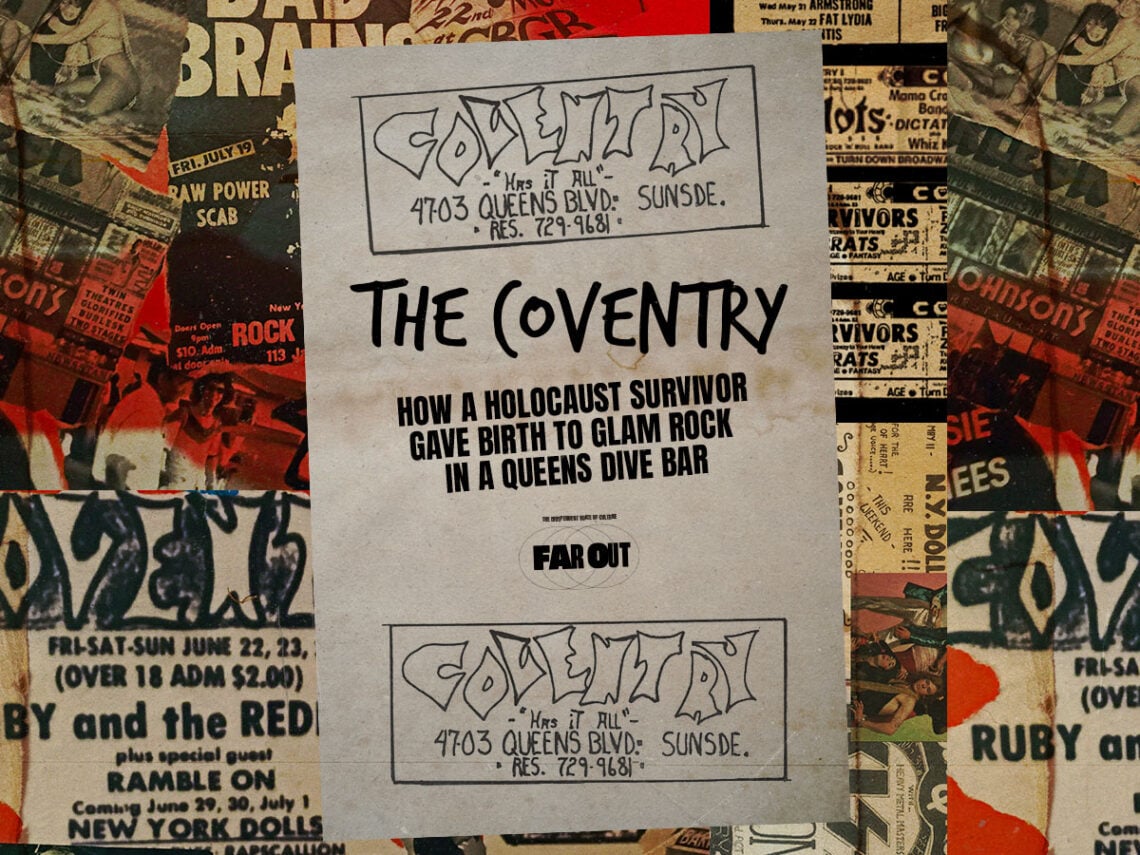
The Coventry: How a Holocaust survivor gave birth to glam rock in a Queens dive bar

At the dawn of the 1970s, New York was in worse shape than a waterlogged football. Between 1969 and 1974, half a million manufacturing jobs had been axed. A million homes depended on welfare. Rapes and burglaries tripled. Drugs dug their claws into the sagging psyche of the city. The murder rate hit a startling high of nearly 33 every week. Things looked bleak, and the Big Apple seemed rotten to its core. So, Paul Sub decided to open a nightclub.
His own father had been a cafe owner and bandleader in Vienna, Austria. He led orchestras and bands in the city. Their dizzying performances dominated the days of Paul Sub’s childhood.
In his youth, he darted about at the candlelit cafe at ankle height, agog like a mouse in a cheese factory, beneath a chorus of chinking of glass, the soft chatter of an excited audience, and the precession of instruments being tuned that floated out from the cafe over the cobbled streets of Vienna, the window’s steemed by the breath of migling spirits from the city’s rich thousand year history, drawing in for the show.
But soon he noticed a souring of this reverie. Performances would peculiarly be halted as everyone hurried to hide under tables. The strange glow went from golden to grey. German troops became frequent callers, but the concerts went on. The worst potentiality remained beyond reconciliation, until one day, Paul Sub’s father was thrown onto the back of a lorry, headed for an extermination camp.
He was recognised by the driver as an esteemed musician and hurled from the moving lorry. He crashed to the pavement, damaging his hearing as he crumbled to the floor. His musical days were dashed by the injury, but he knew others faced a fate far more unspeakable. The family had to hurry to escape Vienna. Paul was one of the lucky few who made it to America where a new life awaited.

It would be far too idyllic to suggest that from that moment on, Paul wanted to set up a nightclub; the brutal realities of what his childhood became bludgeoned any such dreamy notions out of existence. But he did know the importance of art in times of hardship. His father’s cafe had, in its own strange way, kept the worst of the war’s preamble at bay and preserved a fraction of childhood in Paul’s youth, so when New York arrived at its own crumbling juncture, music wasn’t far from his mind.
He just needed fate to gently encourage him a little further. “My father was entrepreneurial, but opening a rock club wasn’t his plan,” Paul’s son, Charlie, explains. “He started with dry goods stores and later ran venues down in The Village, including a notorious sandwich shop.” Suddenly, amid the emerging downturn of the ‘70s, Paul had a new plan.
“The Coventry came about after experimenting with a few business ideas—he found a massive location in Queens that was near the subway and decided to turn it into a music venue,” Charlie continues. It had the air of a lifetime ambition, once buried, now brought to fruition by an odd mix of happenstance and the sense that hard times call for creative outlets.
“Through trial and error, he saw the opportunity to support original bands,” Charlie says, in what can only be described as an understatement. The Coventry became the favourite waterhole of the likes of Cyndi Lauper, Kiss played their first show in their famed Kubaki make-up, and a slew of other culture-defining moments unfurled in a haze of drunken escapism.
In some ways, it was the venue that led to the boom of punk across the bridge. “Punk wasn’t a big part of the scene during the first run of the club, aside from Joey Ramone—who was still going by Jeff Hyman—playing with his band Sniper at the time,” Charlie recalls. “He was a fixture at the bar.”
He continues, “The Coventry wasn’t about pushing one sound. It was an open platform. If a band had something original, something real, my dad gave them a shot and provided they drew a crowd, they kept getting booked. Bands like Kiss, The Harlots of 42nd Street, The New York Dolls, The Dictators—they weren’t mainstream or polished at that time, but they had energy. Some then went on to great success.”
They had a sound and a spirit that typified Queens—the most diverse place on the entire planet. Granted, in the early ‘70s, that meant a whole host of different people facing a whole host of different problems. But such is the situation of Queens, promise always presides on the horizon. As F Scott Fitzgerald wrote, “The city seen from the Queensboro Bridge is always the city seen for the first time, in its first wild promise of all the mystery and the beauty in the world.”
So, it makes sense that the culture that best seemed to capture its plashy mire of hope and decay, the music that helped to describe it anew, came scurrying in from the outskirts, drenched in gutter swill, determined to make it. Not even Charlie saw it so clearly until the trying times of the present, but he now comments, “In hindsight, there’s something meaningful about a survivor creating a space where people could be original, hone their craft, draw a crowd, which led to success for some.”

In some ways, it led to success for the region, offering a degree of hope as a dystopian delapidation looked to be setting in. The powers that be have even since recognised this, granting The Coventry the historic Queensmark Award. The authorities might have been a few decades late to recognition, but the patrons who once partied there always held it as a sanctity.
“For the most part, my Dad would tell you that during the first run of the Coventry, he had very few problems,” Charlie says, marking a stark contrast to the society surrounding it at the time. “Those who attended were really focused on the music and the scene that developed around it. Nothing crazy, just the kind of stuff that came with the scene back then. It wasn’t polished, but that’s what made it real,” he says.
Sadly, after helping to launch the likes of Blondie, Kiss, The New York Dolls, and Ramones, the original Coventry shut down in ’75. “It simply wasn’t generating enough revenue, and many of the bands began heading to Manhattan to play; some went on to achieve great success. My dad reopened the venue not long after as Aretama, a salsa club, and there were a couple more versions after that, including one I ran in the ’80s, but eventually it all wrapped up.” Charlie says.
“The building’s gone now,” he adds, “but what we built there stuck with me. That’s part of why I opened Ethyl’s, a 70s-inspired bar on the Upper East Side—to carry on the spirit. The music lives on.” Other venues soon arose that, like the CBGB, that provided the next step on the ladder, “But The Coventry was first for a lot of them—it was where they got their start. Coventry was a mix of genres, personalities, and moments that didn’t fit into one neat box. That’s part of why we’re launching an Echoes of the Coventry podcast, to tell that full story, straight from the people who lived it.”
Now, its legacy and the story behind it feel more illuminating than ever. As Charlie concludes, “My family didn’t set out to be part of music history—we were just trying to keep the business going. But somehow, something real happened. I’ve seen how music brings people together, how a moment on stage can stick with people. I’ve learned to not overthink it, just keep going, keep playing, and figure it out as you go.”

Never Miss A Beat
The Far Out Punk Newsletter
All the latest Punk content from the independent voice of culture.
Straight to your inbox.