


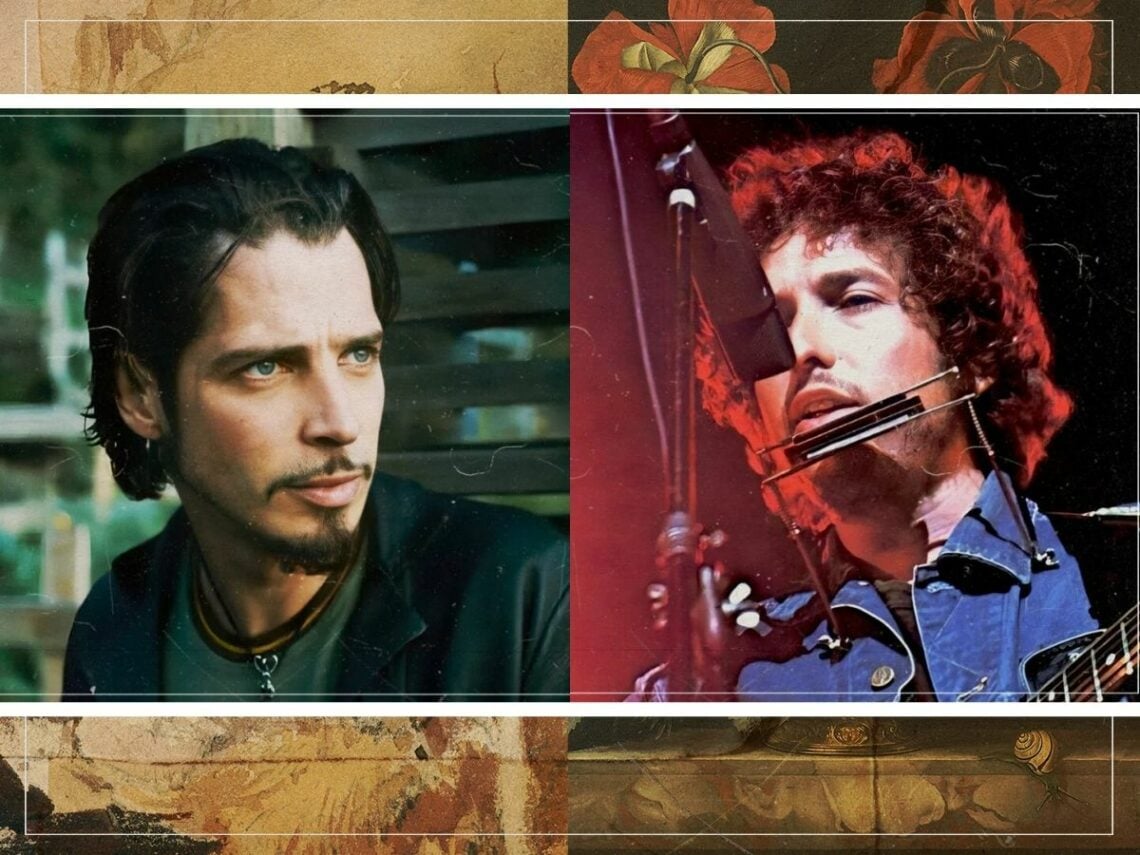
Break my rusty cage: the clear parallels between Bob Dylan and Chris Cornell

Bob Dylan and Chris Cornell might not seem comparable at first glance, yet there are striking similarities between the ‘Voice of a Generation’ and his younger grunge counterpart. Both were immensely consequential songwriters, but it was their refusal to be confined to any single era or sound that truly connected them in spirit.
Famously, Bob Dylan stoked the rage of many in the folk community in 1965 when he decided to pick up the electric guitar on Bringing It All Back Home and push his songwriting knack – which had captured the collective imagination with rousing social commentaries – into something more cerebral and surreal.
In this new rock context, instead of laying it all on the table as he had previously, the Minnesotan troubadour now challenged his audiences to think. This shift, reflective of the times and the fervour of his followers, sparked significant outrage. His early performances with The Hawks were deeply divisive. Some fans were invigorated by his bold new direction, while others felt betrayed, heartbroken that their hero had seemingly forsaken them. The backlash was so intense that one crazed fan even attempted to stab him in Scotland over this perceived artistic betrayal.
Dylan was not one for turning, though. In time, the 1965 album came to be deemed one of his ultimate masterstrokes. It kicked off a career of immense artistic substance that would see him dodge the passing of the times and cement himself as one of the greatest songwriters ever. For the young Dylan, simply being the voice of his generation was not enough. He wanted complete creative enlightenment, and nothing was going to stop him, not even the glimmer of a pocket knife.
Naturally, Cornell, who had long been deemed inextricable from grunge, found a kindred spirit in Dylan. Of course, his connection to the pulsating darkness of the Seattle sound cannot be understated. Soundgarden opened the gates to history as the first grunge act to sign a major-label deal in 1989, thanks to their triumphant metal-laden grooves, but this area only accounts for a small portion of his artistry.
Outside the classic rock acts such as Black Sabbath and Led Zeppelin that every open-eyed American teenager of his generation loved, Cornell was a big fan of chameleonic songwriting powerhouses Paul McCartney and David Bowie, as well as British post-punk innovators Bauhaus, Siouxsie and the Banshees and even new wavers Ultravox. Perhaps more surprisingly, in his late teens, when he had dropped out of school and was immersing himself deep in the world of narcotics, he loved Elvis Costello and two-tone legends The Beat. It’s no surprise that Soundgarden were loosely post-punk when they formed in 1984.

Soundgarden split in 1997, and afterwards, Cornell joined the supergroup Audioslave alongside the former members of Rage Against the Machine. While their sound was still ostensibly alt and hard rock, they blended with funk, soul and R&B influences, pushing themselves into new areas with multi-platinum success. During his post-Soundgarden era he also started working as a solo artist, which meant he was unchained and could experiment to his heart’s content.
While Cornell would never get the hatred that Dylan did, when he released his third solo effort, Scream, in 2009, he had his fair share of detractors. Many longtime fans could not believe he had enlisted hit-making R&B producer Timbaland for a mesh of electronics, loops, samples, hip-hop, soul, funk and other supposedly far-removed textures. The record even featured Justin Timberlake on backing vocals. In reality, it wasn’t that much of a surprise; Soundgarden covered Sly and the Family Stone on an early Peel session. Cornell had also discussed his love of soul and funk on several occasions in the past.
During this period of really branching out, Cornell found a positive example in Bob Dylan’s artistic leap thanks to the 2005 documentary No Direction Home, charting his 1960s arc. While he would state it was ironic that he preferred the parts in the movie where Dylan was without his band, the parallels were unmistakable.
“The funny thing is,” Cornell told The Guardian in 2009, “If you watch that Dylan documentary, they interview the fans, and someone says: ‘I paid to see folk music, and that was just pop music.’ But then this guy says a really smart thing: ‘Well, that wasn’t like any pop music I’ve ever heard.’ And he’s right because that performance doesn’t sound like any other artist, even though it was approached with guitars, drums and keyboards.”
Although the late icon might have been skewed in thinking that his dive into hip-hop might have had a cultural impact, his point was unambiguous: he was never to be boxed in by expectation. He explained that one of the reasons Soundgarden called it quits was to protect their culturally significant grunge legacy, which they never wanted to tarnish with outside sonic flecks. He concluded: “As a performer, I’m able to do what I want, and what I’m doing now feels good.”
It was clear all along that Cornell was to break free from grunge and run off into the distance, creating whatever he wanted. After all, he told us so in 1991’s ‘Rusty Cage’: “I’m gonna break my rusty cage and run”. That was Dylan’s spirit to a tee.

Never Miss A Tale
The Far Out Bob Dylan Newsletter
All the latest stories about Bob Dylan from the independent voice of culture.
Straight to your inbox.