


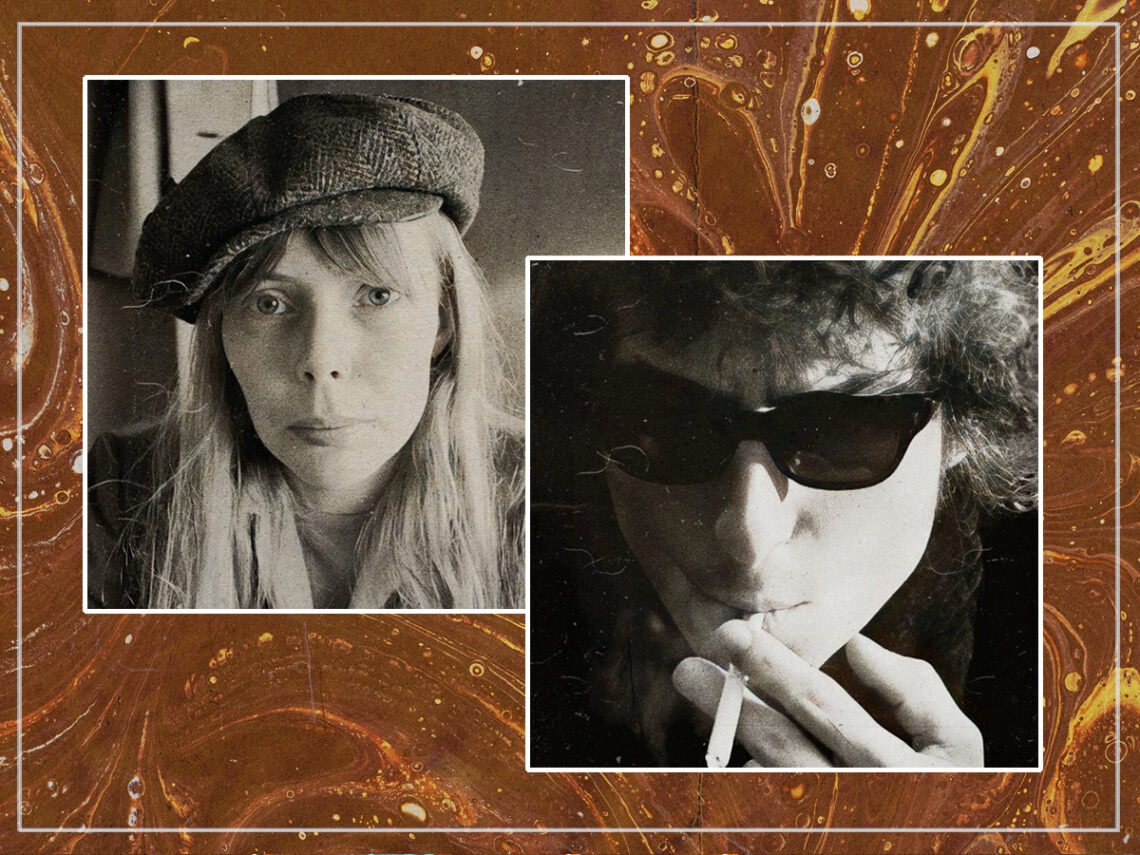
‘Tangled Up In Blue’: The classic song Bob Dylan wrote that was inspired by Joni Mitchell

While most art is a version of pastiche in one form or another, there are a few exceptions to the rule: artists who exist solely in their own lane and rarely draw reference from other artists as a means of creation. Bob Dylan is undoubtedly one of the latter.
Pounding the pavements of Greenwich Village’s burgeoning folk scene in the early 1960s, Dylan’s unique songwriting style achieved nuanced rhyming patterns without neglecting narrative. A narrative that cut to the heart of social issues while being profoundly introspective, all while writing melodic compositions brimming with intricate ideas. He was, more often than not, an innovator of ideas rather than a follower and if that’s a point you’re willing to contest, ask yourself what music’s most famous cover is and who performed it.
After spearheading the popularity of folk in the early 1960s, he turned his back on the genre by plugging in and pursuing his earlier ambition of fronting a rock ‘n’ roll band. Wherever the sonic wind blew him, the outcome was delivered with authenticity and proved that no matter what sonic form, people deeply craved Dylan’s artistic perspective.
A point famously summarised by Joni Mitchell, who once said: “There came a point when I heard a Dylan song called ‘Positively 4th Street’ and I thought ‘oh my God, you can write about anything in songs’. It was like a revelation to me.” Despite the poppier canvas upon which Dylan painted this song, his sincerity still took centre stage, removing false preconceptions that high art can only exist with a more delicate sound.
Come the early 1970s, while Mitchell was carving her sound out of the Laurel Canyon hillside, still enjoying the work of a prolific Dylan, he was back on the opposite coast, reciprocating Mitchell’s admiration.
In 1975, Dylan released his 15th studio album, Blood On The Tracks, which opened with ‘Tangled Up In Blue’. A record that muses on love gained and lost, it combined the folk sensibilities of early ’60s Dylan glittered in the haze of an Americana soundscape. Bolstered by a more elaborate production that gave the record a fuller feel rhythmically, the delicacy within the song’s context is propelled forward by its performance and spits in the face of post-break-up vulnerability.
While blue is a commonly coined term in lyricism and provides an ocean of imagery to dive into when exploring feelings of despondency and abandonment, the rumour mill that circulates much of his lyrics points to a more uncharacteristic influence for someone like Dylan. Four years prior, Mitchell had released her seminal record Blue, which famously explored the conflict of her relationships with fellow musicians Graham Nash and James Taylor.
A folk songwriting powerhouse herself, Mitchell’s record cleverly depicted the conflict between romantic responsibility and independence with such nuance that it still resonates with such a profound sense of personability to this day. Her emotions are laid bare on a delicate bed of folk production; it’s a masterclass record and is widely considered her opus. So four years later, when bootleg circulations of Dylan’s early recordings of Blood On The Tracks circulated, it appeared that Mitchell’s record had deeply influenced him.
Speaking to the New York Times in 2018, Mitchell said: “Joel Bernstein gave me a tape of it, and it was really good, it was really good. But people said, ‘Oh, it’s like a Joni Mitchell album,’ so he went and recut it with his brother in Minnesota. They butchered it all up. They stomped all over it. But originally, the writing was different, it was more vulnerable, and the orchestration was subtle. And one night I had a party here — and Bob crashed it. And the bootleg of that first Blood On The Tracks was playing. They were out in the garden, and somebody said that Bob wanted to see me. And the bootleg was still playing and I said, ‘Why didn’t you put that one out?’ And he said, ‘Somebody stole the tape.’ Which was not true. He chickened out.”
While Dylan’s steely sense of artistic resilience may have prevented him from admitting the influence there, he soon acknowledged Mitchell’s work in a 1978 interview with NME: “Joni Mitchell had an album out called Blue,” he continued. “And it affected me. I couldn’t get it out of my head. It just stayed in my head.”
Mitchell, of course, hasn’t trademarked ‘blue’ as a means of artistic imagery. But her album has since been inextricably linked with the word for its deep-cut approach to portraying the human condition, which hasn’t just affected fans world over but Dylan himself. And still, despite its influence, there’s no arguing that Dylan’s track found a new pool of blue to swim in and achieved appropriately Dylan-esque levels of narrative quality on the track.

Never Miss A Tale
The Far Out Bob Dylan Newsletter
All the latest stories about Bob Dylan from the independent voice of culture.
Straight to your inbox.