


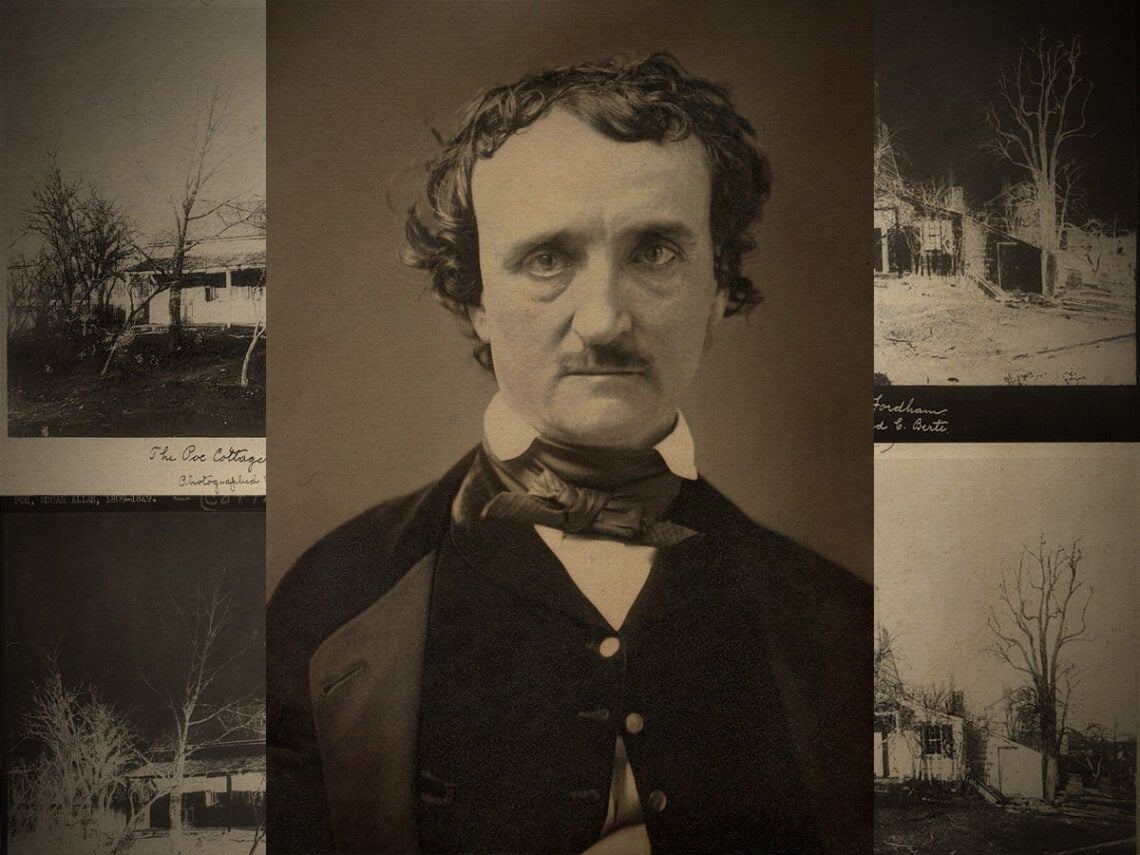
The unassuming Bronx cottage where Edgar Allan Poe wrote his greatest poems

“It was many and many a year ago, / In a kingdom by the sea, / That a maiden there lived whom you may know / By the name of Annabel Lee…” So goes the opening lines of one of Edgar Allan Poe‘s most beloved poems, ‘Annabel Lee’, its story following the tragedy of the narrator’s young wife, with whom he shared a love so strong that it was envied by heavenly angels, prompting her death by a seraphim.
As the poem continues, we learn that every night, the narrator lies beside Annabel Lee’s tomb by the sea, dreaming of her as their souls remain attached. This was to be Poe’s final completed poem before his death in 1849 and was published posthumously, as he once again returned to his faithful theme of the death of a beautiful woman, which he called “the most poetical topic in the world”. Less known, however, is the poem’s origins: a small cottage in the Bronx, New York.
While born in Boston, Poe’s work with literary journals and periodicals took him across Baltimore, Philadelphia and New York City, where he ventured into poetry, prose and editing. In Baltimore, he obtained a license to marry Virginia Clemm, his 13-year-old first cousin, when he was 27 years old. Poe’s biographers have conflicting accounts of the nature of their marriage, which was undeniably strange, even considering the time period. Nonetheless, the two were married in 1836, as Poe began to develop his reputation as a literary critic. Nearly six years later, however, Virginia began to show signs of consumption, otherwise known as tuberculosis.
Poe found success with the publication of his poem ‘The Raven’ in the Evening Mirror in 1845, but he was still in poverty; coinciding was Virginia’s rapidly worsening condition. Thus, he decided to move, with her and her mother, Maria, to New York, first, briefly living in Manhattan, before relocating to a cottage in the Fordham neighbourhood of the Bronx in 1846. The family hoped that the move would improve Virginia’s health, as well as Poe’s fragile mental state. At the time, Fordham was not yet a part of the Bronx, and it was a rural community largely of farmers, newly connected to the city by rail, but it was still tranquil, removed from the bustle of the city.
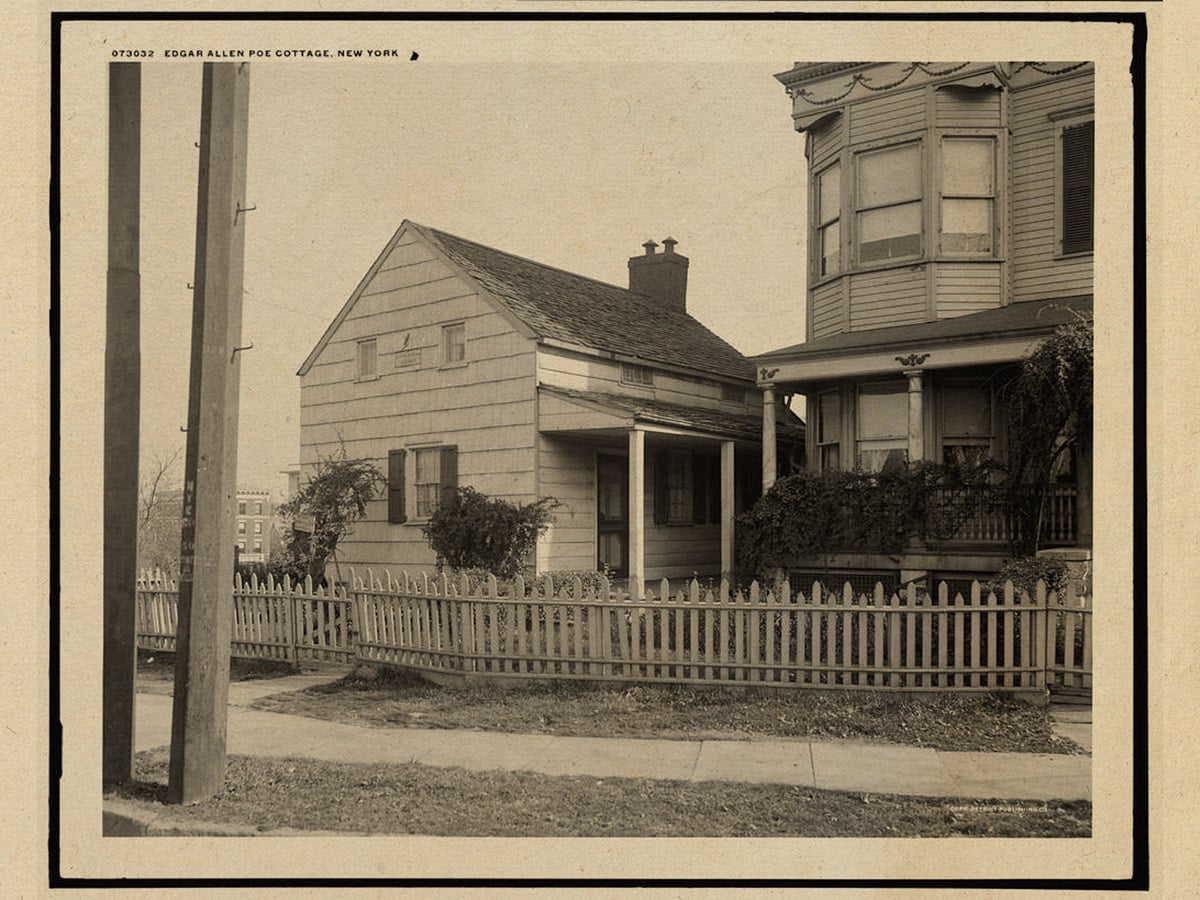
The cottage itself, believed to be built in the early 1800s, was a small, white home with two floors, the first, with a sitting room, bedroom and kitchen, and the second with a bedroom and Poe’s study, and the front porch housed caged songbirds, the whole thing resting on two acres of land. “The place is a beautiful one,” Poe wrote of the cottage, and for the next three years, the trio made the humble space their home, afforded at just $100 a year. “The cottage had an air of taste and gentility,” a friend of Poe’s wrote, years later, “So neat, so poor, so unfurnished, and yet so charming a dwelling I never saw”.
Half a mile away was the Fordham University campus (then known as St John’s College), and Poe would often visit the students to discuss current events and play cards. “They were highly cultivated gentlemen and scholars,” he wrote of the faculty (quoted in a letter by Reverend John Henry Hopkins), “[who] smoked, drank and played cards like gentlemen, and never said a word about religion”. His visits to the campus brought about one of the poems written in the Bronx cottage, ‘The Bells’, inspired by the sounds of the University’s church bells.
While living in the cottage, he also finished ‘Eureka: A Prose Poem’, a nonfiction work that was adapted from a lecture he had given, which tackled his conception of the universe and its nature. With no scientific studies done by him to precede his writing, it was regarded by many as an absurdist work. Still, he does foresee 20th-century scientific discoveries and theories, and he wrote the piece with his usual romantic flair, seemingly not too concerned with seriousness and instead expanding on his views of the universe in the work.



“I offer this Book of Truths, not in its character of Truth-Teller,” he wrote in its preface, “but for the Beauty that abounds in its Truth; constituting it true”. While certainly not his most popular, Poe saw ‘Eureka’ as his greatest work.
The cottage also yielded ‘The Cask of Amontillado’, a short story that follows a man in an unnamed Italian city who plots revenge on a friend who he believes insulted him. It is written from the point of view of a murderer, as he carries out the act of burying his friend-turned-enemy alive, similar to his story, ‘The Tell-Tale Heart’, first published in November 1846, showing Poe’s longstanding preoccupation with the subjects of death and haunting.
In the only surviving letter from Poe to Virginia, from June 12th, 1846, he wrote, “Keep up your heart in all hopelessness, and trust yet a little longer”. Tragically, on January 30th, 1847, about eight months after the family’s move, Virginia died in the first-floor bedroom of the cottage. Her death left Poe shattered, and he would frequently sit beside her tomb, for hours on end, with his writing about the deaths of beautiful women becoming more common. From the morbid beauty of ‘Annabel Lee,’ written after Virginia’s passing and believed to be at least partly inspired by her, to ‘Ulalume’, also written at the cottage in the aftermath, similarly about the narrator’s loss of his love after her death.
Later recorded by Jeff Buckley, ‘Ulalume’ is less romantic than the former, instead focused on the darkness of decay, withering and agony; there is a sense of horror that exists in Poe’s other famous works, from the haunt of ‘The Raven’ to the sinister energy of ‘The Fall of the House of Usher’. “She rolls through an ether of sighs / She revels in a region of sighs,” Poe writes in ‘Ulalume’, “She has seen that the tears are not dry on / These cheeks, where the worm never dies”.
Poe would die suddenly and mysteriously nearly three years after his wife. On October 3rd, 1849, he was found walking the streets of Baltimore, only semiconscious and incoherent, wearing a stranger’s clothing and unable to explain what had happened to him. All he called out was the name “Reynolds” over and over, with no other semblance of a reason for his condition. He died four days later, of what is believed to be a result of his alcoholism, though a conclusive cause of death remains unknown, as his medical records, including the death certificate, have been lost.
At the cottage, only Maria remained, where she learned of Poe’s death two days later. Soon after, she moved out of the cottage to live with family in Brooklyn, and the fate of the cottage after is unknown. 25 years after Poe’s death, the Appleton’s Journal reported that the cottage was “dreadfully out of repair” and was sold at auction 15 years later at just $775, beginning its preservation.
In the early 1900s, the efforts at maintaining the cottage began in earnest, keeping Poe’s legacy intact by moving the home from its original location to just a few hundred feet east on Kingsbridge Road, where it stands today in Poe Park as a historic landmark and a historic house museum as part of the Bronx Historical Society, open to the public to visit and experience where Poe called his final home.
