


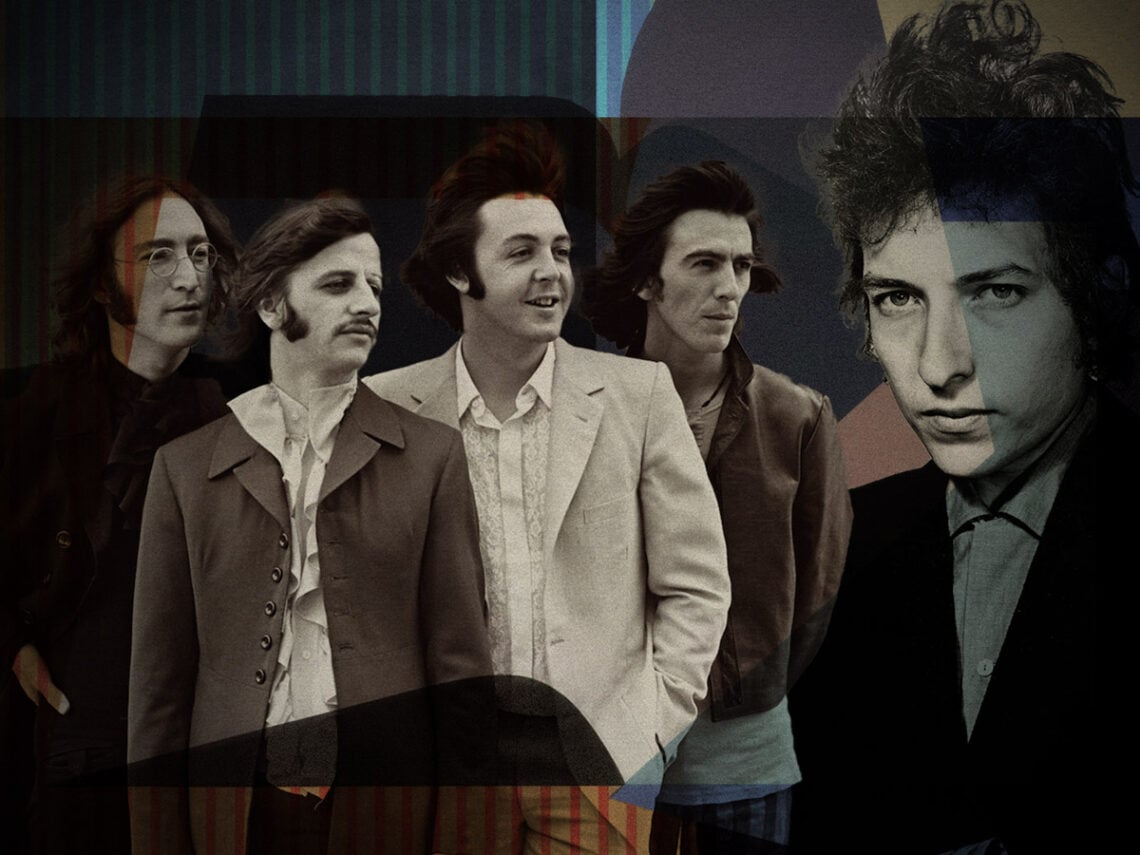
‘4th Time Around’: The twin histories of Bob Dylan and The Beatles

“Did I ever want to acquire the sixties?” Bob Dylan asked Jonathan Lethem in a 2006 interview to promote his then-most recent album, Modern Times, “No. But I own the sixties. Who’s going to argue with me?”
Well, if anybody else had a claim to owning the swinging sixties, if anybody else could fairly wrestle the deed away from Dylan for ownership of the era, then it’s The Beatles.
There are no two more important artists or bodies of work, two more revolutionary, evolutionary and extraordinary names in the post-Elvis world than Bob Dylan and The Beatles. Two artists who consistently released ground-breaking, gravity-defying and mind-bending songs and albums, and so undeniably reset the script for what was going on around them, changing the course of the culture, such that their presence and work still ripple through the tides of everything that we hear today.
However, Dylan doesn’t seem to agree. In 2007, he said that, “I mean I’m in awe of McCartney. He’s about the only one that I am in awe of”, and it seems that McCartney feels something similar himself, as he said in 2019, “There’s one or two people who I would be quite nervous about. Bob Dylan would make me go, ‘Oh my God, what am I gonna say?’”
Or a year later, when he expanded on that thought, saying, “Sometimes I wish I was a bit more like Bob. He’s legendary, and doesn’t give a shit! But I’m not like that”.
Explaining why he is so awed by McCartney, Dylan rhapsodised that “he can do it all and he’s never let up, you know. He’s got the gift for melody, he’s got the rhythm. He can play any instrument. He can scream and shout as good as anybody, and he can sing the ballad as good as anybody, you know? And his melodies are, you know, effortless. That’s what you have to be in awe…I’m in awe of him, maybe just because he’s just so damn effortless.”
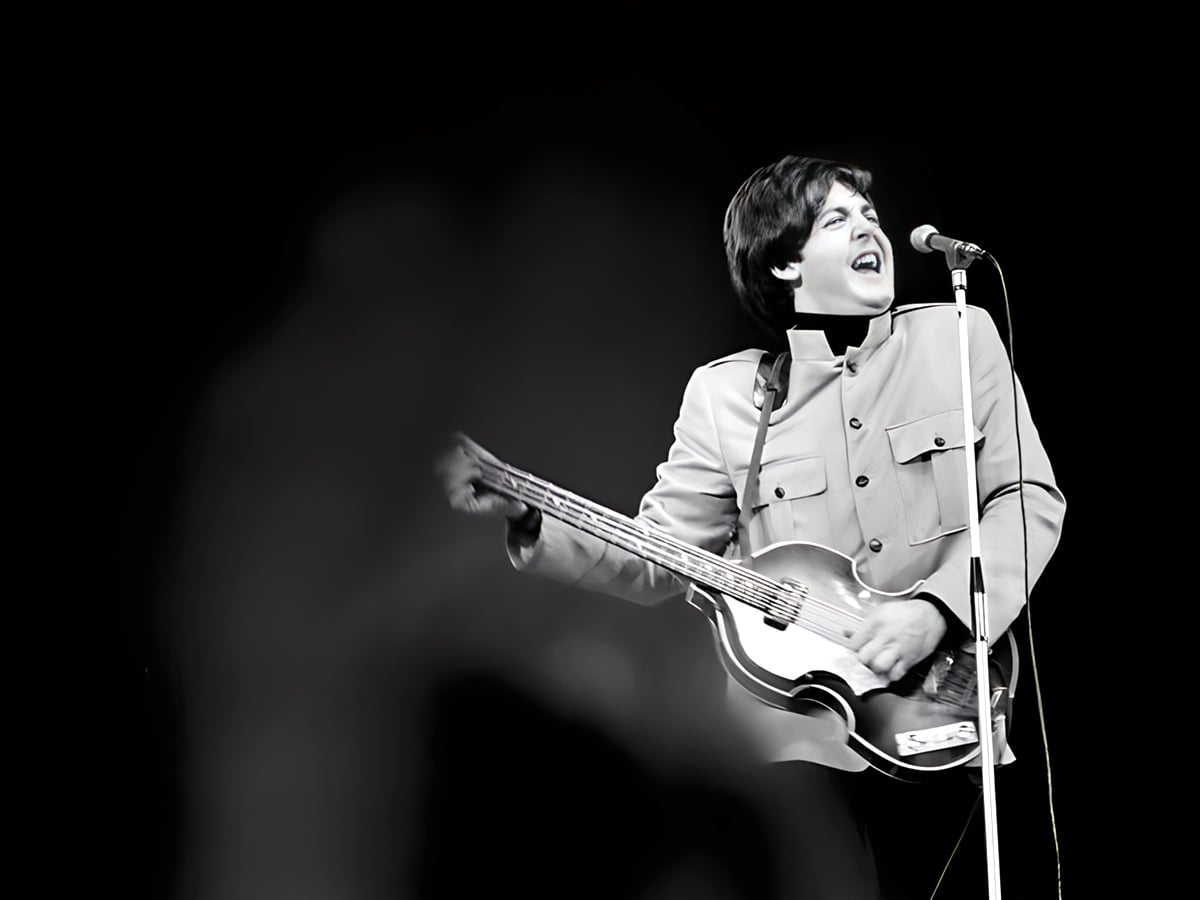
And then, with a laugh, he added that, “I mean, I just wish he’d quit, you know?”


And over the years, there has been no shortage of appreciation and inspiration running back and forth between Bob Dylan and all four fabulous members of The Beatles. If Dylan is in awe of McCartney, then it pales in comparison to George Harrison’s worship of his fellow Traveling Wilbury. Tom Petty once suggested that Harrison revered Dylan so deeply that he “quoted Bob like some people quote Scripture”.
It’s no surprise, then, that Harrison would often drop such Dylan quotes and references into his own lyrics or that he would go on to ask (and then answer) the question in 1993 of “Can you imagine what a world it would be if we didn’t have a Bob Dylan? It would be awful”. But it’s not always been an entirely complimentary mutual appreciation society, either.
Dylan and Lennon have been described as being like two tom-cats circling one another, trying to get the other to back down and occasionally moving in for the strike. Fighting for ground and for territory, hoping to stake their claim as the finest songwriter of their age, Dylan struck the first blow between the pair with ‘4th Time Around’, a melodic pastiche and play on Lennon’s ‘Norwegian Wood’, which the former thought sounded like something he himself might have written. The song ends with the line “and I? I never took much / I never asked for your crutch / now, don’t ask for mine”, which left Lennon paranoid and feeling that Dylan was warning him against trying to get up to his lyrical level.
Lennon himself would fire back in 1980, after Dylan’s Christian conversion, not only saying that “I was surprised when old Bobby boy did go that way. I was listening to the radio, and Dylan’s new single came on. He wants to be a waiter for Christ! The backing is mediocre; the singing’s really pathetic, and the words were just embarrassing”, before recording his own response song to Dylan’s Grammy-winning ‘Gotta Serve Somebody’ called ‘Serve Yourself’. That wasn’t all he had to say about his religious awakening, as my supremely talented colleague Tom Taylor examines and expounds upon in fascinating detail, and with fascinating insight, here.
And so go a million other similar stories, one for each of the revolutionary songs that each Dylan or The Beatles wrote and released, one for each of the countless lives that they changed with their music. You probably know most of them already. All the ones that are true and plenty of the ones that aren’t, as well. You know the story of how Dylan turned The Beatles onto pot and how, upon first hearing an acetate recording of their latest song ‘Tomorrow Never Knows’, Dylan needled McCartney, saying “Oh, I get it. You don’t want to be cute anymore”.

You know that The Beatles wore out their copy of The Freewheelin’ Bob Dylan from playing it so much, and that most of them were in the audience when he played at the Isle of Wight Festival in 1969, instead of being at the Woodstock Festival, which had been organised in his backyard, to try and coax him out of performing retirement.
And you know all that because the stories have been told so many times, by so many people, and in so many publications. But there are still so many mysteries to be unravelled regarding the connection between Dylan and the Fabs, as well. So many new insights to be revealed, new information to be gleaned, and songs about these singers to be sung. In his new book, out now through White Rabbit, called Where The Music Had to Go: How Bob Dylan and the Beatles Changed Each Other – and the World, Jim Windolf goes an incredibly long way in re-telling these tried-and-true stories in a way that you’ve never heard any of them before.
His new book opens with an anecdote about Dylan visiting Lennon’s childhood home, Mendips, before warping back to another age, a world before everything had been exploded and rewritten through the lens of Bob Dylan and The Beatles. Back to a time when the two were each separately listening to Little Richard on the radio and wishing that they were Little Richard, and then to later on, when they were each were being played on the radio in Britain for the first time, a day apart from one another, and on again to another night on the road in 1962 when they happened to be playing roughly 40 miles apart from each other: Dylan in Earls Court and The Beatles just outside London in Kent. Back to a time when McCartney dismissed Dylan as “folk crap” and Dylan dismissed McCartney and co as being too “bubblegum”, writing music for “teenyboppers”.
On their way to changing the world, they would each, of course, change their tunes about each other first.

In a press release sent out accompanying the book, White Rabbit founder and chief editor Lee Brackstone says that “you don’t need reminding that there are more books in circulation about Bob Dylan and the Beatles than Shakespeare and the Nazis combined”. But there aren’t really many, or perhaps even any, that put the pair where they belong, together, and examine the world through the dual lens of their visions for the future.
At one point in the book, Windolf suggests that his (unreleased) song ‘Tomorrow Is a Long Time’ is one of many Dylan compositions from the early 1960s “that gave what may be the oldest type of song, a love song, a freshness and credibility”. In much the same sense, through his warm, enthusiastic, engaging and informative prose, Windolf injects a similar freshness into what might just be the oldest type of book, a biographical history.
Our greatest musicians usually attract our greatest writers, which is why we have such incredible biographies of Elvis (Peter Guralnik’s Last Train to Memphis and Careless Love, perhaps the two best music books of all time), Muddy Waters (Robert Gordon’s Can’t Be Satisfied) and Michael Bloomfield (Guitar King by David Dann). And, like the team at White Rabbit suggests, there are already more books out there about Bob and The Beatles than you could fill up a library with, but some are better than others.
Robert Polito’s recent treatises on Dylan’s late career output (After the Flood: Inside Bob Dylan’s Memory Palace) outwrite and outwit practically everything that has been written by long-time Dylan chronicler Clinton Heylin, but by other lesser writers and thinkers, too. Windolf outshines Heylin here, as well, as he does with plenty of Beatles books and things like Lesley-Ann Jones’ recent Fly Away Paul: The definitive biography of Beatles legend Paul McCartney’s time in Wings, amongst others.
In the case of writers like Heylin and Jones, so much of their prose reads like they have a disdain for the musicians they’re pledging their time to, or at the very least, a score to settle. You almost get a sense that they’re sick of covering the same old stories that have already been lived and told by countless others before them. Like they are writing about them against their will, or that they think of themselves as superior writers to Dylan, McCartney, Lennon, Harrison or Ringo Starr. You get the impression that they think they could have done it all so much better than Dylan did, or that the Beatles could. You can decide if you think that they are or not, but I think I know the decision you’ll come to.

You don’t get that same impression from Guralnik or from Gordon, though; from Dann or from Polito, and you don’t get it from Windolf here, either. First and foremost, he is writing this book because he is a fan in awe of these artists, as they were and are in awe of each other, but also because he is a natural storyteller who can find the thread that will forever weave them together through time, and together through life. He doesn’t get bogged down in excessive and unnecessary details, but gets you far enough in so that you can say that you’ve been there. You know all the scenes, but this book fills in the background, fills in the narrative, and it explains all the impact of all those moments from so long ago.
In lesser hands, the way that he flits between the stories and narrative that follow Bob (as he calls Dylan throughout) and The Beatles could be overwhelming and disorienting, but in this piece of writing, you wouldn’t have it any other way. The two took the music where it had to go, just as in his new book, Jim Windolf takes their story where it needs to, too.
Through a giddying and fantastical twin telling of their stories, the most exciting parts of the book come in the crescendos where the stories of Dylan and the Beatles intertwine, or when Windolf examines the dialogue that was going on between Dylan, Lennon, McCartney, Harrison and, to a lesser extent, Ringo, in their lyrics and songwriting, in things like ‘Ballad of a Thin Man’ and ‘Nowhere Man’s or ‘Norwegian Wood (This Bird Has Flown)’ and ‘4th Time Around’.
Thankfully, the story didn’t end in the sixties, and so neither does the book. Where plenty of people get stuck in time just thinking, talking and writing about the music from those dizzying days, the next 50-to-60 years can be cast off as something of a footnote in their telling. Not so in life, though, and not so here, either, as Windolf tracks the evolution of the relationship over the years right up to the present day, and then weaves all that back into the narrative to inform those early years of genius, camaraderie, competition, rivalry, idolatry and revolution. It is a fine and consummate piece of work that will reward repeated reading as much as the best songs and albums by Bob and by the Beatles demand repeated listening.
Spend a little time listening to Dylan’s ‘Mother of Muses’ and McCartney’s ‘Days We Left Behind’, and you can bet your life that a collaboration between the two would be great, but you already thought as much, anyway, didn’t you?

Never Miss A Beat
The Far Out Beatles Newsletter
All the latest stories about The Beatles from the independent voice of culture.
Straight to your inbox.