


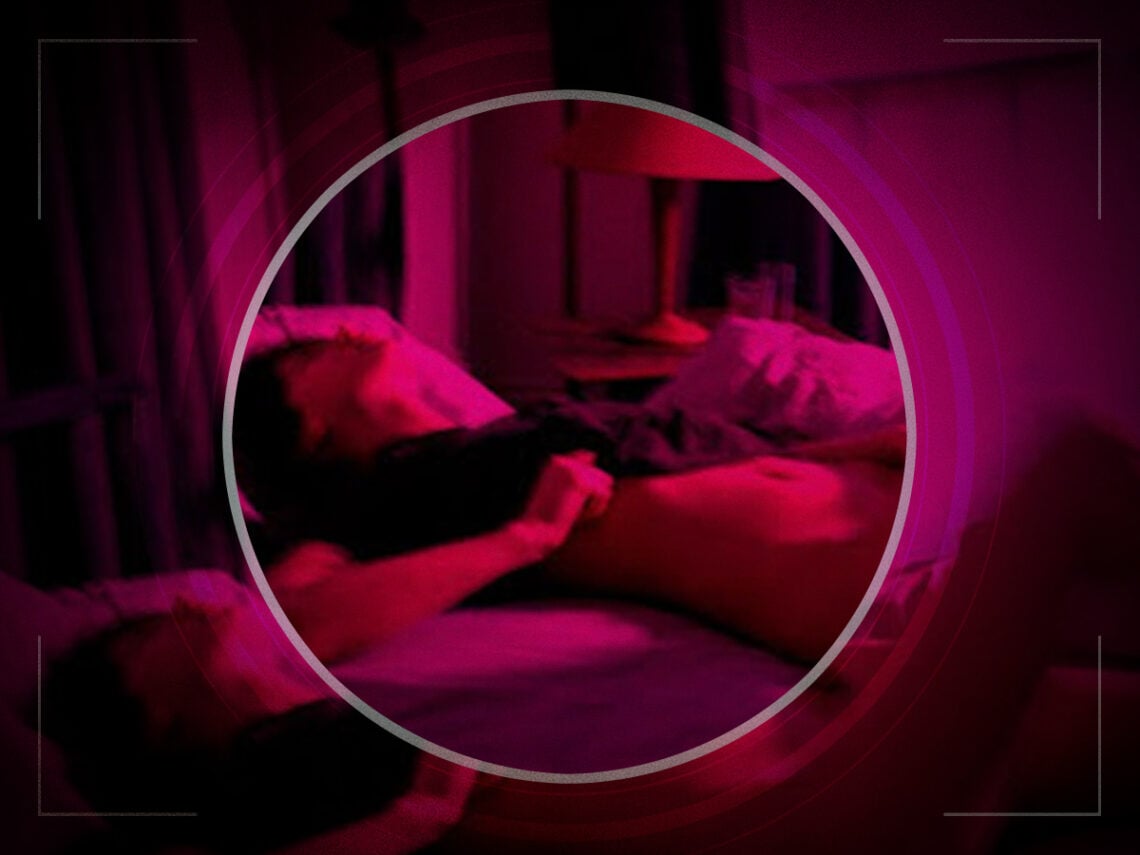
Unsimulated sex scenes and concert footage: the British film that blurred the line between art and pornography

Eroticism in cinema has always been a fascinating angle for filmmakers to explore. In 2004, Wonderland and 24 Hour Party People director Michael Winterbottom released what is undoubtedly one of Britain’s most erotic films, the arthouse romantic drama 9 Songs, starring Kieran O’Brien and Margo Stilley.
Gaining controversial notoriety upon its release, 9 Song combines live concert footage from a series of rock bands with explicit scenes of sexual intercourse. Narratively, Winterbottom’s film tells of a fleeting 12-month relationship in London between Matt, a British climatologist, and Lisa, an American exchange student, told in retrospect by Matt working in Antarctica.
When 9 Songs premiered in 2004, it immediately sparked controversy in Britain and beyond. The film’s decision to show unsimulated sex between its two leads blurred the boundary between arthouse cinema and pornography, prompting debate among critics, politicians and audiences alike. Some praised Winterbottom’s commitment to realism and intimacy, arguing that the explicit scenes reinforced the emotional vulnerability of the relationship, while others dismissed the film as little more than provocation disguised as art. It doesn’t really matter which side of the fence you sit on, but the debate remains valid nonetheless.
The surreal tone of the film is combined with concert footage from bands such as Black Rebel Motorcycle Club, Primal Scream, Elbow and Franz Ferdinand, which both Matt and Lisa attend. These moments are then quickly cut with scenes of the pair having sex. Winterbottom’s commitment to such graphic depictions divided audiences, who were torn between seeing it as a pursuit of realism or as something closer to pornography.
There’s an unflinching nature in both Winterbottom, O’Brien and Stilley in their commitment to capturing penetrative and oral sex on screen, and O’Brien had at the time become the first actor to be depicted ejaculating in a mainstream, UK-produced feature film. However, again, some audience members felt the entire ordeal to be rather over-gratuitous.
Winterbottom first had O’Brien and Stilley act in non-sexual scenes to get to know one another and make everyone on set feel more comfortable with one another. “It wasn’t until after lunch that we had sex,” O’Brien once said of the first day of filming. “[He] really mapped out everything. The order he wanted me to take off my clothes, her clothes, whether my socks stayed on or not.”
“He had specific ideas of how he wanted our bodies to move,” the actor added. “Sometimes, he would start us and then stop and say, ‘Let’s try this from a slightly different angle,’ and then take 15 minutes to reset the shot. I wondered if he remembered the delicate machinery of the male sex organ.”
Yet the film’s lasting impact lies in how it frames intimacy as fleeting and imperfect. By structuring the relationship around nine live performances, Winterbottom mirrors the rhythm of a romance that burns intensely before fading away. The concerts become markers of time passing, turning the sexual explicitness into something almost documentary-like: a record of a relationship remembered through fragments of music, desire and nostalgia.
9 Songs remains one of the most sexually explicit mainstream movies of all time due to its unsimulated sex scenes. Still, beyond the shock of such an approach to filmmaking lies an unfiltered portrayal of human connection that forgoes traditional storytelling techniques in favour of raw realism, even if it’s a realism that can err on the side of pornography.
