


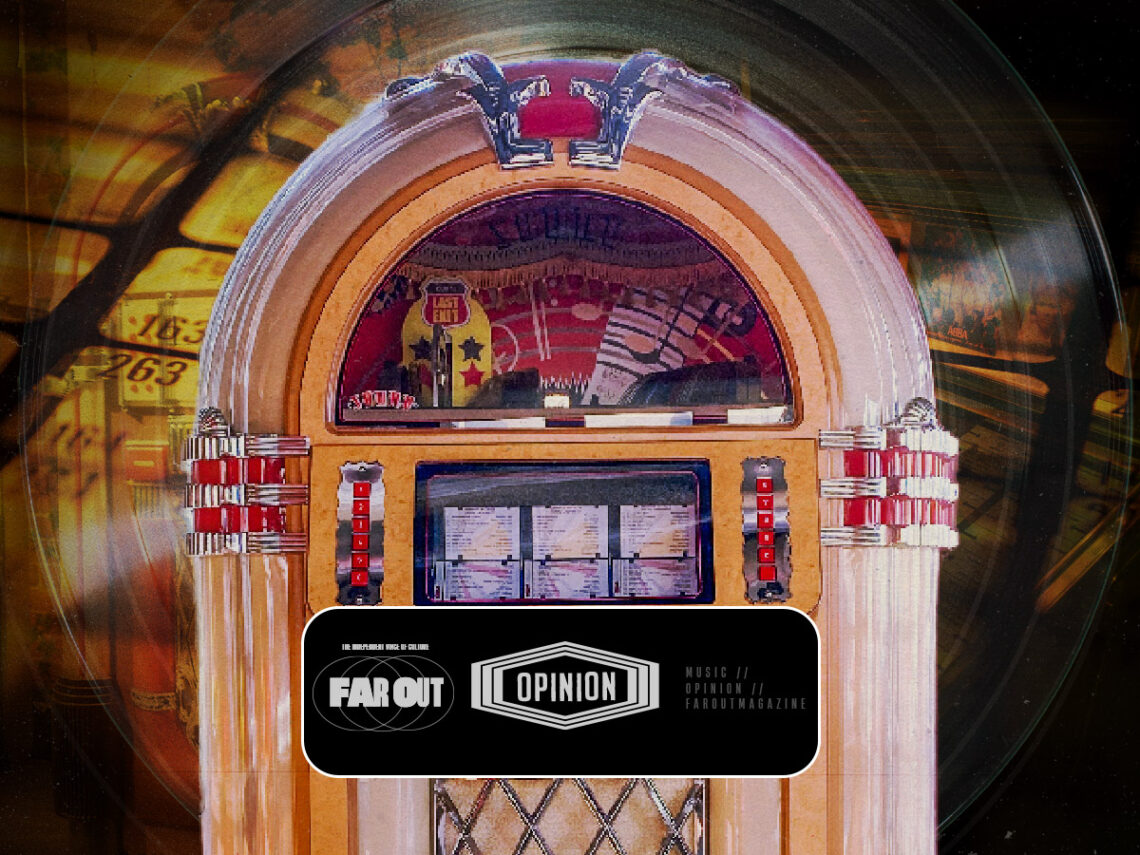
Hear Me Out: The jukebox is making an unexpected comeback

“99% of the world’s lovers are not with their first choice,” Willie Nelson once said. “That’s what makes the jukebox play.”
Before algorithmic music streaming services fed us the perfect songs and artists that we never knew we needed, making music discovery as simple as the click of the ‘Shuffle’ button, the jukebox was a glowing portal into the unknown. The jukebox reached the height of its popularity in the 1950s, becoming a staple in diners and dive bars, and synonymous with a post-war, youth-driven Americana. The jukebox was not just a device to soundtrack a night out; it was a means of community.
Circling around the phonograph – the most well-known design of the music box being a tall, rounded, coin-operated machine with multi-coloured lights, the shuffling of each individual record visible through a small window – meant uniting with friends and family, choosing a favourite song and debating what selection would follow. It was a tangible effort to curate music listening that, today, falls victim to nostalgia. The instantaneous satisfaction of opening a streaming app and playing a song that came to mind just seconds earlier is one of the gratifying things of living in a digital age, but it also removes the thrill of discovery.
The jukebox dates back to the late 1800s, with the music playback method being invented by Thomas Edison as an update to his own phonograph machine. Louis Glass and William S Arnold followed in Edison’s footsteps, creating an original design patented in 1889 – far from the technicoloured structure most well-known today, but the first iteration of a coin-operated machine. “The Automatic Entertainer”, the first multi-selection, coin-operated phonograph was made by the John Gabel Manufacturing Co in 1906, promoting a boom in the manufacturing of jukeboxes in the 1920s and ’30s.
Persisting against all odds, including the Great Depression and the advent of the radio, by the mid-1940s, three-quarters of the records produced in the United States went into jukeboxes and, in the ’50s, jukebox play was measured by Billboard’s record chart. However, by the mid-1960s, the jukebox waned in popularity, falling out of favour against the rise of portable music listening and digitised jukeboxes, leaving vinyl by the wayside.

But nostalgia always comes full circle. The jukebox has seen a resurgence over the last few years, thanks in part to Rock-Ola, a historic jukebox manufacturer purchased by Alexander Walder-Smith in 2019. Walder-Smith began making them in the “traditional” way: “Bring home a piece of Americana,” Rock-Ola’s slogan reads, with a number of authentic phonographs for sale.
Similarly, Sound Leisure, a family business from Yorkshire, is attempting to keep up with the demand for jukeboxes. Operating since 1978, Sound Leisure boasts British-built jukeboxes and, alongside Rock-Ola, remains one of the two jukebox manufacturers left.
The sudden resurgence of jukeboxes stems from the pandemic, when people were prioritising home entertainment; when pubs and social venues were able to open again, they followed suit, showing interest in jukeboxes’ potential to get people to go on nights out again. Walder-Smith credits the revived interest in vinyl records as contributing to the nostalgia factor of a jukebox, telling Shortlist, “Much as people love the tactility and more personal aspect of vinyl – even among younger people who perhaps see it as a reaction against the on-demand digital age – so that’s been the case with jukeboxes.”
With prices ranging from £8,000 to £100,000, modern jukeboxes are certainly not the most affordable method of music consumption, but it is that very nostalgia that continues to intrigue the masses. The sensation of walking up to a jukebox, inserting a coin, pressing a button and watching the vinyl spin your selection is a lesson in how music can remain material in the internet age. Both Rock-Ola and Sound Leisure have modernised their jukeboxes to include CD configuration and Bluetooth-enabling, with additional hardware updates that will keep records spinning for future generations.
“The jukeboxes we make will be around in another 50 years,” Chris Black, the managing director of Sound Leisure, asserts. “They’ll be handed down through generations much as the old ones have been.”
