


Who decides history? The biggest problem with the Rock and Roll Hall of Fame

In 1986, almost 40 years ago to the day, the Rock and Roll Hall of Fame celebrated its first inductees.
Built on the symbolic gesture of recognising the acts that inspired the current cohort of musical icons, the organisation barely had a building, let alone the grandiose ceremonies now broadcast on Disney+.
Four decades on, and the Rock Hall is a spectacle, gatekeeping history, legitimacy, and lineage, and while it does a decent job at making sure some of the genre’s originators and inspirations are accounted for, it begs the question: how do we decide who gets remembered and who gets left behind?
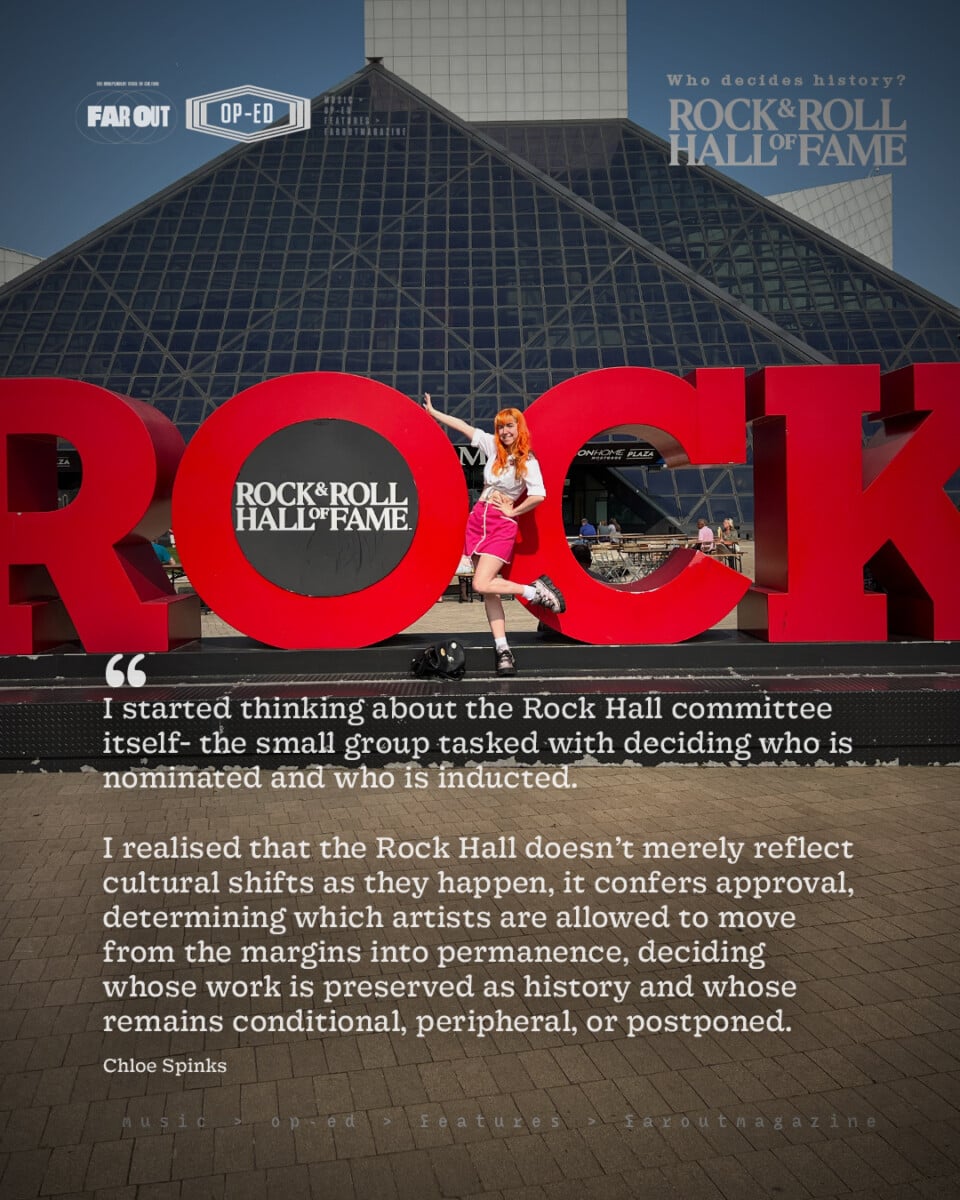
In 2025, I made my pilgrimage to the Rock Hall museum and spent the day trying to hold back floods of tears in front of artefacts that have defined my love of music. Of course, catching sight of Prince’s guitar, handwritten Beatles’ lyrics, and Michael Jackson’s Thriller Jacket left me emotional and in awe; however, what truly broke my emotional barrier was the other moments of recognition: women, punks, weirdos, and unconventional outsiders.
It was different seeing Debbie Harry’s ‘Heart of Glass’ dress, the written lyrics to The Runaways’ ‘Cherry Bomb’, Tina Weymouth’s Stop Making Sense getup, and especially my friends in Big Joanie sharing a display case with X-Ray Spex. Seeing them was not just about fame, but proof of survival, influence, and continuity.
However, this moment was bittersweet, as many of the women represented in the Rock Hall museum are yet to be inducted into the actual Hall of Fame, and there’s a distinct difference between being represented in an exhibit and immortalised by induction.
This moment returned to me recently as a contestant on the ITV Show The Floor, in which I represented the category of the Rock and Roll Hall of Fame. As I was revising my flashcards, I found myself repeating the same three: Roy Orbison, Buddy Holly, and Elvis Costello, infuriated by how similar they looked.
I also kept having to look back at classic and prog rock bands, trying to find small differences in their features and face shapes. While each act is valid in their induction, the message from the Rock Hall is clear: this is what it is acceptable for a musician to look like to be taken seriously. Under ten per cent of the inductees from the Rock Hall are women, and a large majority of acts inducted are white. Why does representation feel exceptional rather than expected?
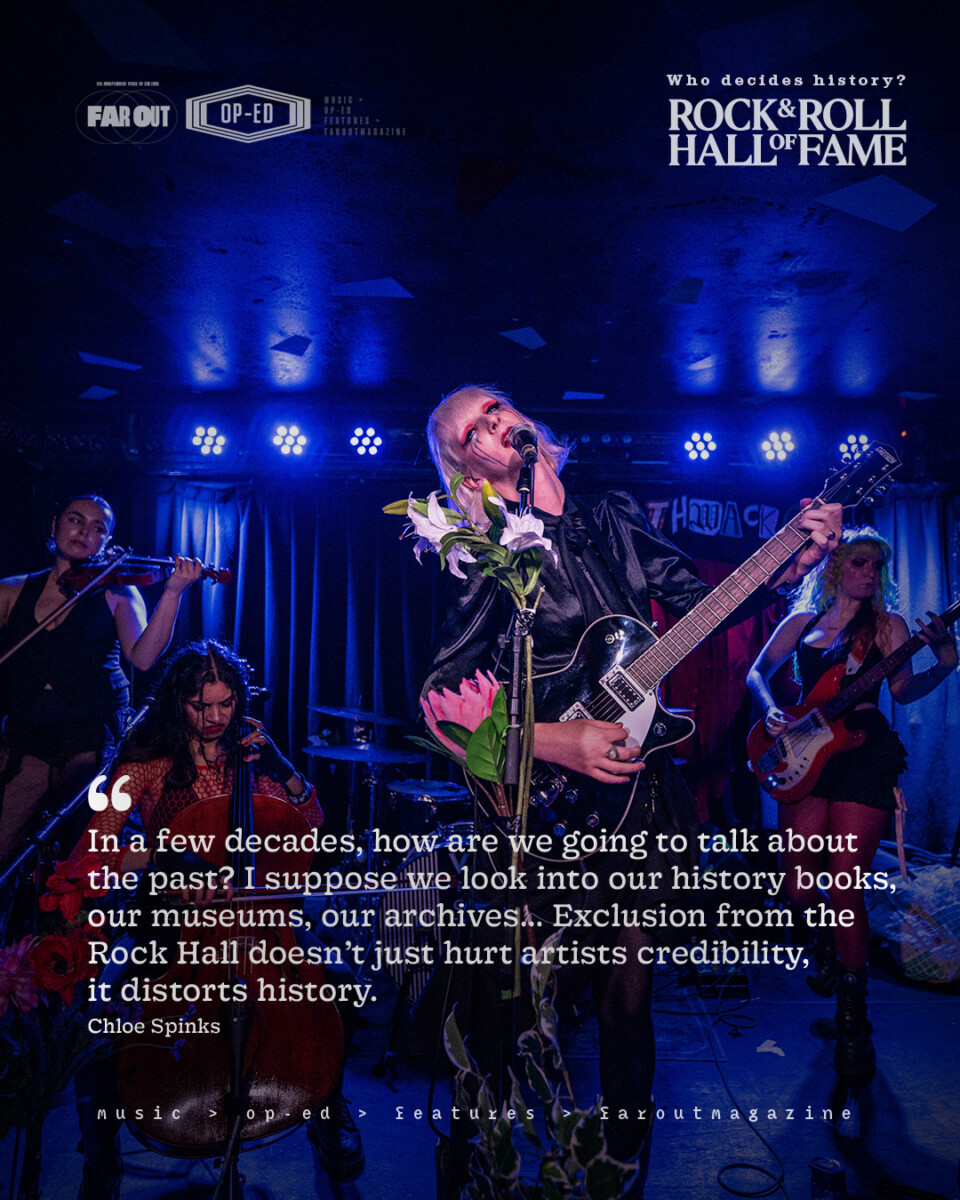
For context, I am in a queer orchestral punk band called THWACK!. We do things independently and have left claw marks in all of it, because things do not come easy to the unconventional. As a band so influenced by the rock greats and wanting to one day stand among them, several things occurred to me: THWACK! isn’t male, or cis, or all white; we’re not conventional, so is there space for us?
THWACK! has previously joked between ourselves about how many minorities we can be before we become completely unpalatable, and in that moment, reading the list of inductees, I realised that we may have crossed the line a while ago… And the uncomfortable truth is that we aren’t even among the most marginalised. We still move through the world with forms of privilege that many artists don’t have.
I started thinking about the Rock Hall committee itself, the small group tasked with deciding who is nominated and who is inducted, and I realised that it doesn’t merely reflect cultural shifts as they happen; it confers approval, determining which artists are allowed to move from the margins into permanence, whose work is preserved as history and whose remains conditional, peripheral, or postponed.
Once I started digging through nomination history, that imbalance became impossible to ignore. Nile Rodgers, one of the most important figures in modern music, only got inducted into the Rock Hall after 11 snubs, the most in the Hall’s history. Looking further, the omissions became louder than the inductions.
Where is Alanis Morissette? Where are the B-52s? Courtney Love? The Runaways? Björk? Bikini Kill? Grace Jones? X-Ray Spex? Have we hit our capacity for women and women of colour? Have we hit our capacity for queer, gender bending, or the otherwise unconventional?
The pattern repeats throughout the Hall’s history. Sister Rosetta Tharpe was only inducted in 2018, but featured on the US postage stamp two decades prior. Nina Simone became eligible for the Rock Hall in 1986, but was only first nominated in 2018. How was Peter Gabriel inducted twice (once with Genesis, once solo) before Whitney Houston in 2020?
In a few decades, how are we going to talk about the past? I suppose we look into our history books, our museums, our archives… Exclusion from the Rock Hall doesn’t just hurt an artist’s credibility; it distorts history.
I remember standing in front of Kathleen Hanna’s dress in the Rock Hall museum and feeling overwhelmed. The moment mattered to me because it was hard-won. The struggles that many have had to feel “valid” or “enough” to be recognised resonated with me, knowing that THWACK! still have a lot of bumpy roads to travel to even get a second look in our direction.
I can’t protect us from what visibility can leave us vulnerable to, but I can look at Siouxsie Sioux’s cape, or Big Joanie’s zine, and know that, while they haven’t yet been inducted into the Rock Hall, loud, proud, and unconventional people have thrived before us and provide their shoulders to stand on.
I turned the corner, with tears in my eyes, yet somehow unable to stop working on band admin, and clicked “share” on THWACK!’s proudest moment so far: our Glastonbury announcement.
