


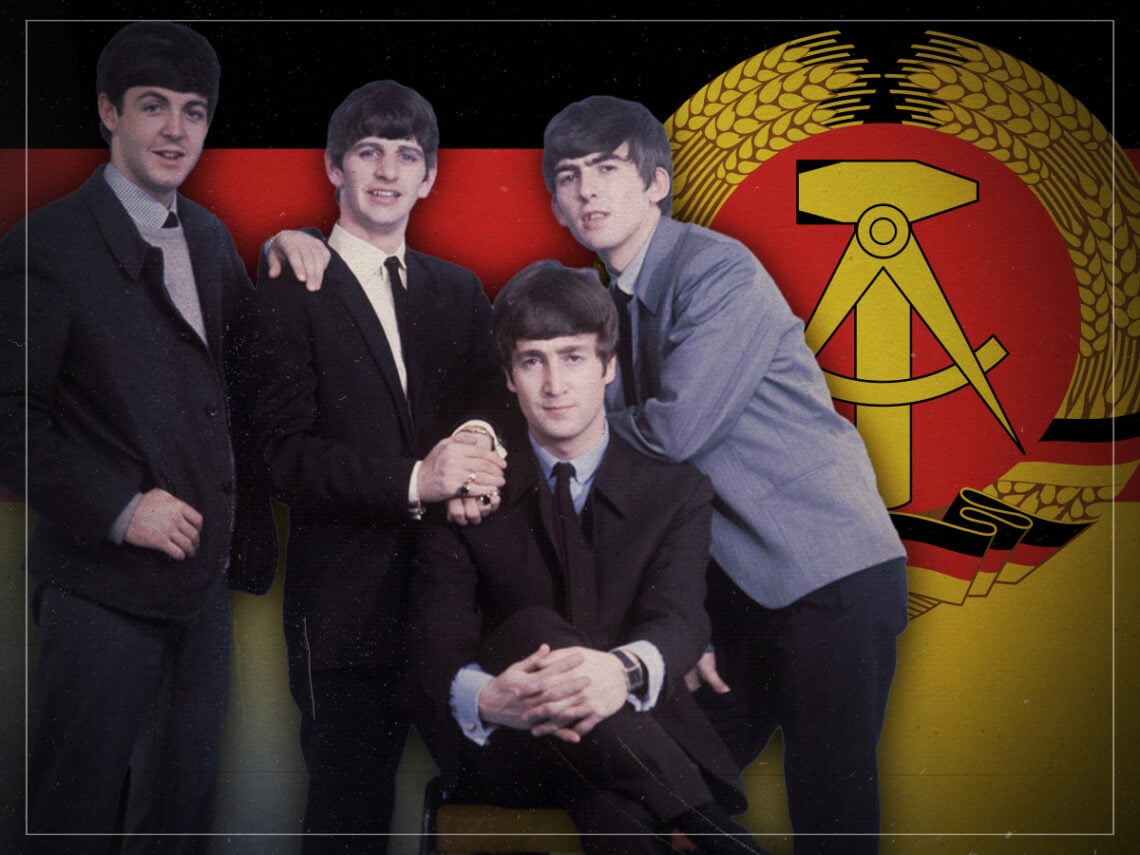
Goodbye Lenin, Hello Lennon: The Beatles song that terrified East Germany

Through espionage and nuclear brinkmanship, it took a little Merseybeat outfit singing “yeah, yeah, yeah” to spook the very top of the East German state during the depths of the Cold War.
To be fair, it wasn’t just the German Democratic Republic that panicked over Beatlemanía’s global conquest. Concerned parents, law enforcement, and stuffy church groups across the capitalist West found plenty wrong with the Fab Four’s pernicious influence on the post-war kids, from their effeminate moptops, youthquake upheaval of social mores, and the teen sexual awakening coursing through the air of screaming fans were enough to incur the wrath of Christian crusaders and arch-traditionalists threatened by the British invasion’s conservative shake-off.
The West’s cultural decadence had been a problem for the Eastern Bloc right through to Moscow. Viewed as symbols of bourgeois corruption pulling communist youth away from socialism’s good word, the Soviet authorities and the orbiting states behind the Iron Curtain kept a tight lid on rock and roll throughout the 1950s, but Beatlemania’s frenzy proved infinitely trickier to stem.
East Germany, most of all. Standing frontline with Western pop, the Fab Four’s capture of the German charts pressured a reluctant GDR to permit some official Beatles releases via the state-owned Amiga label, 1964’s The Beatles compilation landing in the communist East with the same impact as Meet the Beatles! in the States.
Such tolerance didn’t last long, however. Despite having struck the world’s charts back in August 1963, ‘She Loves You’ travelled to the very heart of the State Council and prompted a response from the ruling Socialist Unity Party of Germany. The other side of the Wall had been treated to the bespoke ‘Sie liebt dich’, a vocal rerecord of John Lennon singing ‘She Loves You’ in German, backed with ‘Komm, gib mir deine Hand’s Deutsche grapple of ‘I Want to Hold Your Hand’, affording the lyrical “Yeah, yeah, yeah” pollutants extra waft into the East German underground and exasperating the Marxist-Leninist state’s leader, Walter Ulbricht.
“Is it truly the case that we have to copy every dirt that comes from the West?” Ulbricht rhetorically asked at the 11th Plenary Meeting of the Central Committee. “Think, comrades, with the monotony of the ‘yeah, yeah, yeah’ and whatever it is all called, yes, we should put an end to it”.
The GDR’s creative culture in general was one of the SED’s targets for the sitting. While some liberalisation had been permitted in the arts, an antsy communist regime disturbed by the avant-garde and formalism soon sought to eliminate such potential subversion and restore the push for socialist realism imagery of happy workers and proletarian pride working the fields and hammering away in the factories.

Among the crackdowns on literature, plays, and artworks suspected of counter-revolutionary leanings, The Beatles’ one Amiga LP was soon swiped off the shelves and virtually banned by the East German state. From then on, the Fab Four existed as smuggled contraband, secretly passing the border via bootlegs or creative means of black market importing Beatles records, as well as illegally tuning in to West German pop radio. Even sporting a moptop risked harassment from the Stasi secret police and possible detention for a forced haircut.
The “yeah, yeah, yeah” would win out in the end. Blind eyes had been turned by the USSR’s Melodiya label, various Beatles EPs and compilations quietly released without titles and unrelated artwork to at least pay lip service to the official censorship, but the GDR finally saw Amiga issue the early A Collection of Beatles Oldies in 1974 during later General Secretary Erich Honecker’s many yo-yoing eases on youth culture.
For many young Germans growing up in the former East, ‘She Loves You’ sparks the GDR music big bang, paving the way for the ‘professional performance license’ groups like Silly, Karat and the Puhdys, and the later high-profile shows from Bob Dylan and Bruce Springsteen, not long before the Wall fell and the GDR ceased to be shortly after.

Never Miss A Beat
The Far Out Beatles Newsletter
All the latest stories about The Beatles from the independent voice of culture.
Straight to your inbox.