


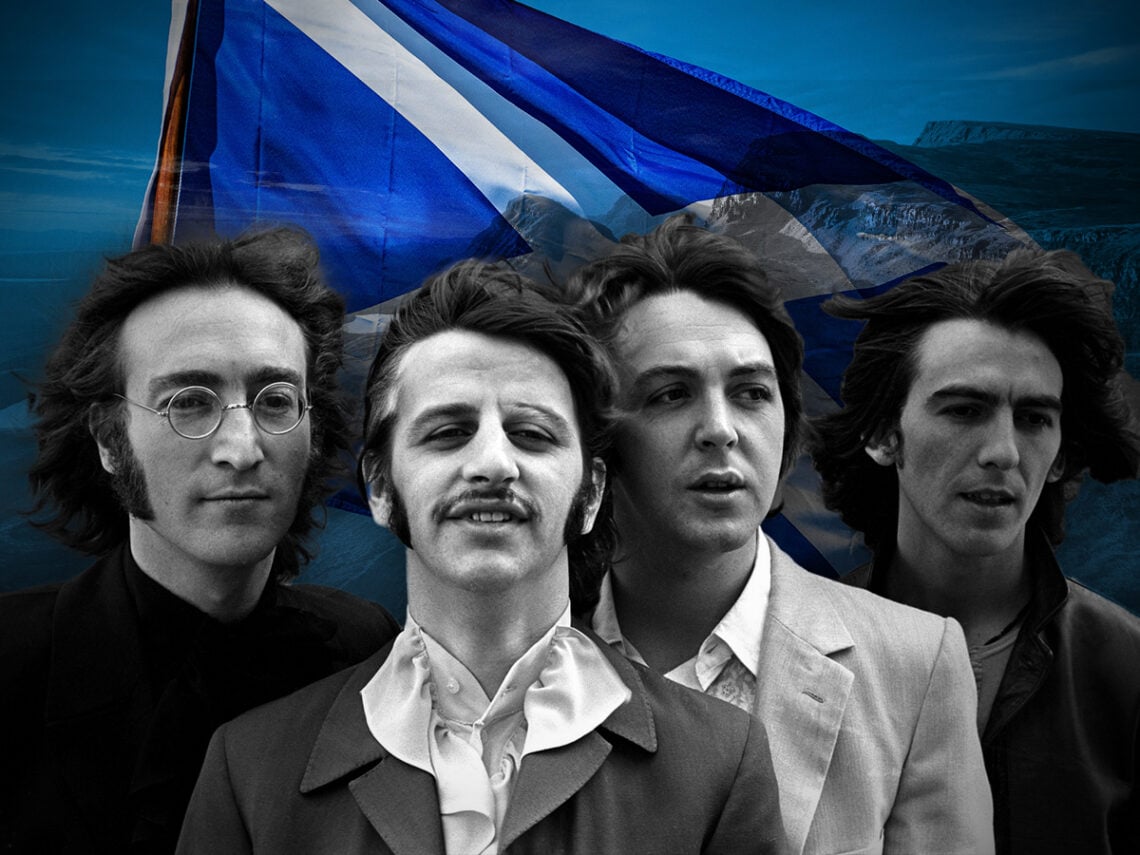
Have you heard? The Beatles are essentially Scottish

Liverpudlian legends this, Merseybeat mega stars that. Whatever. What if I told you that The Beatles are essentially Scottish?
OK, it might take a bit of convincing. Of course, there’s no denying the fact that the band each had their Liverpudlian origins inscribed into their blood from the very first moment they hit the scene. It was, and still is, the very fabric of who they are, with the majority of a tourist economy and cultural capital of a city being built on that foundation.
And to be clear, this is not an attempt to laugh in the face of the people of Liverpool – well, maybe just a little bit. The point is that, from my Scottish point of view, The Beatles have more of a lingering presence in this country than many others, and possibly even to a greater extent than in their hometown.
It’s a strong claim to put out there: I’m under no illusions about that. But there’s simply no avoiding the fact that the Fab Four have an intrinsic Scottish connection that shaped them, soured them, and saved them at various points in their respective lives. All roads lead back to Liverpool, but if they carry on for another three hours north on the M6, that’s when they’ll cross the border to their real home.
John Lennon is the most obvious person to begin with on this front, with his connection to the country travelling almost as far back as the length of his life itself. The basis of his childhood summers was spent across the length of Scotland – from staying with his aunt and uncle at their home in Edinburgh to the remote Highland landscape of Durness. Was it any surprise that he wrote ‘Rain’ based on one of the wettest places in the world?

But it was the escape to the rugged north that plainly left the greatest impression on Lennon for the rest of his life, as he repeatedly returned to Durness when the toll of fame got too much. It was always thought that he wrote ‘In My Life’ inspired by the cherished memories of his time there, and even when things went pear-shaped – like when he crashed his car near Tongue in 1971 – it never lost its charm.
A similarly soothing effect could be observed throughout the band when it came to Scotland, but particularly also for Paul McCartney. It doesn’t take a rocket scientist to figure that out, given he’s got a whole song called ‘Mull of Kintyre’. But the fact that Macca’s first instinct to escape the post-Beatles chaos was to head over the border speaks volumes about what the place really means to him.
He has owned the High Park Farm in Campbeltown since 1966 – a near-constant presence in his life ever since, even living there for a time in the 1970s with his late wife Linda while they worked on Wings. Even recently, he sent a message to the local paper, the Campbeltown Courier, to talk about the “magical memories” he has there. The impact never leaves.
For George Harrison, the Scottish appeal was actually less about escapism than it was about personal connection, after he famously visited the Isle of Skye in 1971 to see his friend Donovan, where they wrote songs together and established a hippie commune. Admittedly, the hoards of hippies flocking to the tiny, often uninhabited islets of Mingay and Clett, but the thought was definitely there for how to leave his mark.
And last but not least, for Ringo Starr, you could say his pull to Scotland was the most tenuous of the four, but it was also seemingly the place that he wouldn’t have been born without. Looking back over the scores of the Starkey family tree, folklore has it that his maternal great-great-grandfather came from a family in Shetland and only moved to Liverpool around 1870.
So really, the band of Liverpudlian legends were really Scottish legends all along, with the cold, hard facts to prove it. After all, Scotland is far from a desolate place, but for The Beatles, it proved to be a landscape where they could each escape the pressures and the mental toll of the lives they had been faced with, long before discussions about those kinds of struggles were ever commonplace.
The rest of the world may have been manic and chaotic, but as soon as they crossed over that border at any time in their lives, the heart rate would steady, the blood pressure would drop, and suddenly they could be the ordinary people they were before the lasting grip of fame took its hold. The Beatles were global powerhouses, but in Scotland, they were simple human beings. It’s the mark of a country which treats its people right.

Never Miss A Beat
The Far Out Beatles Newsletter
All the latest stories about The Beatles from the independent voice of culture.
Straight to your inbox.