


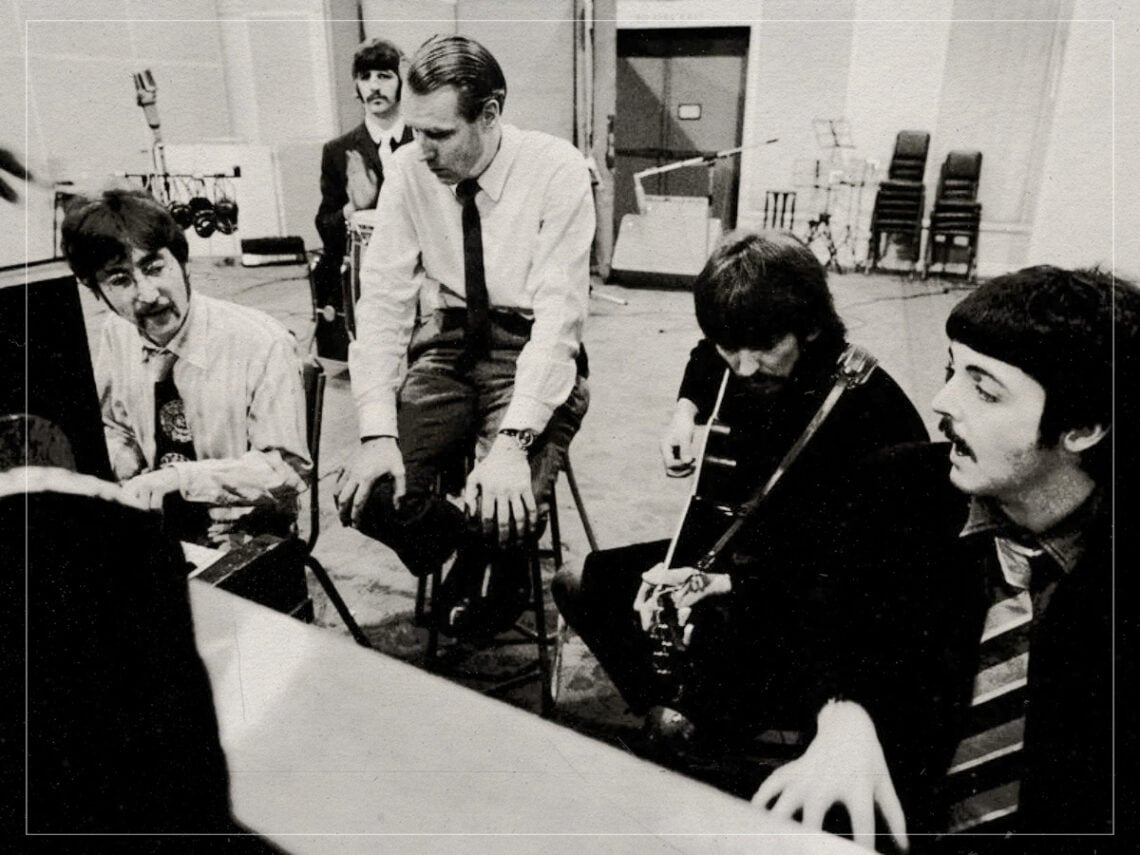
The Beatles’ best ever harmony, according to George Martin

If there’s any individual who earned the title of being the ‘fifth Beatle’ more than anyone else, then the title has to be awarded to none other than their producer, George Martin.
While it’s not exactly true or accurate to say that the band would have been nothing without his input, given how the role of a producer is arguably to translate the ideas of a band or artist into tighter works that have an immediacy about them, he was certainly integral to the band being able to rapidly develop a sound and identity that grew beyond their origins as a simply, if tight, pop outfit.
The songs were evidently already good, as were the musicians who were writing them, but what Martin did was embellish them with additional arrangements and ensured that all elements had the right amount of balance, and this became increasingly evident over time as the band became more and more adventurous with their compositions and songwriting.
One could argue that working alongside someone with the know-how of Martin rubbed off on the Beatles, who would eventually develop some of these skills for themselves and go on to assist with later material and produce their own work after the band’s 1970 split.
However, it was towards the end of their time as a group that they would demonstrate exactly why their partnership with Martin worked so well, and the band were almost intuitively incorporating some of the things that he had shown them how to do. Even though vocal harmonies were always a strong part of their repertoire in the first place, with large amounts of their early material being characterised by tightly-woven vocal interplay, they’d become even more elaborate over time.
This is perhaps why Abbey Road is the greatest masterpiece that the Beatles ever made, with five minds all working in sync with one another and creating works that compositionally exceeded everything else they’d ever done before. One of the highlights from the album is the track, ‘Because’, sitting pretty in the middle of the record and putting their vocal work front and centre of attention.
When Martin and his son, Giles, came to revisit the song to remix it for the Love album and stage production in 2006, he noted in the album’s liner notes that it was perhaps the greatest example of their ability to carve out vocal harmonies.



“An inspired offering from John when we recorded it for the Abbey Road album,” Martin quipped. “He had heard the opening of Beethoven’s ‘Moonlight Sonata’ and then evolved a pattern of arpeggios on his guitar that laid the foundation for this song. Listening anew to this track, with the harmonies that only John, Paul and George could provide, one realises what great vocalists they were.”
While not necessarily comparable with their pop masterpieces, ‘Because’ is a truly sublime effort of theirs, regardless of its immediacy. It shows a great amount of growth, maturation, and immense musicality that Martin had helped them to harness, and there aren’t many greater examples of three-part harmonies on any of their other releases.

Never Miss A Beat
The Far Out Beatles Newsletter
All the latest stories about The Beatles from the independent voice of culture.
Straight to your inbox.